Treatment Overview

Coarctation repair surgery in India is a treatment used to correct a congenital narrowing of the aorta, the body's main artery. The repair restores blood flow to the lower part of the body and reduces the extra pressure placed on the heart.
Coarctation of the aorta, often shortened to CoA, may be diagnosed in a newborn, child, teenager, or adult. The best treatment depends on the patient's age, anatomy, severity of narrowing, blood pressure, heart function, previous repair, and whether other congenital heart defects are present.
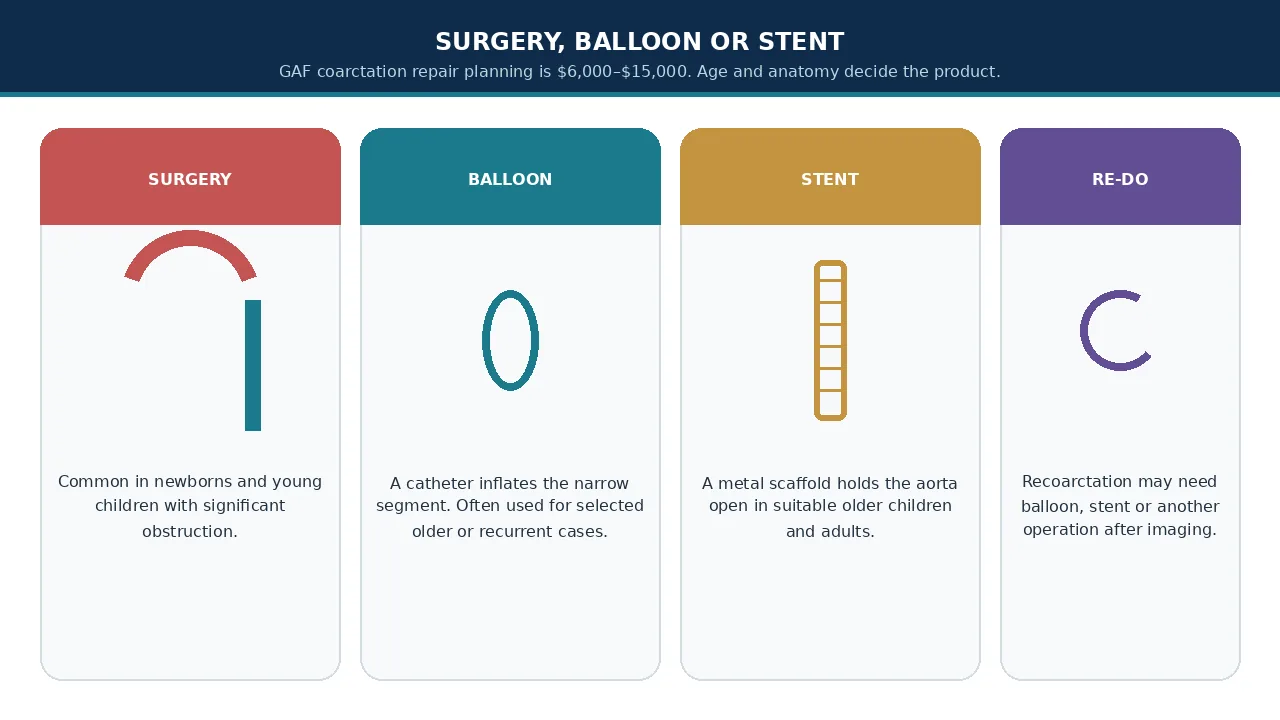
In newborns and young children with significant coarctation, surgical repair is commonly used. In older children, adolescents, and adults, catheter-based balloon angioplasty or stent placement may also be considered, particularly for suitable anatomy or recurrent coarctation.
India has specialist pediatric cardiac surgery and congenital heart disease programs that manage both complex newborn cases and adults with previously repaired or newly diagnosed coarctation.
Associated holes between the ventricles sit on Ventricular Septal Defect (VSD) Surgery in India. Adult aortic tears sit on Aortic Dissection Repair Surgery in India. Composite root-and-valve work sits on Bentall Procedure in India. Broader surgical valve lists sit on Heart Valve Replacement Surgery in India. There is no live GAF balloon-coarctation-only or pediatric-cardiac-surgery-only treatment page. This page is the named coarctation-repair product. TOF lists sit on TOF Repair Surgery in India. Glenn lists sit on Glenn Procedure Surgery in India. Fontan lists sit on Fontan Procedure Surgery in India. Arterial-switch lists sit on Arterial Switch Operation in India. PDA lists sit on PDA Closure Surgery in India.
GAF Healthcare planning for coarctation repair is $6,000–$15,000 (typically 6–14 nights; parent stay expected). US comparison is $40,000–$110,000. Neighbouring congenital heart surgery is $8,000–$28,000 (typically 7–21 nights) when a broader congenital list is the honest product. Neighbouring VSD closure is $4,500–$11,000 when a ventricular hole is closed in the same sitting. Neighbouring ASD closure is $4,000–$9,500. Neighbouring PDA closure is $3,500–$8,500. Neighbouring TOF repair is $6,500–$16,000. Neighbouring aortic valve replacement is $7,000–$18,500 when a bicuspid valve needs replacement. Neighbouring aortic root replacement is $10,000–$24,000. Catheter balloon or stent work for recoarctation has no separate live GAF sheet and is quoted after imaging. These are planning ranges from partner hospital cost sheets, not hospital quotations.
International patients comparing pediatric cardiac surgeons commonly start with Delhi NCR, Mumbai, Bengaluru, Chennai and Hyderabad. Partner pediatric cardiac surgery hospitals in Delhi NCR, Mumbai and Bengaluru, and in Chennai and Hyderabad, are a typical first filter because coarctation repair needs a pediatric or congenital cardiac ICU, four-limb pressure checks and emergency backup. City cost sheets include Delhi NCR, Mumbai, Bengaluru, Chennai and Hyderabad. Kolkata, Pune, Ahmedabad, Chandigarh and Kochi may have congenital theatres. They are not live GAF catalog cities on this site.
Important: A critically ill newborn with poor feeding, grey skin, weak leg pulses or shock belongs in a local emergency department first. WhatsApp at +91 90443 46292 is for planned record review after the child is stable, not for duct-dependent collapse.
What is coarctation of the aorta?
Coarctation of the aorta is a congenital heart defect in which a section of the aorta is abnormally narrow.
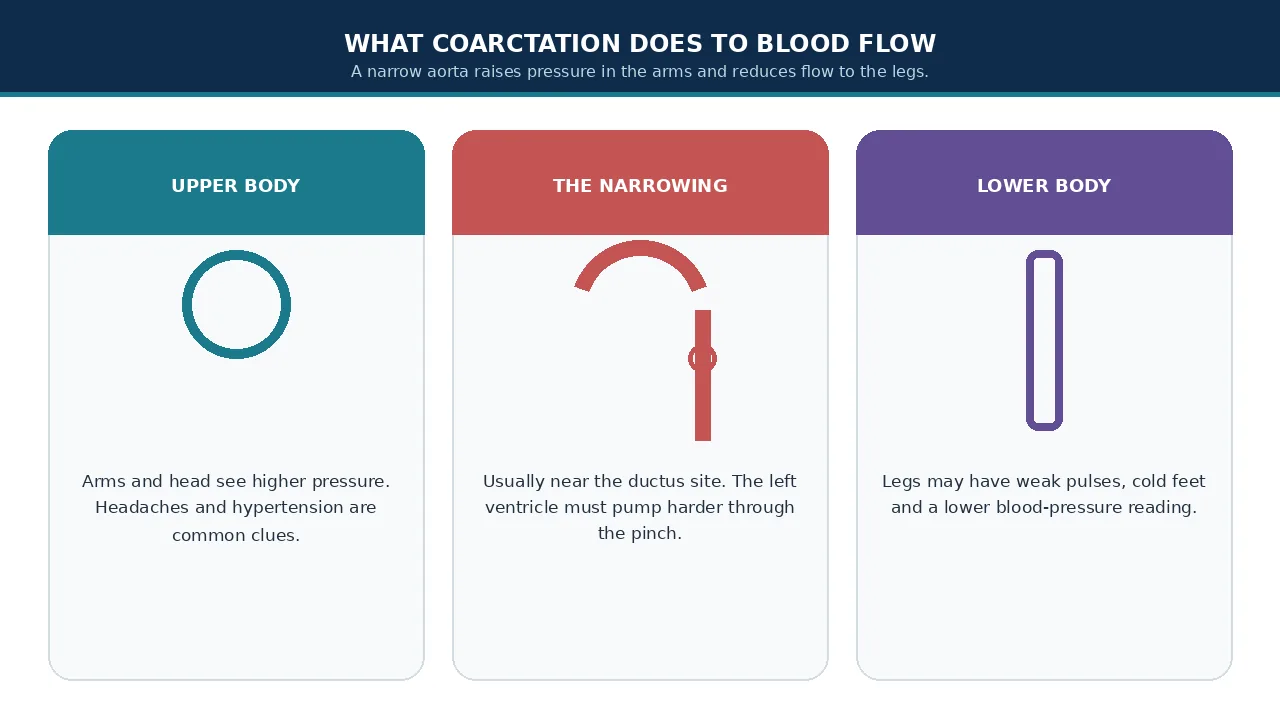
The aorta carries oxygen-rich blood from the heart to the rest of the body. When part of it is narrowed, the left side of the heart has to pump harder to push blood through the obstruction.
This can create higher blood pressure in the arms and upper body while reducing blood flow and pressure to the legs and lower body. In severe newborn cases, the reduced blood flow can lead to heart failure, poor organ perfusion and shock.
The narrowing commonly occurs near the area of the aorta where the ductus arteriosus connects during fetal life.
Coarctation may occur alone or together with other congenital heart conditions. Associated abnormalities can include a bicuspid aortic valve, ventricular septal defect, patent ductus arteriosus and abnormalities of the aortic arch. Neighbouring VSD surgery is a different product. ASD lists sit on ASD Closure Surgery in India.
Why is coarctation repair necessary?
A significant coarctation can put continuous pressure on the heart.
The left ventricle may become thickened because it has to work against increased resistance. Severe obstruction can reduce blood supply to organs and the legs.
If significant coarctation is left untreated, possible complications include:
- High blood pressure
- Left ventricular hypertrophy
- Heart failure
- Reduced blood flow to the lower body
- Kidney or other organ dysfunction in severe newborn cases
- Exercise intolerance
- Aortic complications
- Recurrent narrowing after previous treatment
The American Heart Association notes that severe coarctation in infants can cause heart failure, while hypertension can remain an important long-term issue even after successful repair.
Symptoms of coarctation of the aorta
Symptoms depend heavily on the age of the patient and the severity of the narrowing.
Symptoms in newborns
A baby with severe coarctation may become seriously ill when the ductus arteriosus begins to close after birth.
Possible signs include:
- Difficulty breathing
- Poor feeding
- Excessive sweating
- Irritability
- Pale or greyish skin
- Weak pulses in the legs
- Poor blood circulation
- Low blood pressure
- Reduced urine output
- Lethargy
- Signs of heart failure or shock
Severe neonatal coarctation is considered a critical congenital heart defect. That child belongs in a local emergency department, not on an international flight.
Symptoms in older children
Older children may have:
- High blood pressure
- Headaches
- Fatigue
- Shortness of breath during exercise
- Cold feet
- Leg weakness or discomfort
- Nosebleeds in some cases
- Reduced exercise tolerance
Some children have very few symptoms and are diagnosed because of a heart murmur or differences between arm and leg blood pressure.
Symptoms in teenagers and adults
Adults may present with:
- Hypertension
- Headaches
- Chest discomfort
- Exercise intolerance
- Leg fatigue
- Shortness of breath
- Weak femoral pulses
- A heart murmur
- Incidental findings on cardiac imaging
Some adults are diagnosed only after investigation of otherwise unexplained hypertension.
How is coarctation diagnosed?
Diagnosis begins with a clinical examination and assessment of blood pressure and pulses.
One important clue is a difference between the blood pressure or pulse strength in the arms and legs.
Doctors may then use imaging to understand the anatomy.
Echocardiography
An echocardiogram, or heart ultrasound, is usually one of the first investigations.
It can help assess:
- The location of the narrowing
- Severity of obstruction
- Heart chamber function
- Left ventricular function
- Associated congenital heart defects
- Aortic valve abnormalities
CT angiography
CT angiography can provide detailed images of the aorta and surrounding blood vessels.
It can be particularly useful when the anatomy is complex or when the doctor needs detailed information about the aortic arch and collateral vessels.
Cardiac MRI
Cardiac MRI can provide detailed information without ionizing radiation and is particularly useful for long-term assessment of the aorta in children and adults.
Cardiac catheterization
Cardiac catheterization may be used to measure pressures across the obstruction and visualize the aorta.
It can also become part of treatment when balloon angioplasty or stenting is appropriate.
Ask whether surgery or stent is the honest product
When is coarctation repair recommended?
Treatment is individualized.
A congenital heart team considers:
- Patient age
- Symptoms
- Severity of obstruction
- Arm-to-leg blood pressure difference
- Left ventricular function
- Aortic anatomy
- Length of the narrowed segment
- Aortic arch development
- Associated congenital heart defects
- Previous repair
- Presence of recurrent coarctation
- Hypertension
- Suitability for catheter-based intervention
For a symptomatic newborn with severe obstruction, treatment can be urgent.
In older patients, the decision may be planned after detailed imaging and assessment of blood pressure and the pressure gradient.
Adult congenital heart disease guidance recommends intervention for appropriate adults with significant coarctation associated with hypertension, with surgical repair or catheter-based stenting selected according to the clinical situation.
Coarctation repair options in India
There is no single repair technique that is appropriate for every patient.
The main treatment approaches are:
- Surgical coarctation repair
- Balloon angioplasty
- Catheter-based stent placement
- Re-intervention for recurrent coarctation
The patient's age and anatomy are particularly important when choosing between these approaches. GAF Healthcare planning for the named coarctation repair sheet is $6,000–$15,000. Balloon or stent work is quoted after the congenital team names that product.
Coarctation repair surgery
Surgery is commonly used in neonates, infants and young children with significant coarctation.
The surgeon accesses the narrowed section of the aorta and reconstructs it to create a wider passage for blood.
Unlike procedures that repair defects inside the heart, coarctation surgery generally focuses on the aorta itself rather than opening the heart chambers.
Common surgical techniques
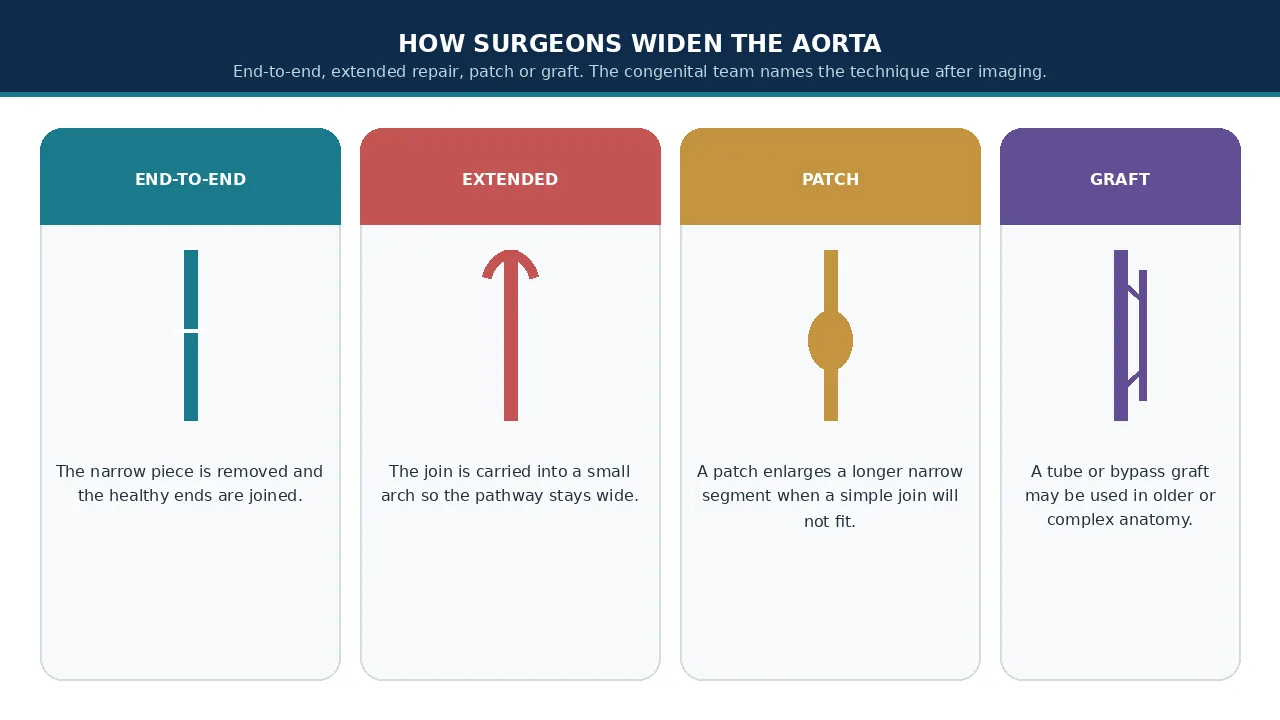
1. Resection with end-to-end anastomosis
The narrowed portion is removed.
The two healthy ends of the aorta are then connected directly.
This is called an end-to-end anastomosis.
It can be appropriate when the narrowed segment is relatively discrete and the surrounding aorta can be brought together without excessive tension.
2. Extended end-to-end repair
In babies with more extensive narrowing or arch involvement, the reconstruction may extend beyond the immediate coarctation.
The objective is to create a sufficiently wide pathway and address associated hypoplasia of the aortic arch when necessary.
3. Patch aortoplasty
A patch is used to enlarge the narrowed area.
Different patch materials and techniques may be considered depending on the anatomy.
4. Subclavian flap repair
In selected cases, part of the subclavian artery can be used in reconstructing the narrowed portion of the aorta.
The technique is less commonly used than some modern reconstruction methods but remains part of the surgical history and may have a role in selected anatomy.
5. Interposition graft or bypass
In older patients or selected complex cases, a graft may be used to create an alternative pathway around the narrowed area.
The exact technique depends on anatomy, age and previous operations.
Mayo Clinic lists resection with end-to-end anastomosis, patch aortoplasty and bypass graft repair among surgical approaches to coarctation.
Coarctation repair in newborns
A newborn with critical coarctation may deteriorate rapidly after birth because closure of the ductus arteriosus can further reduce blood flow to the lower body.
The first priority is stabilization.
In severe cases, prostaglandin E1 may be administered to keep the ductus arteriosus open temporarily and improve systemic blood flow while the baby is prepared for definitive treatment.
The baby may require:
- Neonatal intensive care
- Ventilatory support
- Blood pressure monitoring
- Echocardiography
- Correction of metabolic abnormalities
- Treatment of heart failure
- Kidney and organ-function monitoring
- Definitive surgical repair
For international families, a newborn with suspected critical coarctation should generally be assessed and stabilized locally or at an appropriate emergency cardiac center before considering medical travel.
Ask how urgent a newborn case is
Coarctation repair in older children
Older children may present with hypertension, a murmur or reduced leg pulses.
The treatment decision depends on the degree and anatomy of obstruction.
For some children, surgery remains the preferred approach.
For others, especially older children and adolescents with suitable anatomy, catheter-based balloon dilation or stenting may be considered.
The choice should be made by a congenital heart team after reviewing imaging rather than simply by age.
Coarctation repair in adults
Adults may have either:
- Previously repaired coarctation
- Recurrent coarctation
- Unrepaired coarctation diagnosed later in life
Hypertension is particularly important in adults with coarctation.
For appropriate adults with significant native or recurrent coarctation and hypertension, guidelines support either surgical repair or catheter-based stenting depending on the clinical and anatomical situation.
Adults who have undergone previous repair also require continued surveillance.
The American Heart Association recommends ongoing aortic imaging in adults with coarctation, including those who have previously undergone surgical or catheter-based intervention.
A diseased root and valve in the same adult is a different product and sits on Bentall Procedure in India. An acute aortic tear sits on Aortic Dissection Repair Surgery in India.
Balloon angioplasty and stenting
Balloon angioplasty uses a catheter inserted through a blood vessel.
A balloon is positioned at the narrowed section and inflated to enlarge the passage.
A stent may be placed to provide structural support and maintain the enlarged diameter.
Stenting is more commonly considered in older children, adolescents and adults than in small infants.
It can also be useful for recurrent coarctation after previous surgery.
The American Heart Association notes that balloon dilation and stenting are commonly used in older patients and in patients who develop recurrent narrowing after surgery. There is no live GAF balloon-coarctation or stent-only treatment page. Those products are quoted after imaging on this page's named coarctation repair sheet.
Surgery vs stent for coarctation
| Factor | Surgical repair | Balloon/stent |
|---|---|---|
| Newborns | Commonly used when significant repair is required | Generally limited in very small infants |
| Young children | Frequently considered | Selected cases |
| Older children | Possible depending on anatomy | Often considered when anatomy is suitable |
| Adolescents | Selected cases | Commonly considered |
| Adults | Selected cases | Frequently considered for suitable anatomy |
| Recurrent coarctation | Possible | Important treatment option |
| Long-segment/complex anatomy | May be preferred | Depends on anatomy |
| Previous surgical repair | Can be considered | Often useful for suitable recurrent narrowing |
The table is a general clinical framework, not a treatment recommendation for an individual patient.
Preoperative evaluation before coarctation surgery
Before surgery, the congenital cardiac team generally reviews the patient's complete anatomy and physiological status.
Evaluation may include:
Cardiac imaging
- Echocardiography
- CT angiography
- Cardiac MRI
- Cardiac catheterization when indicated
Cardiovascular assessment
- Four-limb blood pressure
- Pulse examination
- Oxygen saturation
- Heart rhythm
- Left ventricular function
- Assessment of associated heart defects
General preoperative tests
Depending on age and clinical status:
- Complete blood count
- Kidney function tests
- Electrolytes
- Blood grouping and cross-match
- Coagulation tests
- Chest imaging
- ECG
- Other anesthesia-related investigations
For a newborn, the evaluation is often more urgent and may occur while the baby is being stabilized in the neonatal or cardiac intensive care unit.
How is coarctation repair surgery performed?
The exact operation varies with the patient's anatomy.
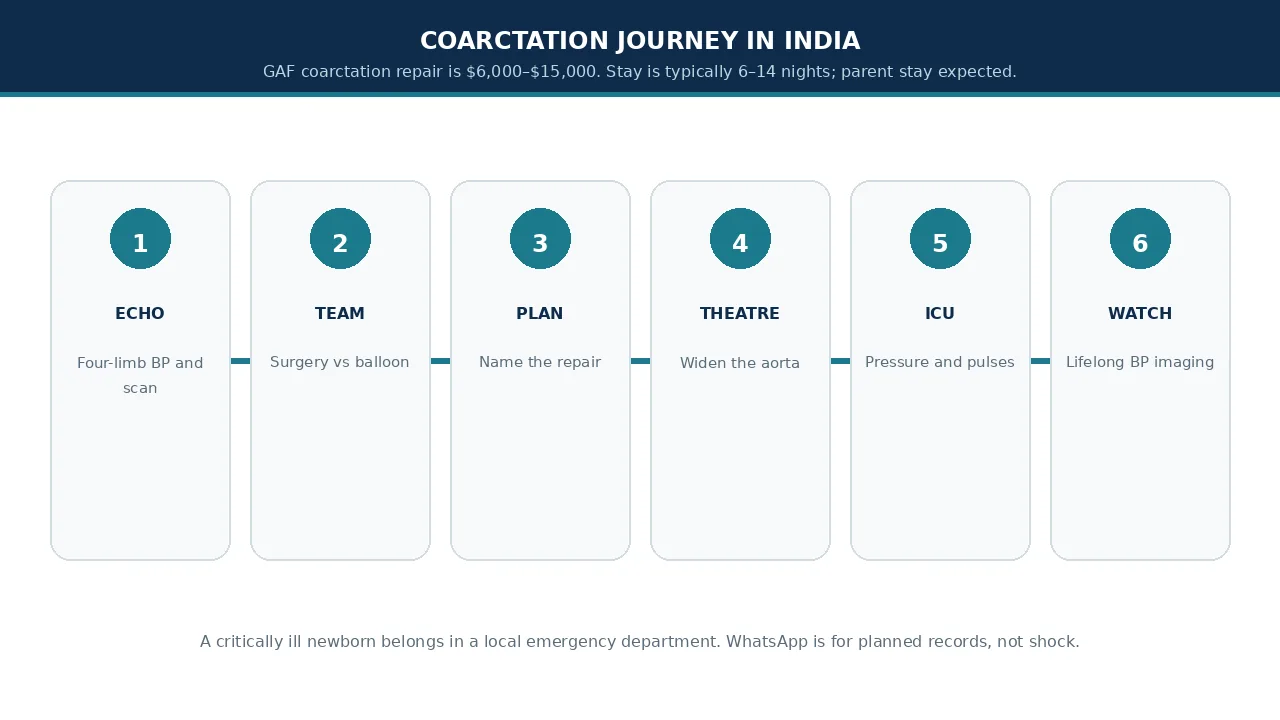
A simplified surgical pathway is:
Step 1: Anesthesia
The patient receives general anesthesia.
The anesthesia team continuously monitors blood pressure, oxygenation, heart rhythm and other vital parameters.
Step 2: Surgical access
The surgeon accesses the portion of the chest containing the affected section of the aorta.
Step 3: Identification of the narrowed segment
The surgeon identifies the coarctation and evaluates the surrounding aortic anatomy.
Step 4: Aortic reconstruction
The narrowed segment may be removed and the healthy ends joined.
Alternatively, the aorta may be enlarged using an extended reconstruction or patch technique.
Step 5: Restoration of blood flow
The reconstructed aorta is assessed to ensure that blood can pass through the repaired area.
Step 6: Closure and intensive monitoring
After the operation, the patient is transferred to a cardiac intensive care unit or pediatric cardiac ICU for monitoring.
Is coarctation repair open-heart surgery?
This is a common question from parents.
Coarctation repair is generally not an intracardiac operation.
The surgeon is repairing the narrowed portion of the aorta rather than closing a hole inside the heart.
However, it is still a major cardiovascular operation and requires specialized pediatric or congenital cardiac surgical care.
If a VSD or valve must be repaired in the same sitting, that additional product is named separately.
Risks and complications of coarctation repair
Coarctation repair is an established treatment, but every major cardiovascular procedure has potential risks.
Possible complications include:
- Bleeding
- Infection
- Recurrent narrowing
- Persistent hypertension
- Aortic aneurysm or pseudoaneurysm
- Injury to nearby structures
- Abnormal blood pressure after surgery
- Chylothorax or lymphatic complications
- Heart rhythm problems
- Reduced heart function
- Kidney complications in critically ill newborns
- Neurological complications, which are uncommon
- Need for repeat intervention
The exact risk depends on age, anatomy, urgency, associated heart disease and the patient's overall condition.
Rare neurological complications, including spinal cord injury, have been reported after aortic surgery.
Recovery after coarctation repair
Recovery varies significantly between a newborn, a young child and an adult.
In the intensive care unit
After surgery, monitoring may include:
- Blood pressure
- Heart rhythm
- Oxygen levels
- Kidney function
- Urine output
- Limb perfusion
- Heart function
- Surgical site
- Pain control
Blood pressure management is particularly important after repair.
In the hospital
The medical team gradually transitions the patient from intensive monitoring to normal ward care.
For children, feeding and activity are also assessed before discharge.
A complex neonatal case may require a substantially longer hospitalization than an uncomplicated repair in an older child. GAF planning is typically 6–14 nights, with parent stay expected.
How long does it take to recover?
Recovery is individual.
A child may require several weeks before returning to normal energy levels after major surgery.
The surgeon and cardiologist will determine when the patient can:
- Return to school
- Resume normal walking
- Exercise
- Participate in sports
- Travel by air
- Return to normal activities
A patient should not use a generic online recovery timeline instead of the treating team's instructions.
Long-term follow-up after coarctation repair
Successful surgery does not mean that cardiac follow-up can stop.
Patients with repaired coarctation require lifelong surveillance.
Important long-term issues include:
Blood pressure
Hypertension can persist or develop years after repair.
This is one of the most important long-term considerations.
Recurrent coarctation
The repaired area can become narrowed again.
This is more commonly a concern in patients who were repaired at a young age or who have complex anatomy.
Aortic aneurysm
The repaired segment can develop an abnormal enlargement or aneurysm, making long-term imaging important.
Aortic valve disease
Some patients with coarctation also have a bicuspid aortic valve and require surveillance for associated valve and aortic problems. Neighbouring aortic valve replacement is $7,000–$18,500 when SAVR is later named.
Exercise-related hypertension
Some patients can have normal resting blood pressure but develop excessive blood pressure during exercise.
Imaging
MRI or CT angiography may be used to evaluate the repaired aorta.
Adult congenital heart disease guidelines specifically recommend initial and follow-up aortic imaging in adults with coarctation, including those who have undergone previous repair.
Request an itemised coarctation estimate
Can coarctation come back after surgery?
Yes.
Recurrent narrowing is known as recoarctation.
If significant recoarctation develops, treatment may involve balloon angioplasty, stenting or repeat surgery depending on the patient's age and anatomy.
In adults and older children, catheter-based treatment can be particularly useful for suitable recurrent lesions.
This is one reason why lifelong follow-up is important even when the initial surgery was successful.
Coarctation repair surgery cost in India
The cost of coarctation repair surgery in India varies considerably depending on the patient's age, hospital, surgeon, ICU requirement, complexity of the aortic anatomy, associated congenital heart defects and whether the treatment is surgical or catheter-based.
GAF Healthcare planning for coarctation repair is $6,000–$15,000 (typically 6–14 nights; parent stay expected). US comparison is $40,000–$110,000. Neighbouring broader congenital heart surgery is $8,000–$28,000. Published Indian rupee listings are not GAF quotations.
Indicative planning table
| Treatment pathway | Indicative GAF planning |
|---|---|
| Surgical coarctation repair | $6,000–$15,000; typically 6–14 nights |
| Neighbouring congenital heart surgery | $8,000–$28,000 when a broader congenital list is named |
| Neighbouring VSD closure | $4,500–$11,000 if a ventricular hole is added |
| Catheter balloon or stent | Quoted after imaging; no separate live GAF sheet |
| Complex neonatal repair | May cost more because of ICU nights |
| Recurrent coarctation | Cost depends on surgery versus catheter work |
| International patient package | Written after echocardiography and CT or MRI review |
These are planning figures, not quotations.
The final estimate should be based on the patient's echocardiogram, CT/MRI images, medical history and proposed treatment.
What is included in the cost of coarctation surgery?
A hospital quotation may include some or all of the following:
- Surgeon fees
- Anesthesia
- Operating room charges
- ICU charges
- Room charges
- Nursing
- Medicines
- Blood products when required
- Surgical consumables
- Diagnostic tests
- Echocardiography
- Postoperative monitoring
- Follow-up consultation
However, inclusions vary by hospital.
International patients should ask for an itemized written quotation rather than relying only on a headline package price.
Ask whether the price includes ICU days, parent stay, prostaglandin if used, extra nights, balloon or stent hardware, associated VSD or valve work and complication-related expenses.
Additional costs international patients should consider
Families traveling to India may also need to budget for:
- Flights
- Visa-related expenses
- Accommodation
- Food
- Local transportation
- Companion expenses
- Additional investigations
- Longer ICU or hospital stay
- Additional procedures
- Medicines after discharge
- Follow-up imaging
- Emergency or unexpected treatment
For an infant or child, the cost of a parent or accompanying family member should be considered separately.
Why do families consider India for coarctation repair?
India has established pediatric cardiology and congenital cardiac surgery programs.
Treatment may involve collaboration between:
- Pediatric cardiologists
- Pediatric cardiac surgeons
- Adult congenital cardiologists
- Cardiac anesthetists
- Cardiac intensivists
- Interventional cardiologists
- Radiologists
- Neonatologists
- Specialized nursing teams
The complexity of coarctation makes the experience of the congenital heart team and availability of appropriate intensive care more important than simply choosing a hospital based on the advertised package price.
The AHA emphasizes that optimal congenital heart surgery depends on an integrated multidisciplinary team with lesion-specific expertise and perioperative care.
Choosing a hospital for coarctation repair in India
When evaluating hospitals, families should ask:
1. Does the hospital treat newborn congenital heart disease?
This is especially important for critical neonatal coarctation.
2. Is a pediatric cardiac ICU available?
A dedicated cardiac ICU can be important for postoperative monitoring.
3. Does the center provide both surgery and catheter-based treatment?
Having both options allows the team to consider different strategies if the anatomy changes the treatment plan.
4. Is advanced imaging available?
Ask whether the center can perform:
- Pediatric echocardiography
- CT angiography
- Cardiac MRI
- Cardiac catheterization
5. Is long-term follow-up available?
Coarctation is not simply a one-time surgical problem.
The patient needs lifelong surveillance.
6. Can the hospital manage associated congenital heart defects?
This is particularly important because coarctation may occur together with other heart abnormalities.
Partner pediatric cardiac surgery hospitals in Delhi NCR, Mumbai, Bengaluru, Chennai and Hyderabad are the live GAF first filter.
Preparing for coarctation surgery in India as an international patient
International families should ideally send the patient's records before traveling.
Useful documents include:
- Echocardiography reports
- Echocardiography videos or image files where available
- CT angiography
- MRI
- Cardiac catheterization reports
- Previous operation notes
- Discharge summaries
- Current medication list
- Blood test results
- Previous genetic investigations if relevant
- Vaccination records for children
- Growth and development records for pediatric patients
The actual imaging is often more useful to the surgical team than a short written diagnosis.
Send echo, CTA and four-limb pressures before travel
Medical travel timeline for coarctation repair
A typical international-patient pathway may look like this:
Step 1 — Send medical records
The family provides the child's or adult's medical reports and imaging.
Step 2 — Specialist review
A pediatric cardiologist, congenital cardiologist or cardiac surgeon reviews the case.
Step 3 — Treatment plan
The team determines whether the patient may require surgery, catheter intervention or additional evaluation.
Step 4 — Cost estimate
The hospital prepares a patient-specific quotation.
Step 5 — Travel planning
Once the patient is considered suitable for travel, the family can coordinate visa, flights and accommodation.
Step 6 — Hospital admission
Additional tests may be performed after arrival.
Step 7 — Treatment
Surgery or catheter intervention is performed according to the final clinical plan.
Step 8 — Recovery
The patient remains under hospital observation until medically stable.
Step 9 — Follow-up
The family receives a discharge plan and instructions for future imaging, blood pressure monitoring and cardiology review.
A coordinator can also open WhatsApp at +91 90443 46292 for planned records review.
Questions to ask the coarctation surgeon
Before proceeding with treatment, families can ask:
- Where exactly is the narrowing?
- How severe is the coarctation?
- Is the aortic arch also narrowed?
- Does my child need surgery now?
- Could catheter-based treatment be appropriate?
- What surgical technique are you considering?
- Are there other congenital heart defects?
- How is the left ventricle functioning?
- What are the major risks in this particular case?
- How long might ICU care be required?
- How long is the expected hospital stay?
- What are the chances of recurrent narrowing?
- Will blood pressure remain high after repair?
- How frequently will imaging be needed?
- Will my child eventually be able to participate in sports?
- When is air travel safe?
- What happens if recoarctation develops?
- What follow-up is required after returning home?
Coarctation repair and physical activity
Many children can eventually participate in normal physical activities after successful repair.
However, activity recommendations depend on:
- Residual narrowing
- Blood pressure
- Aortic size
- Heart function
- Associated valve disease
- Previous surgery
- Exercise testing results
The American Heart Association notes that children with repaired coarctation and no significant residual narrowing or hypertension may be able to participate in normal activities, while restrictions may be appropriate when abnormalities remain.
Coarctation repair and pregnancy
Women who have had coarctation repair can often become pregnant, but pregnancy should be planned with appropriate congenital cardiology care.
Before pregnancy, the medical team may assess:
- Blood pressure
- Aortic anatomy
- Aortic dimensions
- Residual coarctation
- Heart function
- Associated valve disease
A personalized plan is important because pregnancy increases cardiovascular demands.
What happens if coarctation is not repaired?
The consequences depend on the severity of the obstruction.
Severe untreated coarctation can cause inadequate blood flow to the lower body and heart failure, particularly in newborns.
Less severe disease can remain undiagnosed for years but may contribute to hypertension and increased cardiovascular risk.
The American Heart Association and CDC both emphasize the importance of diagnosis, treatment when indicated and lifelong follow-up.
Coarctation repair: key facts for parents
If your child has been diagnosed with coarctation, the most important questions are not simply about cost.
The more important questions are:
- How severe is the narrowing?
- Is the baby or child clinically stable?
- Is the aortic arch normal?
- Is there associated heart disease?
- Is surgery or catheter treatment more appropriate?
- Does the child have hypertension?
- What is the condition of the left ventricle?
- What type of repair is planned?
- What long-term surveillance will be needed?
A good treatment plan should answer these questions before surgery.
Ask about recoarctation and lifelong imaging
Frequently asked questions about coarctation repair surgery in India
What is coarctation repair surgery?
Coarctation repair surgery is an operation used to correct a narrowed section of the aorta and improve blood flow from the heart to the lower body.
Is coarctation a congenital heart defect?
Yes. Coarctation of the aorta is a congenital cardiovascular defect, meaning it develops before birth.
At what age is coarctation repaired?
Coarctation can be repaired at any age. Severe neonatal disease may require urgent treatment, while milder disease can be diagnosed and treated later in childhood or adulthood.
Is coarctation surgery open-heart surgery?
The repair generally involves reconstruction of the aorta rather than opening the heart chambers.
Can coarctation be treated without surgery?
Yes. Balloon angioplasty and stent placement are treatment options for selected patients, particularly older children, adolescents and adults or patients with recurrent coarctation.
Is coarctation surgery safe?
Coarctation repair is an established treatment, but the risks vary considerably depending on age, severity, anatomy, associated defects and overall health.
Can coarctation come back after surgery?
Yes. Recoarctation can occur and may sometimes require catheter-based treatment or repeat surgery.
Will blood pressure become normal after coarctation repair?
Repair improves the obstruction, but hypertension can persist or develop later. Long-term blood pressure monitoring is therefore important.
How much does coarctation repair cost in India?
GAF Healthcare planning for coarctation repair is $6,000–$15,000, typically 6–14 nights, with parent stay expected. US comparison is $40,000–$110,000. A personalized hospital quotation is required for an accurate figure.
How long does coarctation surgery take?
The duration depends on the surgical technique, anatomy and whether other cardiac abnormalities need to be treated. An isolated repair may take several hours.
How long will my child stay in the hospital?
Hospitalization varies with age and complexity. Newborns and children requiring intensive postoperative support may stay substantially longer than uncomplicated older patients. GAF planning is typically 6–14 nights.
Does my child need lifelong follow-up?
Yes. Even after successful repair, lifelong monitoring for blood pressure, recurrent narrowing and aortic complications is recommended.
Can a child live a normal life after coarctation repair?
Many children do well after successful repair, but long-term cardiology follow-up remains important.
Can adults undergo coarctation repair in India?
Yes. Adults with native or recurrent coarctation can undergo surgical or catheter-based treatment when clinically indicated.
Can coarctation repair be performed in newborns?
Yes. Severe neonatal coarctation can require urgent stabilization and surgical repair. Unstable newborns should not travel for a cheaper package.
What documents should an international patient send before coming to India?
Send echocardiography reports and images, CT/MRI scans, previous surgical records, discharge summaries, medication lists and other relevant cardiac investigations.
Is a second opinion useful before coarctation surgery?
For a major congenital cardiac operation, a second specialist opinion can be useful, particularly when the treatment choice between surgery and catheter intervention is not straightforward.
Is coarctation completely cured after surgery?
The obstruction can often be successfully repaired, but patients remain at risk of long-term issues such as hypertension, recurrent narrowing and aortic complications. Lifelong follow-up is therefore recommended.
Coarctation repair surgery in India: key takeaway
Coarctation repair surgery in India can restore blood flow through a narrowed aorta and reduce the pressure burden on the heart.
For newborns and young children with significant coarctation, surgical reconstruction is an important treatment option. Older children, adolescents and adults may also be candidates for balloon angioplasty or stent placement depending on their anatomy and previous treatment.
The most important step is a detailed evaluation by a pediatric cardiologist, congenital cardiologist and/or congenital cardiac surgeon.
GAF Healthcare planning for the named coarctation-repair sheet is $6,000–$15,000.
For international patients, treatment planning should be based on the patient's actual echocardiogram and imaging rather than diagnosis alone.
And even after a successful repair, coarctation should be considered a condition requiring lifelong cardiovascular follow-up, particularly for blood pressure and the repaired aorta.
Share reports for a preliminary coarctation estimate
Related GAF Healthcare pages
- Ventricular Septal Defect (VSD) Surgery in India
- Bentall Procedure in India
- Aortic Dissection Repair Surgery in India
- Heart Valve Replacement Surgery in India
- Coarctation repair cost
- Congenital heart surgery cost
- VSD closure cost
- Pediatric cardiac surgeons in India
- Pediatric cardiac surgery hospitals in India
Balloon-coarctation-only treatment pages are not live on this site. Use this page plus the named modality sheets.
Top 10 sources
- Centers for Disease Control and Prevention (CDC) — Coarctation of the Aorta.
- American Heart Association (AHA) — Coarctation of the Aorta.
- Mayo Clinic — Coarctation of the Aorta.
- Merck Manual Professional Edition — Coarctation of the Aorta.
- AHA/ACC Guideline for Adults With Congenital Heart Disease.
- 2025 ACC/AHA/HRS/ISACHD/SCAI Guideline for Adults With Congenital Heart Disease.
- NCBI StatPearls — Coarctation of the Aorta.
- European Society of Cardiology — long-term surveillance after coarctation repair.
- GAF Healthcare coarctation repair cost sheet — Coarctation Repair.
- GAF Healthcare congenital heart surgery cost sheet — Congenital Heart Surgery.
Medical disclaimer
This page is intended for general medical education and healthcare-planning purposes. It does not diagnose coarctation or replace an examination by a qualified pediatric cardiologist or congenital cardiac surgeon.
The decision to operate, to use a balloon or stent, and the surgical technique must be made individually after imaging and clinical review.
Treatment costs are planning ranges from partner hospital cost sheets. A critically ill newborn, sudden collapse, grey skin or absent leg pulses belongs in a local emergency department.
Treatment Process
- 1
Share echo
The family provides echocardiography, four-limb pressures and CT or MRI before anyone books travel.
- 2
Congenital team review
A pediatric cardiologist and congenital surgeon review whether the case is surgery, balloon, stent or urgent local care.
- 3
Name the product
The team writes end-to-end repair, extended arch work, balloon or stent after anatomy review.
- 4
Itemized estimate
GAF coarctation repair planning is $6,000–$15,000. Neighbouring congenital heart surgery is $8,000–$28,000.
- 5
Travel only if stable
Stable planned cases travel after records review. A shocked newborn belongs in a local emergency department.
- 6
Repeat essential tests
The receiving unit confirms echo, pulses, kidney function and fitness after arrival.
- 7
Widen the named aorta
Surgical reconstruction, balloon or stent proceeds only after the product is named.
- 8
Cardiac ICU and ward
Upper and lower-body pressure, pulses, kidneys and feeding are watched before discharge.
- 9
Lifelong follow-up
The family leaves with a blood-pressure plan, imaging dates and who will watch for recoarctation after returning home.