Treatment Overview

Arterial Switch Operation (ASO) in India is a complex neonatal and infant heart surgery used primarily to correct d-transposition of the great arteries (d-TGA), a serious congenital heart defect in which the aorta and pulmonary artery are connected to the wrong ventricles. The operation restores the normal circulation of blood by reconnecting the great arteries to the correct ventricles and carefully transferring the coronary arteries.
For babies with d-TGA, treatment is usually time-sensitive. The arterial switch is generally performed during the neonatal period or early infancy, depending on the baby's anatomy, oxygen level, associated heart defects, coronary anatomy and overall clinical condition.
India has established pediatric cardiac surgery programs capable of managing neonatal arterial switch procedures, including babies with very low birth weight and complex associated congenital heart defects.
Associated ventricular holes sit on Ventricular Septal Defect (VSD) Surgery in India. A persistent duct sits on PDA Closure Surgery in India. Aortic narrowing sits on Coarctation Repair Surgery in India. Broader surgical valve lists sit on Heart Valve Replacement Surgery in India. There is no live GAF TGA-only, Mustard, Senning, balloon-atrial-septostomy-only, ECMO or pediatric-cardiac-surgery-only treatment page. This page is the named arterial-switch product. TOF lists sit on TOF Repair Surgery in India. Glenn lists sit on Glenn Procedure Surgery in India. Fontan lists sit on Fontan Procedure Surgery in India.
GAF Healthcare planning for arterial switch operation is $12,000–$26,000 (typically 10–21 nights; parent stay expected). US comparison is $80,000–$200,000. Neighbouring congenital heart surgery is $8,000–$28,000 (typically 7–21 nights) when a broader congenital list is the honest product. Neighbouring VSD closure is $4,500–$11,000 when a ventricular hole is closed in the same sitting. Neighbouring PDA closure is $3,500–$8,500. Neighbouring ASD closure is $4,000–$9,500. Neighbouring coarctation repair is $6,000–$15,000. Neighbouring TOF repair is $6,500–$16,000. Neighbouring Glenn is $8,000–$18,000. Neighbouring Fontan is $9,000–$22,000. Balloon atrial septostomy, Mustard, Senning and ECMO have no live GAF treatment pages or separate sheets. These are planning ranges from partner hospital cost sheets, not hospital quotations.
International patients comparing pediatric cardiac surgeons commonly start with Delhi NCR, Mumbai, Bengaluru, Chennai and Hyderabad. Partner pediatric cardiac surgery hospitals in Delhi NCR, Mumbai and Bengaluru, and in Chennai and Hyderabad, are a typical first filter because arterial switch needs a neonatal or pediatric cardiac ICU, coronary-transfer experience and emergency catheter backup. City cost sheets include Delhi NCR, Mumbai, Bengaluru, Chennai and Hyderabad. Kolkata, Pune, Ahmedabad, Chandigarh and Kochi may have congenital theatres. They are not live GAF catalog cities on this site.
Important: A cyanotic, collapsing or duct-dependent newborn belongs in a local emergency department first. WhatsApp at +91 90443 46292 is for planned record review after the baby is stable enough for transfer, not for neonatal shock.
What is an arterial switch operation?
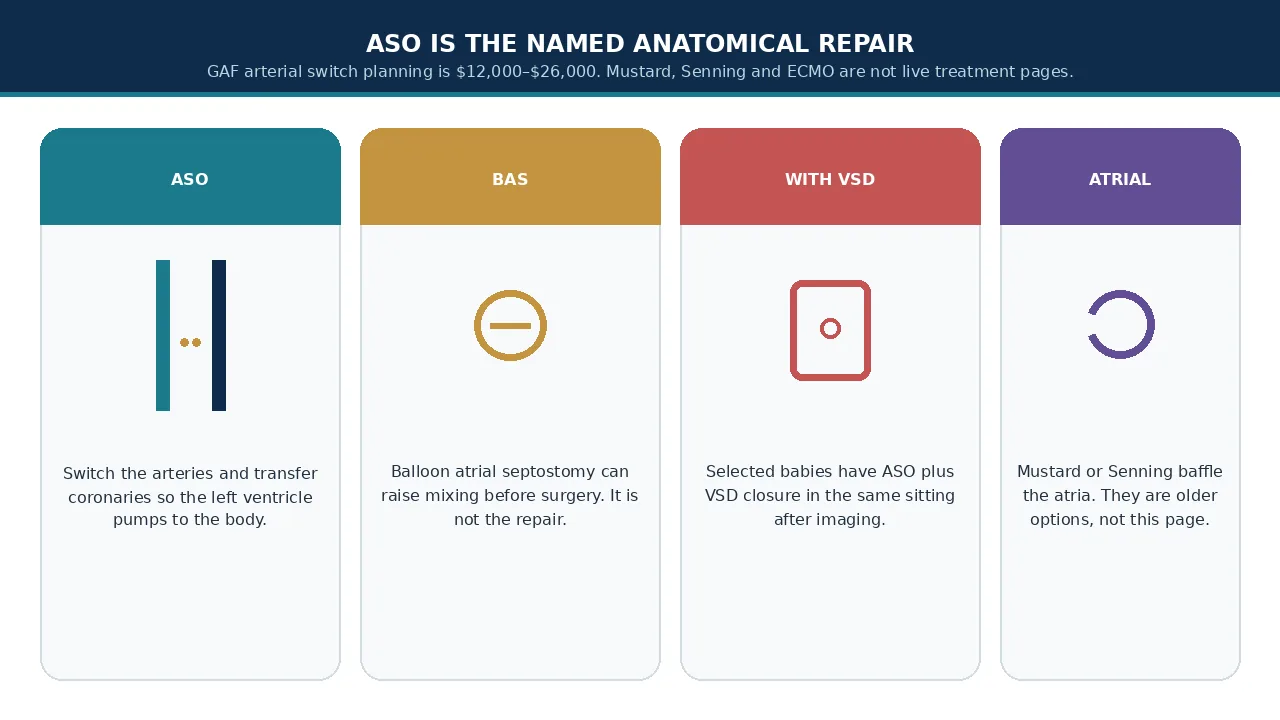
The arterial switch operation, also called the Jatene procedure, is an anatomical repair for d-transposition of the great arteries.
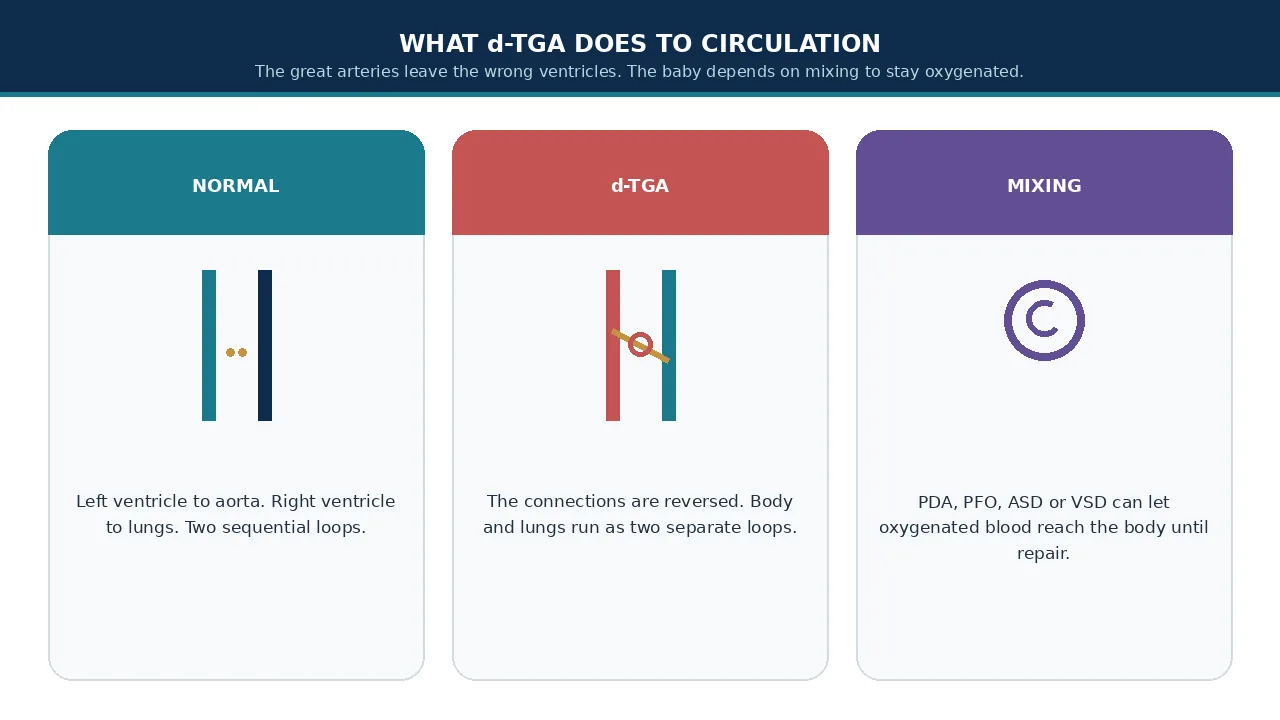
In a normal heart:
- Right ventricle → pulmonary artery → lungs
- Left ventricle → aorta → body
In d-TGA, these connections are reversed. The right ventricle pumps oxygen-poor blood back toward the body through the aorta, while the left ventricle pumps oxygen-rich blood back toward the lungs through the pulmonary artery.
This creates two largely separate circulation loops.
The arterial switch operation corrects this anatomical problem by reconnecting the great arteries to their appropriate ventricles. The coronary arteries are also detached from the original aortic root and reimplanted onto the new aortic root.
The result is an anatomical repair in which the left ventricle becomes the systemic pumping chamber, rather than relying on an atrial baffle to redirect blood.
What is d-transposition of the great arteries?
d-TGA is a congenital heart defect present at birth.
The two major arteries leaving the heart—the aorta and pulmonary artery—are connected to the wrong ventricles. As a result, oxygen-rich blood returning from the lungs may continue circulating through the lungs while oxygen-poor blood from the body continues circulating through the body.
The baby therefore depends on mixing between the two circulations to receive enough oxygen.
Some mixing can occur through structures such as:
- Patent ductus arteriosus (PDA)
- Patent foramen ovale (PFO)
- Atrial septal defect (ASD)
- Ventricular septal defect (VSD)
The amount of mixing varies from baby to baby. Severe cyanosis can occur shortly after birth when mixing is inadequate.
Named PDA closure and VSD surgery are different products. ASD lists sit on ASD Closure Surgery in India.
Why is arterial switch surgery needed?
Without adequate mixing and definitive treatment, d-TGA can cause profound oxygen deficiency.
A baby may develop:
- Bluish skin or lips
- Low oxygen saturation
- Rapid breathing
- Difficulty feeding
- Lethargy
- Metabolic acidosis
- Poor circulation
- Heart failure in some circumstances
The condition requires urgent assessment by a specialized neonatal and pediatric cardiac team.
The Centers for Disease Control and Prevention notes that surgery is required for babies with d-TGA, with arterial switch operation being the most common definitive surgical procedure.
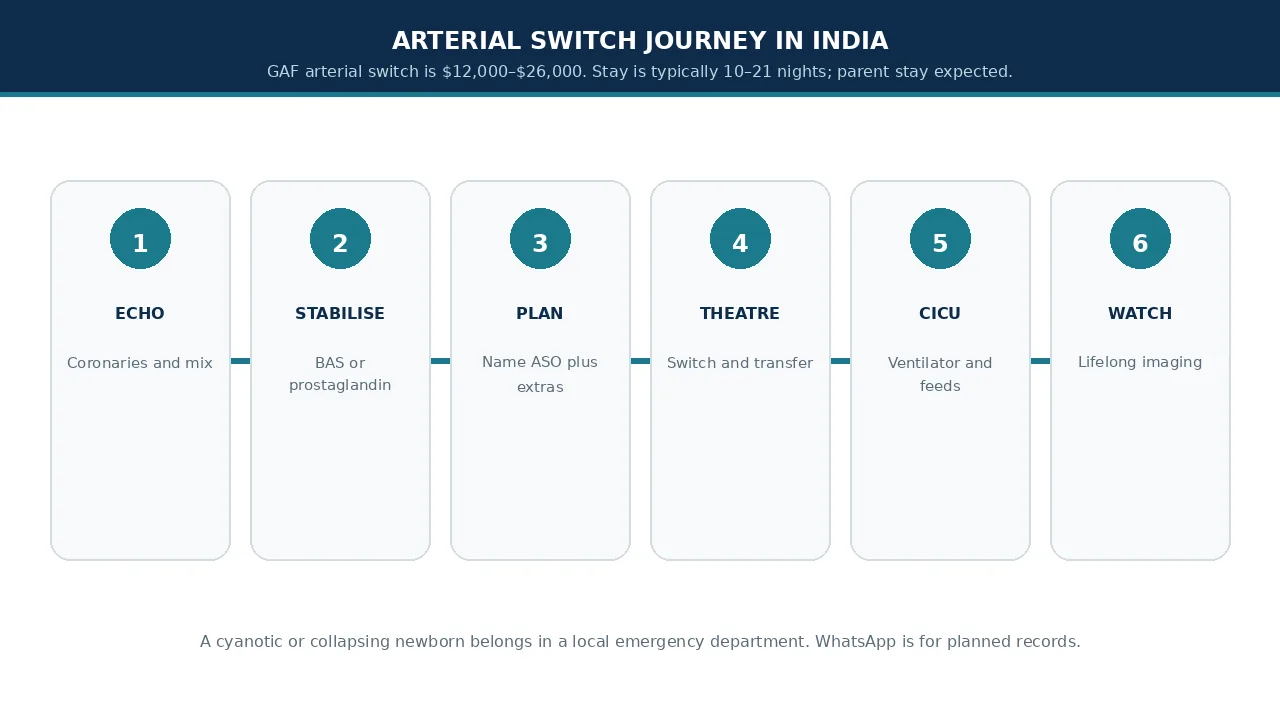
A severely cyanotic newborn belongs in a local emergency department, not on an international flight arranged around a package price.
Ask whether ASO is the honest product
Arterial switch operation vs atrial switch
These two procedures should not be confused.
| Feature | Arterial switch | Atrial switch |
|---|---|---|
| Main concept | Arteries are physically switched | Blood is redirected using an atrial baffle |
| Common use today for d-TGA | Standard anatomical repair | Used much less commonly |
| Systemic ventricle after repair | Left ventricle | Right ventricle |
| Coronary arteries transferred? | Yes | No |
| Long-term concern | Coronary, neo-aortic and pulmonary artery complications | Systemic right ventricular dysfunction, arrhythmias and baffle-related problems |
| Typical timing | Usually neonatal/early infancy | Selected circumstances |
The arterial switch has largely replaced the older Mustard and Senning atrial-switch approaches for suitable patients with d-TGA.
There is no live GAF Mustard-procedure or Senning-procedure treatment page. Those names are historical comparisons, not products on this site.
Who is a candidate for arterial switch operation?
The decision is individualized.
An arterial switch may be considered for babies with:
- d-TGA with intact ventricular septum
- d-TGA with VSD
- d-TGA with certain associated congenital heart defects
- Some forms of Taussig-Bing anomaly or double-outlet right ventricle depending on anatomy
- Suitable coronary artery anatomy
- A left ventricle capable of supporting systemic circulation
The surgical strategy becomes more complicated when the baby has unusual coronary anatomy, significant ventricular dysfunction, pulmonary hypertension, obstruction of the left ventricular outflow tract or other major congenital abnormalities.
Therefore, the diagnosis "TGA" alone is not enough to determine the surgical plan.
The detailed cardiac anatomy matters.
When is arterial switch surgery performed?
For uncomplicated d-TGA with an intact ventricular septum, arterial switch surgery is generally performed during the neonatal period, often within the first few weeks of life.
The precise timing depends on:
- Oxygen saturation
- Coronary anatomy
- Ventricular function
- Presence of VSD
- Left ventricular preparedness
- Associated heart defects
- Infection or other medical problems
- Prematurity
- Birth weight
- Overall stability of the newborn
The CDC describes arterial switch as usually being performed within the first month of life.
Some babies may require stabilization before definitive surgery.
What happens before arterial switch surgery?
The baby is usually assessed by a multidisciplinary congenital heart team.
1. Echocardiography
An echocardiogram provides detailed information about:
- Ventricular anatomy
- Great artery connections
- VSD or ASD
- Valve function
- Coronary artery origins
- Pulmonary arteries
- Ventricular function
- Associated abnormalities
Echocardiography is one of the most important investigations in d-TGA.
2. Pulse oximetry
Oxygen saturation helps determine how severely the baby's circulation is affected.
3. Blood tests
Blood tests may evaluate:
- Blood gases
- Lactate
- Hemoglobin
- Electrolytes
- Kidney function
- Infection markers
- Coagulation
4. Chest X-ray
A chest X-ray may be performed as part of the overall assessment.
5. CT or MRI
Advanced imaging is not required for every newborn but can be useful in selected complex cases.
6. Coronary anatomy assessment
The coronary arteries are particularly important because they must be transferred during ASO.
An unusual coronary pattern can make the operation technically more demanding.
Balloon atrial septostomy before ASO
Some babies with d-TGA have insufficient mixing of oxygenated and deoxygenated blood.
In such cases, a procedure called balloon atrial septostomy, commonly known as the Rashkind procedure, may be performed.
A catheter is passed into the heart and used to enlarge the opening between the atria.
This improves mixing and can raise oxygen levels while the medical team prepares for definitive surgery.
Balloon atrial septostomy is generally a stabilizing procedure, not the definitive anatomical repair. There is no live GAF balloon-atrial-septostomy treatment page.
Ask about balloon atrial septostomy
Prostaglandin therapy before surgery
Some newborns with d-TGA may receive prostaglandin E1 to help maintain ductal patency.
The ductus arteriosus can provide an additional pathway for blood flow and mixing while the baby is being stabilized.
The need for prostaglandin depends on the baby's anatomy and circulation and is determined by the treating neonatal cardiac team.
A duct that later needs elective closure sits on PDA Closure Surgery in India. That is a different product from keeping the duct open as a bridge to ASO.
How is arterial switch operation performed?
The arterial switch is a major open-heart procedure.
Although the exact technique varies according to anatomy, the major steps generally include:
Step 1: General anesthesia
The baby receives general anesthesia and is continuously monitored.
Step 2: Median sternotomy
The surgeon accesses the heart through the chest.
Step 3: Cardiopulmonary bypass
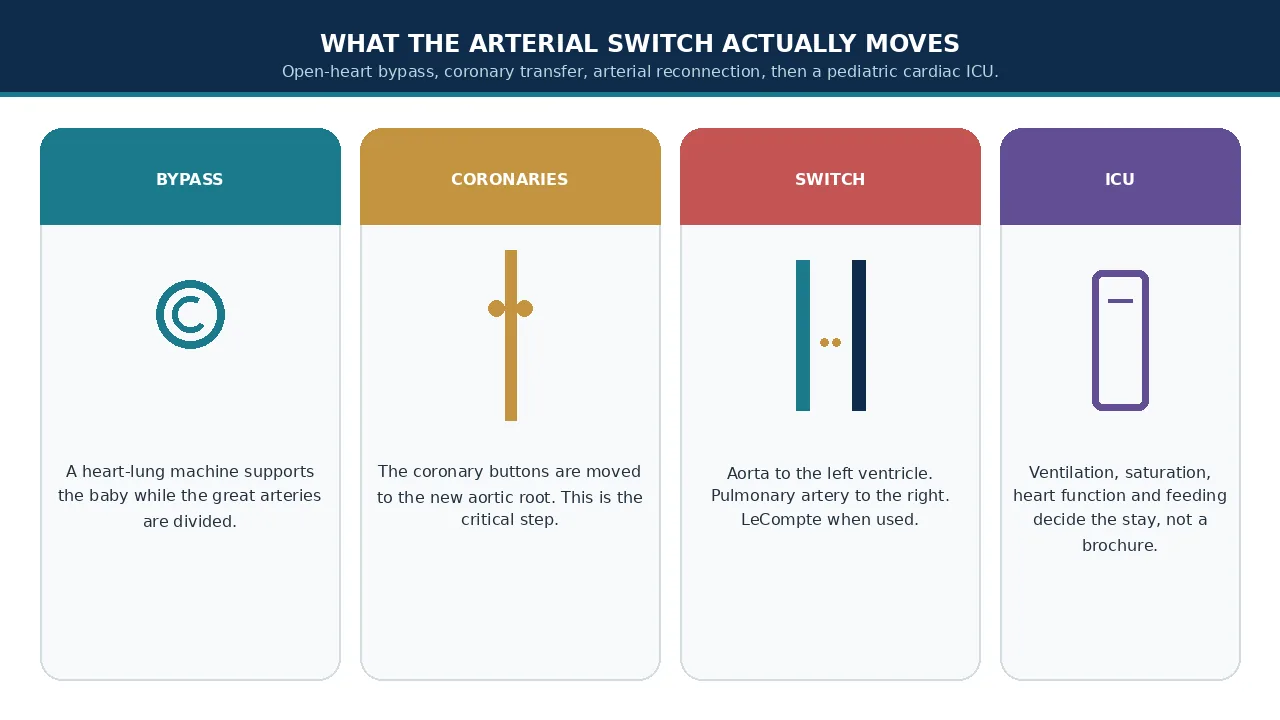
A heart-lung machine temporarily takes over circulation and oxygenation while the heart is operated upon.
Step 4: Great arteries are divided
The aorta and pulmonary artery are separated from their original positions.
Step 5: Coronary arteries are transferred
The coronary arteries are carefully removed from the native aortic root with surrounding tissue and transferred to the new aortic root.
This is one of the technically critical parts of ASO.
Step 6: Arteries are reconnected
The aorta is connected to the left ventricular outflow tract, while the pulmonary artery is connected to the right ventricular outflow tract.
Step 7: LeCompte maneuver
In many ASO procedures, the pulmonary arteries are positioned anteriorly relative to the aorta using the LeCompte maneuver.
Step 8: Associated defects are repaired
If indicated, associated defects such as a VSD may be addressed during the same operation.
Step 9: Heart is restarted
The surgical team gradually restores the baby's own circulation and assesses cardiac function.
Step 10: Transfer to pediatric cardiac ICU
The baby is transferred to the intensive care unit for close monitoring.
The arterial switch therefore does much more than simply "swap two arteries." Coronary transfer and reconstruction of the great vessels are central parts of the operation.
What is the LeCompte maneuver?
The LeCompte maneuver is an important component of many arterial switch operations.
After the great arteries are divided, the pulmonary artery branches are brought anterior to the aorta before the reconstructed vessels are connected.
The technique helps establish the new anatomical relationship between the great vessels and can reduce tension on the reconstructed pathways.
Its exact use and surgical configuration depend on the patient's anatomy and the surgeon's operative strategy.
Why are the coronary arteries so important?
The coronary arteries supply blood to the heart muscle itself.
During ASO, the coronary arteries must be transferred to the new aortic root because the native pulmonary root becomes the neoaorta.
The surgeon therefore needs to understand:
- Number of coronary arteries
- Coronary origins
- Coronary branching pattern
- Intramural coronary anatomy
- Coronary course
- Relationship to the great vessels
An unusual coronary pattern can increase surgical complexity.
Coronary complications can also occur later in life, which is one reason long-term follow-up remains important after ASO.
Arterial switch operation for TGA with VSD
Some babies with TGA also have a ventricular septal defect (VSD).
In these cases, the surgical team may perform arterial switch plus VSD closure during the same operation when anatomically appropriate.
The precise operation depends on:
- Location and size of VSD
- Great artery relationship
- Coronary anatomy
- Ventricular outflow anatomy
- Presence of pulmonary obstruction
- Other associated abnormalities
A VSD can also influence long-term neoaortic valve outcomes, so long-term surveillance remains important.
Isolated VSD lists sit on Ventricular Septal Defect (VSD) Surgery in India. Neighbouring VSD closure is $4,500–$11,000 when that sheet is the honest add-on.
Arterial switch operation in premature or low-birth-weight babies
Prematurity and low birth weight can make neonatal cardiac surgery more challenging.
The medical team may need to address:
- Respiratory immaturity
- Feeding difficulties
- Infection risk
- Low body weight
- Organ function
- Hemodynamic instability
- Difficulty maintaining temperature
- Prolonged intensive care needs
However, low birth weight does not automatically mean that surgery is impossible.
The decision must be individualized.
Indian centers have reported successful arterial switch procedures in very young and low-weight infants. For example, Fortis Escorts Heart Institute reported an arterial switch in a one-day-old infant weighing 1.8 kg, with additional congenital abnormalities, followed by postoperative recovery.
For international families, a premature or unstable newborn should generally be assessed and stabilized locally before anyone considers medical travel.
Recovery after arterial switch surgery
After surgery, the baby is usually cared for in a specialized pediatric cardiac intensive care unit (PICU/CICU).
Monitoring may include:
- Heart rate
- Blood pressure
- Oxygen saturation
- ECG
- Echocardiography
- Urine output
- Blood gases
- Lactate
- Drain output
- Ventilator requirements
- Kidney function
- Fluid balance
The baby may initially require:
- Mechanical ventilation
- Intravenous medications
- Fluid management
- Antibiotics when clinically indicated
- Pain control
- Nutritional support
Recovery varies considerably.
A straightforward postoperative course can be very different from the recovery of a premature, low-weight or critically ill newborn.
GAF planning is typically 10–21 nights, with parent stay expected. Critically ill neonates can stay longer.
How long does the baby stay in the hospital?
There is no universal hospitalization period.
The length of stay depends on:
- Age and weight
- Preoperative condition
- Surgical complexity
- Ventilator requirements
- Heart function
- Infection
- Kidney function
- Feeding
- Postoperative complications
Families should therefore be cautious about hospitals or websites promising a fixed number of days for every child.
A baby who requires prolonged intensive care may remain hospitalized considerably longer.
Arterial switch operation recovery at home
Once the baby is medically stable, the family receives instructions regarding:
- Feeding
- Medication
- Incision care
- Weight gain
- Warning signs
- Follow-up appointments
- Echocardiography
- Activity as the child grows
Parents should seek urgent medical advice if they notice signs such as:
- Increasing breathing difficulty
- Bluish discoloration
- Poor feeding
- Excessive sweating during feeding
- Marked lethargy
- Fever
- Poor weight gain
- Rapid breathing
- Reduced urine output
- New swelling
- Wound problems
Those warning signs belong in a local emergency department.
Risks and complications of arterial switch operation
ASO has become a highly established procedure, but it remains major neonatal cardiac surgery.
Early complications
- Bleeding
- Infection
- Low cardiac output
- Arrhythmias
- Ventilator dependence
- Kidney dysfunction
- Neurological complications
- Pleural or pericardial effusion
- Coronary artery problems
- Need for additional intervention
Later complications
- Coronary artery stenosis or obstruction
- Pulmonary artery stenosis
- Right ventricular outflow obstruction
- Neoaortic root dilation
- Neoaortic valve regurgitation
- Arrhythmias
- Ventricular dysfunction
- Need for catheter-based or surgical reintervention
Long-term studies emphasize that successful ASO does not eliminate the need for congenital cardiology follow-up.
Long-term outcomes after arterial switch operation
One of the major advantages of ASO is that it restores the left ventricle as the systemic ventricle.
With modern surgical techniques and specialized postoperative care, long-term survival after ASO can be excellent. Published literature reports survival into adulthood for many patients, although outcomes depend strongly on the original anatomy, associated defects and postoperative complications.
It is important, however, not to interpret a successful operation as the end of cardiac care.
The American Heart Association emphasizes the need for ongoing specialist congenital heart care after d-TGA repair.
Long-term follow-up after arterial switch
Follow-up may monitor:
1. Neoaortic root
The pulmonary root becomes the new aortic root.
Its size and development are followed over time.
2. Neoaortic valve
The former pulmonary valve becomes the neoaortic valve.
Regurgitation can develop over the long term. A systematic review of 30 studies involving 6,169 patients found that the risk of neoaortic regurgitation increases with longer follow-up, although the need for valve or root surgery remained relatively low during the early decades.
Later named valve work sits on Heart Valve Replacement Surgery in India. Neighbouring aortic valve replacement is $7,000–$18,500 when SAVR is later named.
3. Pulmonary arteries
The reconstructed pulmonary artery pathway is assessed for narrowing or obstruction.
4. Coronary arteries
Coronary anatomy and patency can require specialized assessment.
5. Ventricular function
The cardiologist evaluates how well the ventricles are functioning.
Can coronary problems occur years after ASO?
Yes.
The coronary arteries are surgically transferred during ASO, and late coronary abnormalities can occur.
Importantly, some patients may have few or nonspecific symptoms even when coronary abnormalities are present.
A systematic review of adults after ASO found that reported clinical coronary complications were uncommon, but anatomical abnormalities could be detected on imaging.
This is one reason modern congenital heart programs emphasize structured long-term surveillance.
The 2025 ACC/AHA adult congenital heart disease guideline recommends periodic echocardiography and cardiovascular magnetic resonance in adults after ASO to assess areas including neoaortic size, valve function, pulmonary artery anatomy and ventricular function. It also addresses individualized coronary assessment.
Is another surgery needed after an arterial switch?
Many patients do not require another major heart operation.
However, some patients may eventually require:
- Balloon angioplasty
- Pulmonary artery stenting
- Surgical pulmonary artery reconstruction
- Neoaortic valve intervention
- Coronary intervention
- Other congenital cardiac procedures
The likelihood depends on the original anatomy and postoperative course.
CHOP, for example, tracks ASO as a specific congenital cardiac quality indicator and emphasizes the importance of risk-adjusted interpretation of surgical outcomes rather than comparing hospitals solely on raw mortality figures.
Arterial switch operation success rate
It is tempting to ask for a single "success rate," but this can be misleading.
Outcomes vary according to:
- d-TGA anatomy
- Coronary pattern
- VSD or other defects
- Age at surgery
- Birth weight
- Prematurity
- Preoperative oxygenation
- Associated organ problems
- Surgical center experience
- Postoperative intensive care
Modern series report very good outcomes in experienced congenital cardiac centers, but published percentages should always be interpreted according to the patient population and time period studied.
For this reason, families should ask a hospital for center-specific, risk-adjusted outcomes for arterial switch surgery, rather than relying only on a generic percentage published online.
Cost of arterial switch operation in India
The cost of arterial switch operation in India varies significantly and should be quoted only after reviewing the baby's medical records.
GAF Healthcare planning for arterial switch operation is $12,000–$26,000 (typically 10–21 nights; parent stay expected). US comparison is $80,000–$200,000. Neighbouring broader congenital heart surgery is $8,000–$28,000. Published Indian rupee listings are not GAF quotations.
Indicative planning table
| Treatment pathway | Indicative GAF planning |
|---|---|
| Arterial switch operation | $12,000–$26,000; typically 10–21 nights |
| Neighbouring congenital heart surgery | $8,000–$28,000 when a broader congenital list is named |
| Neighbouring VSD closure | $4,500–$11,000 if a ventricular hole is added |
| Neighbouring PDA closure | $3,500–$8,500 if a later duct closure is named |
| Balloon atrial septostomy | Quoted with the ASO plan; no separate live GAF sheet |
| Prolonged neonatal ICU | May cost more because of ventilator nights |
| International patient package | Written after echocardiography and coronary review |
These are planning figures, not quotations.
The final estimate should be based on the baby's echocardiogram, coronary anatomy, saturations, weight and proposed additional procedures.
Request an itemised arterial-switch estimate
A typical hospital estimate may be influenced by:
- Pediatric cardiac surgeon's fees
- Pediatric cardiac anesthesia
- Operating room charges
- Cardiopulmonary bypass
- Pediatric ICU stay
- Ventilator support
- Investigations
- Echocardiography
- Blood products
- Medicines
- Consumables
- Length of hospitalization
- Balloon atrial septostomy before surgery
- Treatment of VSD or other associated defects
- Management of postoperative complications
What should an international patient ask the hospital?
Request a written quotation that clearly separates:
- Surgery package
- ICU charges
- Surgeon fees
- Anesthesia
- Investigations
- Medicines
- Blood products
- Additional procedures
- Extra ICU days
- Management of complications
Do not compare two ASO quotations based only on the headline surgery price.
A lower initial package may not include the same ICU duration, investigations, consumables or additional procedures.
For a newborn requiring urgent cardiac surgery, the medical team's ability to provide neonatal cardiac surgery, pediatric cardiac anesthesia, perfusion, intensive care and emergency catheter-based support is more important than simply comparing package prices.
Additional costs international patients should consider
International families should also consider:
- Medical visa or appropriate travel documentation
- Accommodation for parents
- Local transportation
- Interpreter services
- Preoperative investigations
- Additional hospital stay
- ICU extension
- Emergency procedures
- Follow-up consultations
- Post-discharge accommodation
- Return travel after medical clearance
For an unstable newborn, travel should never be arranged solely around the lowest treatment cost.
The treating pediatric cardiac team should first determine whether the baby is medically fit for transfer and whether the receiving hospital has accepted the case.
Choosing a hospital for arterial switch in India
The more useful question is not simply "Which city is best?"
Families should evaluate whether the selected center has:
- Dedicated pediatric cardiac surgery
- Neonatal cardiac surgery
- Pediatric cardiac ICU
- Pediatric cardiac anesthesia
- Experienced perfusionists
- Pediatric cardiology
- Emergency cardiac catheterization
- Advanced echocardiography
- Cardiac CT/MRI when required
- Blood bank support
- Neonatal intensive care
- Experience with complex coronary anatomy
- Long-term congenital heart follow-up
Indian hospitals including Apollo and Fortis publicly list arterial switch operations among their pediatric congenital cardiac surgery services.
Pune and Kolkata may have congenital theatres. They are not live GAF catalog cities on this site.
About the surgeon
- How many arterial switch operations does the team perform?
- Does the surgeon routinely operate on neonates?
- Does the team manage complex coronary anatomy?
- What is the team's experience with low-weight infants?
About the hospital
- Is there a dedicated pediatric cardiac ICU?
- Is pediatric cardiac anesthesia available 24/7?
- Is emergency catheterization available?
- Can the hospital manage ECMO or advanced mechanical circulatory support when indicated?
- Is neonatal intensive care available?
There is no live GAF ECMO treatment page. Mechanical-support questions belong in the hospital review, not in an invented URL.
About outcomes
Ask for:
- Number of ASO procedures performed
- Operative mortality for comparable cases
- Major complication rates
- Reoperation rates
- Follow-up program
- Risk-adjusted outcomes where available
A hospital's overall cardiac surgery statistics are not necessarily representative of neonatal ASO outcomes. Neighbouring adult CABG lists are a different product.
Arterial switch operation in Delhi NCR and Chennai
Delhi NCR is one of India's major medical destinations for complex pediatric cardiac care.
Hospitals in the National Capital Region provide pediatric cardiology, congenital cardiac surgery, neonatal cardiac intensive care and complex congenital procedures.
For example, Fortis Escorts Heart Institute in New Delhi publicly describes arterial switch surgery within its pediatric cardiothoracic surgery services, while Apollo Hospitals Indraprastha has documented arterial switch procedures in neonates.
Chennai is another established destination for pediatric cardiac surgery.
Apollo Children's Hospital describes a dedicated pediatric cardiothoracic surgery program performing complex neonatal and congenital operations, including arterial switch procedures.
For international families, Delhi NCR and Chennai sit alongside Mumbai, Bengaluru and Hyderabad as live GAF catalog cities when evaluating treatment options.
Preparing for arterial switch in India as an international patient
For families traveling to India, the process generally begins with remote medical evaluation.
The hospital may request:
- Baby's age
- Birth weight
- Current weight
- Oxygen saturation
- Echocardiogram
- CT/MRI if already performed
- Previous catheterization reports
- Blood reports
- Discharge summaries
- Current medication list
- Ventilator requirements
- Clinical photographs or videos when clinically relevant
The pediatric cardiologist and surgeon then determine whether the case can be accepted.
For a critically ill newborn, transferring the baby between countries can itself carry substantial medical risk. The treating team should therefore coordinate the transfer.
Send echo, saturations and coronary notes before travel
Medical travel timeline for arterial switch
A typical international-patient pathway may look like this:
Medical records → Pediatric cardiologist review → Surgical opinion → Hospital acceptance → Cost estimate → Travel planning → Admission → Stabilization → ASO → Pediatric cardiac ICU → Ward recovery → Discharge → Follow-up
For emergency neonatal cases, several steps may occur simultaneously, and travel may not be appropriate at all.
A coordinator can also open WhatsApp at +91 90443 46292 for planned records review.
Questions parents should ask the pediatric cardiac surgeon
Before consenting to surgery, parents may wish to ask:
- What type of TGA does my baby have?
- Does the baby have a VSD?
- What is the coronary artery pattern?
- Does the baby need balloon atrial septostomy?
- Does the baby need prostaglandin?
- When do you recommend surgery?
- What other procedures will be performed during ASO?
- What are the major risks in this particular baby?
- How long might the baby need mechanical ventilation?
- What is the expected ICU course?
- What complications are you most concerned about?
- What is the hospital's experience with neonatal ASO?
- What are the outcomes for babies with similar anatomy?
- What is included in the treatment estimate?
- What follow-up will be required after discharge?
- Where should the child receive lifelong congenital heart follow-up?
Ask about lifelong imaging after ASO
Frequently asked questions about arterial switch operation
Is arterial switch operation a permanent repair?
It is intended as an anatomical repair, but it does not mean that the patient can stop cardiac follow-up. Long-term monitoring remains important because complications involving the neoaorta, pulmonary arteries, coronary arteries and ventricular function can occur.
Is arterial switch operation performed on newborn babies?
Yes. ASO is primarily performed during the neonatal or early-infant period for suitable babies with d-TGA.
Is arterial switch surgery open-heart surgery?
Yes. It is a major open-heart procedure generally performed using cardiopulmonary bypass.
Are the coronary arteries moved during ASO?
Yes. Coronary arteries are transferred to the new aortic root as part of the anatomical reconstruction.
Can a baby with TGA survive without surgery?
Severe d-TGA is a medical emergency. Without adequate blood mixing and definitive treatment, the baby can develop life-threatening oxygen deficiency.
Does every baby with TGA need balloon atrial septostomy?
No. It depends on the adequacy of blood mixing and the baby's clinical condition.
Can ASO and VSD closure be performed together?
Yes, in appropriately selected patients, associated defects such as VSD can be repaired during the same operation.
Can an arterial switch be performed in a low-weight baby?
It can be performed in selected low-weight or premature babies, but these cases may carry additional challenges and require highly specialized neonatal cardiac care. Indian centers have reported ASO in very low-weight neonates.
Does the child need lifelong follow-up?
Yes. Even when the child is doing well, congenital cardiology follow-up remains important.
Can children who undergo ASO live normal lives?
Many children who undergo successful ASO grow and develop well and reach adulthood. However, individual outcomes depend on anatomy, associated conditions, surgical course and long-term complications.
How much does arterial switch cost in India?
GAF Healthcare planning for arterial switch operation is $12,000–$26,000, typically 10–21 nights, with parent stay expected. US comparison is $80,000–$200,000. A personalized hospital quotation is required for an accurate figure.
Can international patients have the surgery in India?
Yes, subject to medical assessment, hospital acceptance and the baby's clinical stability for travel. An unstable newborn should not travel for a cheaper package.
Is arterial switch better than the Mustard or Senning procedure?
For suitable patients with d-TGA, ASO has become the standard anatomical repair and has largely replaced atrial-switch procedures. It leaves the left ventricle as the systemic ventricle.
When should I go to an emergency department?
Bluish skin, severe breathing difficulty, poor feeding or collapse in a baby belongs in a local emergency department, not in a WhatsApp message.
Arterial switch operation in India: key takeaway
Arterial Switch Operation in India can restore the great arteries to the correct ventricles and transfer the coronary arteries so the left ventricle pumps to the body.
Surgery is generally performed in the neonatal period or early infancy. Some babies need balloon atrial septostomy or prostaglandin first. Associated VSD may be closed in the same sitting.
The most important step is a detailed evaluation by a pediatric cardiologist and congenital or pediatric cardiac surgeon.
GAF Healthcare planning for the named arterial-switch sheet is $12,000–$26,000.
For international patients, treatment planning should be based on the baby's actual echocardiogram, coronary anatomy and stability for travel rather than diagnosis alone.
And even after a successful repair, arterial switch should be considered the beginning of a lifelong congenital-heart care pathway, particularly for coronaries, the neoaortic root and valve, pulmonary arteries and ventricular function.
Share reports for a preliminary arterial-switch estimate
Related GAF Healthcare pages
- Ventricular Septal Defect (VSD) Surgery in India
- PDA Closure Surgery in India
- Coarctation Repair Surgery in India
- Heart Valve Replacement Surgery in India
- CABG Surgery in India
- Arterial switch cost
- Congenital heart surgery cost
- VSD closure cost
- Pediatric cardiac surgeons in India
- Pediatric cardiac surgery hospitals in India
TGA-only, Mustard, Senning, balloon-atrial-septostomy-only and ECMO treatment pages are not live on this site. Use this page plus the named modality sheets.
Top 10 sources
- Centers for Disease Control and Prevention (CDC) — d-Transposition of the Great Arteries.
- American Heart Association (AHA) — d-Transposition of the Great Arteries.
- 2025 ACC/AHA/HRS/ISACHD/SCAI Guideline for Adults With Congenital Heart Disease.
- Children's Hospital of Philadelphia — arterial switch outcomes.
- Mayo Clinic — Transposition of the Great Arteries.
- Leeds Teaching Hospitals NHS Trust — TGA and arterial switch information.
- Systematic review of neoaortic regurgitation after ASO.
- GAF Healthcare arterial switch cost sheet — Arterial Switch Operation.
- GAF Healthcare congenital heart surgery cost sheet — Congenital Heart Surgery.
- GAF Healthcare VSD and PDA sheets — VSD Closure and PDA Closure.
Medical disclaimer
This page is intended for general medical education and healthcare-planning purposes. It does not diagnose d-TGA or replace an examination by a qualified pediatric cardiologist or congenital cardiac surgeon.
The decision to operate, to perform balloon atrial septostomy, and the exact reconstructive plan must be made individually after echocardiography and coronary review.
Treatment costs are planning ranges from partner hospital cost sheets. A cyanotic, collapsing or duct-dependent newborn belongs in a local emergency department.
Treatment Process
- 1
Share echo
The family provides echocardiography, saturations, weight and coronary notes before anyone books travel.
- 2
Congenital team review
A pediatric cardiologist and congenital surgeon review whether the baby is fit for ASO, BAS or local emergency care.
- 3
Name the product
The team writes arterial switch, plus VSD closure or septostomy only after anatomy review.
- 4
Itemized estimate
GAF arterial switch planning is $12,000–$26,000. Neighbouring congenital heart surgery is $8,000–$28,000.
- 5
Travel only if stable
Stable planned cases travel after records review. A cyanotic or collapsing newborn belongs in a local emergency department.
- 6
Repeat essential tests
The receiving unit confirms echo, saturations, coronaries and fitness after arrival.
- 7
Switch the named arteries
Open-heart ASO with coronary transfer proceeds only after the product is named.
- 8
Pediatric cardiac ICU
Ventilation, saturation, heart function and feeding are watched before discharge.
- 9
Lifelong follow-up
The family leaves with an imaging plan for coronaries, neoaorta, pulmonary arteries and who will follow the child at home.