Treatment Overview

The Glenn procedure, also called a bidirectional Glenn shunt (BDG) or superior cavopulmonary connection, is a staged heart surgery used for babies and children with certain complex congenital heart defects in which a normal two-ventricle repair is not possible or is not the preferred pathway.
During the operation, the superior vena cava (SVC) is connected directly to the pulmonary arteries. This allows oxygen-poor blood returning from the upper half of the body to flow directly into the lungs without passing through the heart first.
The Glenn procedure is generally considered the second stage of single-ventricle palliation, often following an initial operation such as a Norwood procedure, Blalock-Taussig shunt, Sano shunt, pulmonary artery banding, or another neonatal intervention. A later Fontan procedure may complete the staged circulation in children who remain suitable candidates.
For families travelling to India, Glenn surgery requires more than finding a hospital and arranging an operation. The child's previous surgeries, heart anatomy, pulmonary arteries, ventricular function, oxygen levels, pulmonary vascular resistance, venous anatomy and overall clinical condition must be reviewed by a congenital or pediatric cardiac team before travel.
Fontan completion sits on Fontan Procedure Surgery in India. d-TGA anatomical repair sits on Arterial Switch Operation in India. A persistent duct sits on PDA Closure Surgery in India. Associated ventricular holes sit on Ventricular Septal Defect (VSD) Surgery in India. Aortic narrowing sits on Coarctation Repair Surgery in India. Broader surgical valve lists sit on Heart Valve Replacement Surgery in India. Pacing after heart block sits on Pacemaker Implantation in India. There is no live GAF Norwood, HLHS-only, Blalock-Taussig, Sano, heart-transplant or pediatric-cardiac-surgery-only treatment page. This page is the named Glenn-procedure product. ASD lists sit on ASD Closure Surgery in India. TOF lists sit on TOF Repair Surgery in India.
GAF Healthcare planning for Glenn procedure is $8,000–$18,000 (typically 8–16 nights; parent stay expected). US comparison is $60,000–$160,000. Neighbouring Fontan procedure is $9,000–$22,000 (typically 10–18 nights) when completion is the honest product. Neighbouring Norwood procedure is $18,000–$40,000 (typically 3–8 weeks in a paediatric cardiac ICU) when first-stage HLHS palliation is named. Neighbouring arterial switch is $12,000–$26,000. Neighbouring congenital heart surgery is $8,000–$28,000. Neighbouring VSD closure is $4,500–$11,000. Neighbouring PDA closure is $3,500–$8,500. Neighbouring pediatric heart transplantation is $50,000–$120,000 when later listing is named. These are planning ranges from partner hospital cost sheets, not hospital quotations.
International patients comparing pediatric cardiac surgeons commonly start with Delhi NCR, Mumbai, Bengaluru, Chennai and Hyderabad. Partner pediatric cardiac surgery hospitals in Delhi NCR, Mumbai and Bengaluru, and in Chennai and Hyderabad, are a typical first filter because Glenn surgery needs a pediatric cardiac ICU, catheterization and interstage follow-up. City cost sheets include Delhi NCR, Mumbai, Bengaluru, Chennai and Hyderabad. Kolkata, Pune, Ahmedabad, Chandigarh and Kochi may have congenital theatres. They are not live GAF catalog cities on this site.
Important: A collapsing, grey or severely breathless child with single-ventricle physiology belongs in a local emergency department first. WhatsApp at +91 90443 46292 is for planned record review after the child is stable, not for a collapsing infant in the night.
What is the Glenn procedure?
The Glenn procedure changes the way blood travels between the heart, lungs and body.
In a normal circulation, oxygen-poor blood from the body returns to the right side of the heart and is pumped to the lungs. Oxygen-rich blood then returns to the left side of the heart and is pumped to the body.
Children with single-ventricle physiology cannot use this normal two-pump circulation effectively. Their anatomy may include only one adequately functioning ventricle, or the ventricles may be too small or otherwise unsuitable for a conventional biventricular repair.
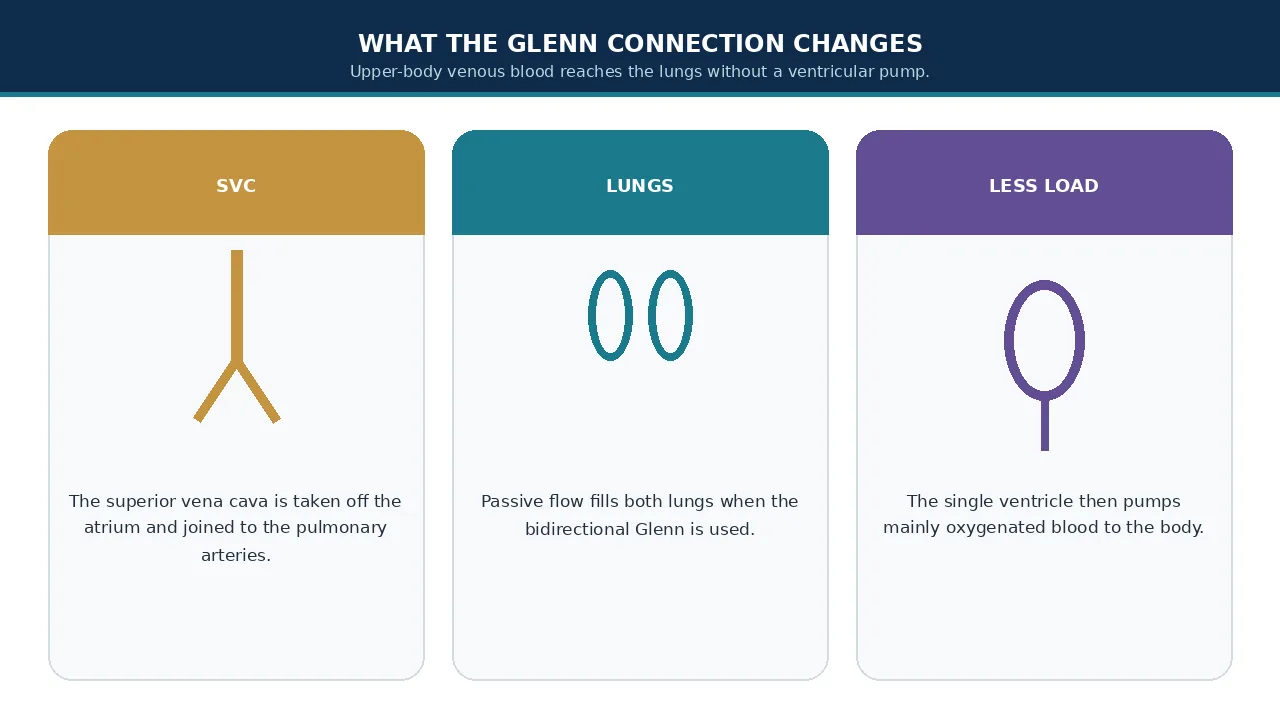
The Glenn procedure helps by connecting the superior vena cava directly to the pulmonary artery. Blood returning from the head, neck and upper limbs can then flow passively into the lungs.
This reduces the amount of blood that the single functioning ventricle has to pump and therefore reduces ventricular volume overload.
The bidirectional Glenn is described as the second stage of Fontan palliation and is used to create a superior cavopulmonary connection.
How does a bidirectional Glenn work?
The key change is the connection between the superior vena cava (SVC) and the pulmonary arteries.
Before Glenn surgery, the single ventricle may be handling a substantial volume of blood returning from both the upper and lower parts of the body.
After the Glenn:
- Blood from the upper body travels from the SVC directly to the pulmonary arteries.
- The blood then flows through the lungs and becomes oxygenated.
- The pulmonary venous blood returns to the heart.
- The single ventricle primarily pumps oxygenated blood to the systemic circulation.
- The ventricle therefore handles less volume than before the Glenn.
The flow through the Glenn is largely passive. It depends on favorable pulmonary vascular resistance, pulmonary artery anatomy, venous pressure and intrathoracic pressure.
This is why the condition of the pulmonary arteries and lungs is extremely important when determining whether a child is ready for Glenn surgery.
The Indian Journal of Thoracic and Cardiovascular Surgery describes the modern bidirectional Glenn as an SVC-to-pulmonary-artery connection that provides blood flow from the SVC toward both lungs.
Why is Glenn surgery needed?
Glenn surgery is usually part of a planned staged pathway for children with single-ventricle heart disease.
Some congenital heart defects are extremely difficult or impossible to repair by separating the circulation into two normally functioning ventricles.
Rather than attempting a conventional repair that the child's anatomy cannot support, pediatric cardiac surgeons may use staged palliation.
The goals include:
- Improving pulmonary blood flow.
- Increasing systemic oxygen saturation compared with the pre-Glenn circulation.
- Reducing the volume workload on the single ventricle.
- Supporting ventricular remodeling.
- Preparing the circulation for possible Fontan completion.
The American Heart Association describes the bidirectional Glenn/hemi-Fontan as the second stage in the staged palliation of children with single-ventricle congenital heart disease.
Ask whether Glenn is the honest product
Congenital heart conditions that may require a Glenn procedure
The Glenn procedure may be considered in several forms of complex congenital heart disease.
Common examples include:
Hypoplastic left heart syndrome (HLHS)
HLHS is one of the best-known conditions treated through staged single-ventricle palliation.
The first stage is commonly a Norwood-type procedure, followed by a superior cavopulmonary connection such as a bidirectional Glenn and, later, Fontan completion when appropriate.
There is no live GAF HLHS-only or Norwood treatment page. Neighbouring Norwood is $18,000–$40,000 when that first-stage sheet is named.
Tricuspid atresia
In tricuspid atresia, the tricuspid valve does not form normally. This prevents normal blood flow from the right atrium to the right ventricle.
Some children require staged single-ventricle palliation that includes a Glenn procedure.
Pulmonary atresia with intact ventricular septum
Some children with pulmonary atresia have a severely underdeveloped right ventricle and cannot achieve a conventional two-ventricle circulation.
A staged pathway may therefore be considered.
Double-inlet left ventricle
Both atria connect predominantly to the same ventricle. These children may require single-ventricle palliation.
Unbalanced atrioventricular septal defect
When an atrioventricular septal defect is significantly unbalanced toward one ventricle, a conventional biventricular repair may not be feasible.
Other single-ventricle anatomies
Other complex congenital abnormalities can also result in a single-ventricle pathway.
The decision is individualized according to the child's anatomy rather than based solely on the name of the congenital heart defect.
A critically ill newborn belongs in a local emergency department, not on an international flight arranged around a later Glenn package.
Glenn procedure as part of the three-stage single-ventricle pathway
Understanding the overall treatment pathway is important for parents.
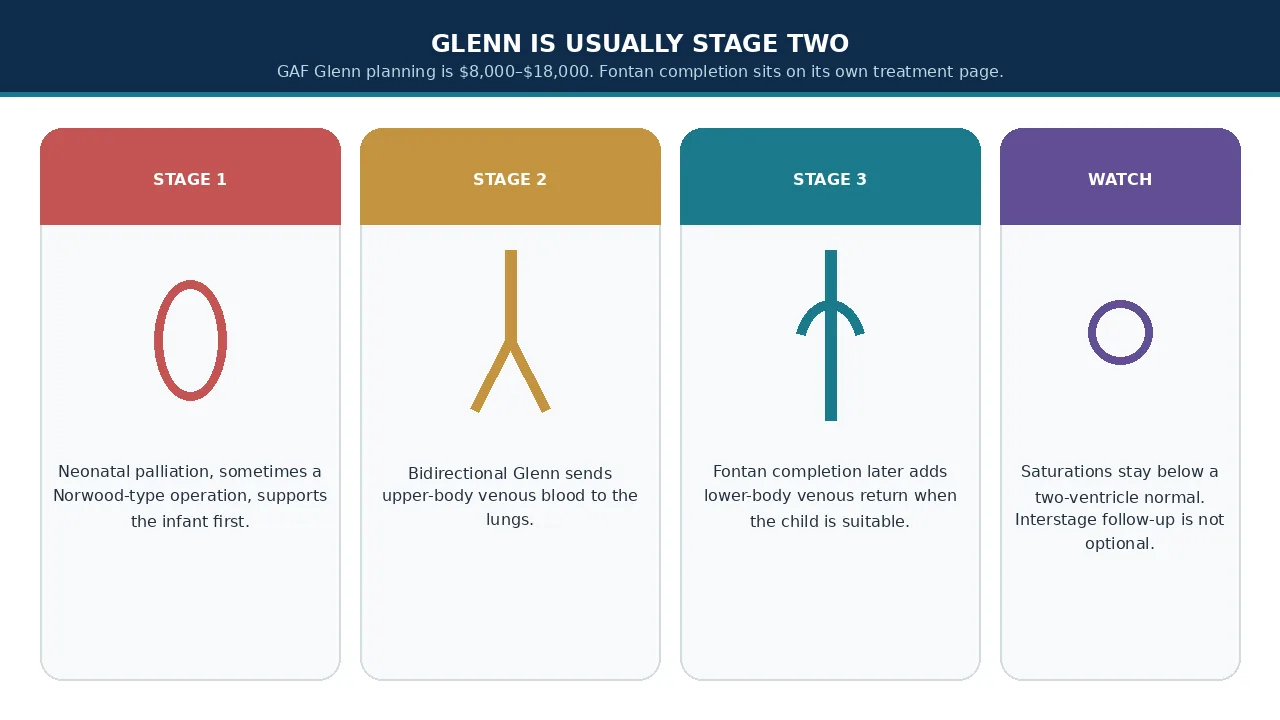
Stage 1: Initial palliation
The first operation is usually performed during the newborn period or early infancy.
Depending on the diagnosis, this could involve:
- Norwood procedure
- Blalock-Taussig shunt
- Sano conduit
- Pulmonary artery band
- Atrial septectomy
- Other anatomy-specific reconstruction
The objective is to establish adequate systemic and pulmonary blood flow while protecting the single ventricle.
Neighbouring Norwood procedure is $18,000–$40,000 when that first-stage sheet is the honest product. There is no live GAF Norwood, Blalock-Taussig or Sano treatment page.
Stage 2: Bidirectional Glenn
The Glenn is the second stage.
The SVC is connected to the pulmonary arteries so that upper-body venous blood can reach the lungs without being pumped by the ventricle.
The operation reduces ventricular volume load and prepares the circulation for the next stage.
This page is the named Glenn-procedure product. GAF Healthcare planning is $8,000–$18,000.
Stage 3: Fontan completion
The Fontan procedure is the later stage of palliation.
It directs systemic venous blood from the lower body toward the pulmonary arteries, creating a circulation in which venous blood reaches the lungs without a dedicated ventricular pump.
Not every child automatically proceeds to Fontan completion. The child's anatomy, ventricular function, pulmonary vascular resistance, valve function and overall condition must be assessed.
Fontan lists sit on Fontan Procedure Surgery in India. Neighbouring Fontan procedure is $9,000–$22,000.
The American Heart Association describes this staged sequence as Stage I palliation, Stage II superior cavopulmonary connection and Stage III Fontan palliation.
Ask about Glenn versus Fontan stage
When is Glenn surgery performed?
There is no single age that is appropriate for every child.
Historically, the Glenn procedure has commonly been performed at around 3–6 months of age, although timing varies according to the diagnosis and physiology.
The child's medical team may consider:
- Oxygen saturation
- Weight and growth
- Pulmonary artery size
- Pulmonary artery pressures
- Pulmonary vascular resistance
- Ventricular function
- Atrioventricular valve function
- Systemic outflow
- Pulmonary blood flow
- Previous shunt or Norwood operation
- Venous anatomy
- Overall clinical stability
A review of the procedure notes that the lowest mortality risk in one analysis was associated with Glenn surgery approximately 3–6 months after Stage I repair, while other data support individualized timing based on patient characteristics.
Therefore, age alone should never be used to determine whether a child is ready for Glenn surgery.
Tests before Glenn procedure
A detailed preoperative evaluation is essential.
The pediatric cardiac team may request several investigations.
Echocardiography
An echocardiogram evaluates:
- Ventricular function
- Valve function
- Atrial communication
- Pulmonary arteries
- Blood-flow patterns
- Residual defects
- Outflow obstruction
Cardiac catheterization
Cardiac catheterization may be recommended when detailed hemodynamic information is needed.
It can help measure:
- Pulmonary artery pressure
- Pulmonary vascular resistance
- Cardiac pressures
- Oxygen saturations
- Venous anatomy
- Pulmonary artery anatomy
- Collateral vessels
Catheterization is not necessarily required in exactly the same way for every patient. Some centers and selected patients may proceed using detailed non-invasive imaging when the clinical circumstances permit.
CT or MRI
Cross-sectional imaging may be useful when the team needs detailed information about:
- Pulmonary arteries
- Pulmonary veins
- Systemic veins
- Collateral vessels
- Aortic anatomy
- Previous surgical reconstruction
Blood tests
Routine blood testing may include:
- Complete blood count
- Kidney function
- Liver function
- Electrolytes
- Coagulation profile
- Blood group and crossmatch
The exact investigation list depends on the child's medical condition and the planned operation.
What happens during Glenn surgery?
The child receives general anesthesia and is monitored closely throughout the operation.
The surgeon exposes the heart and major blood vessels through a chest incision.
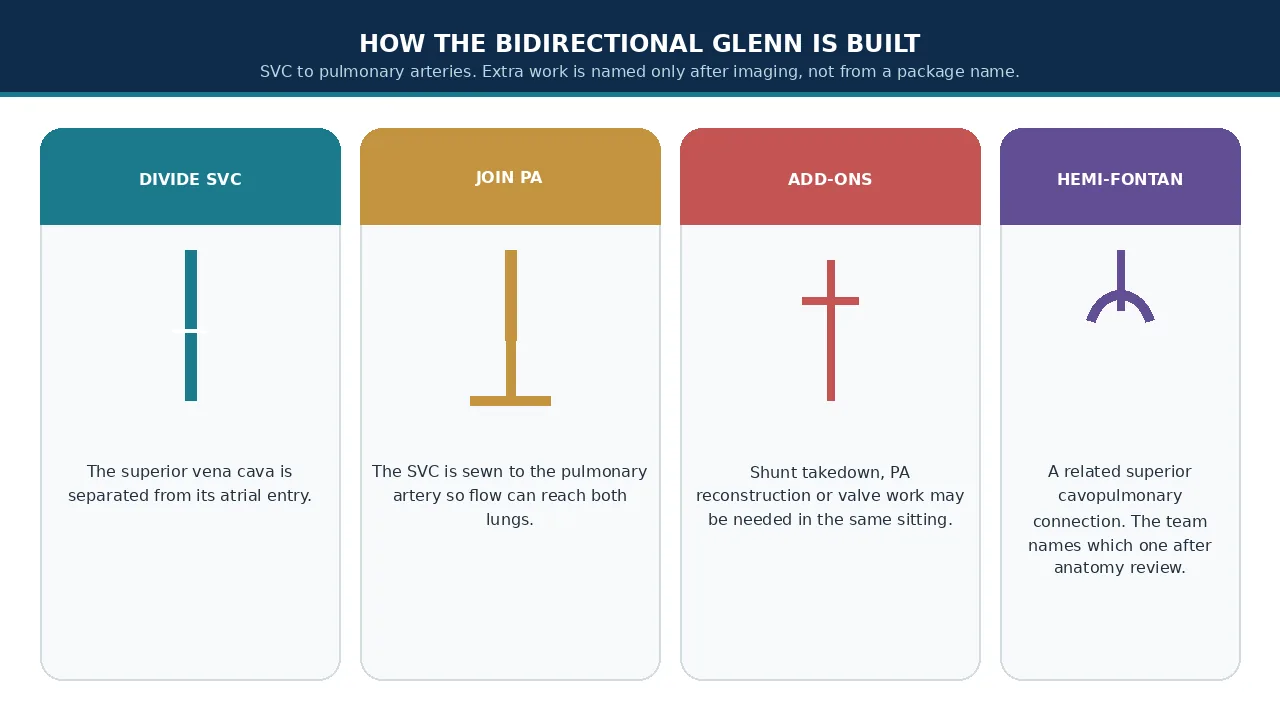
The superior vena cava is separated from its normal entry into the right atrium and connected to the pulmonary artery.
In a typical bidirectional Glenn, blood entering the SVC can flow toward the pulmonary circulation on both sides.
Depending on the child's anatomy, the operation may also include:
- Pulmonary artery reconstruction
- Removal or revision of a previous shunt
- Adjustment of antegrade pulmonary blood flow
- Atrioventricular valve repair
- Atrial septectomy
- Treatment of residual obstruction
- Other anatomy-specific procedures
The exact surgical plan is therefore not identical for every child.
The literature describes additional procedures such as pulmonary artery augmentation and atrioventricular valve repair being performed when required by the patient's anatomy.
Bidirectional Glenn vs hemi-Fontan
The terms bidirectional Glenn and hemi-Fontan are related but technically describe different surgical approaches to creating a superior cavopulmonary connection.
Both aim to establish a pathway that allows upper-body venous blood to reach the lungs without being pumped through the single ventricle.
The choice depends on:
- Previous operations
- Anatomy
- Surgical preference
- Pulmonary artery anatomy
- Planned future Fontan pathway
- Associated abnormalities
Families should therefore ask the surgical team which form of superior cavopulmonary connection is being planned and why.
Glenn procedure with additional pulmonary blood flow
Some children may have another source of pulmonary blood flow in addition to the Glenn.
The surgical team may decide whether to:
- Eliminate additional pulmonary blood flow
- Retain some antegrade pulmonary blood flow
- Modify an existing shunt
- Perform another anatomy-specific intervention
This decision is individualized.
Additional pulmonary blood flow may affect oxygen saturation and pulmonary artery pressure, but it can also increase the risk of complications such as pleural effusion in some settings.
Glenn procedure cost in India
The cost of Glenn surgery in India varies substantially because this is not a standardized operation performed under identical circumstances.
A child undergoing an uncomplicated planned bidirectional Glenn has a different resource requirement from a child who needs pulmonary artery reconstruction, valve repair, treatment of residual obstruction, prolonged ICU care or management of postoperative complications.
Indicative Glenn procedure cost in India
| Cost component | Indicative information |
|---|---|
| Glenn procedure in India | $8,000–$18,000 GAF Healthcare planning range |
| Hospital stay | Typically 8–16 nights; parent stay expected |
| ICU care | Usually required after major pediatric cardiac surgery |
| Preoperative investigations | May be included or billed separately |
| Cardiac catheterization | May be additional if required |
| Additional surgery | May substantially increase the estimate |
| Neighbouring Fontan | $9,000–$22,000 when completion is named |
| Neighbouring Norwood | $18,000–$40,000 when first-stage palliation is named |
| Medicines | Depends on the child's postoperative plan |
| Accommodation | Usually separate for international families |
| Flights and visa | Usually separate |
| US comparison | $60,000–$160,000 |
GAF Healthcare's current international-patient planning page lists $8,000–$18,000 for Glenn procedure in India and notes that the figure is not a patient-specific quotation.
Headline medical-tourism prices that omit ICU nights, catheterization or associated reconstruction should not be compared with a GAF partner sheet. Families should compare what is actually included rather than comparing headline prices alone.
Published Indian rupee listings are not GAF quotations.
What can increase the cost?
The final estimate may increase when the child requires:
- Complex pulmonary artery reconstruction
- Additional cardiac repair
- Valve repair
- Treatment of pulmonary artery stenosis
- Longer ICU care
- Prolonged ventilation
- Management of pleural effusion
- Treatment of infection
- Blood products
- Additional catheter procedures
- Emergency surgery
- Extended hospital stay
For an international patient, families should request an itemized written quotation that clearly states inclusions and exclusions.
Glenn procedure cost in India vs other countries
Published medical-tourism prices are difficult to compare directly because hospitals may define packages differently.
A useful comparison should ask whether the quoted amount includes:
- Surgeon fees
- Anesthesia
- Operating room
- ICU
- Ward stay
- Investigations
- Blood products
- Medicines
- Catheterization
- Additional procedures
- Follow-up
- Complication management
For this reason, a lower advertised price does not necessarily represent a lower total treatment cost.
US cash comparison for a named Glenn list is $60,000–$160,000. That figure is a planning comparison, not a promise that every child in India will stay at the lower bound of $8,000–$18,000.
Glenn surgery hospital stay
The child will usually spend time in a pediatric cardiac intensive care unit after surgery.
The duration depends on:
- Hemodynamic stability
- Oxygen saturation
- Ventilator requirement
- Fluid balance
- Chest drainage
- Heart rhythm
- Feeding
- Kidney function
- Infection
- Other postoperative complications
GAF Healthcare currently uses 8–16 nights as an international-family planning range for the overall hospital stay, with parent stay expected. Other published sources report shorter hospital stays. This difference illustrates why families should plan according to the child's actual clinical pathway rather than a generic number.
Recovery after Glenn surgery
Recovery after Glenn surgery happens in stages.
Initially, the child remains under close monitoring in the cardiac ICU.
The medical team monitors:
- Oxygen saturation
- Heart rate
- Blood pressure
- Central venous pressure
- Respiratory status
- Chest-drain output
- Fluid balance
- Urine output
- Heart rhythm
- Ventricular function
As the child stabilizes, intensive monitoring is gradually reduced.
Feeding is restarted and increased according to tolerance.
The child may require medications after discharge. The exact medications depend on the anatomy, surgical procedure and treating team's protocol.
Ask about hospital stay after Glenn
Oxygen saturation after Glenn surgery
One of the most important points for parents is that a Glenn circulation is not the same as normal two-ventricle circulation.
The child's oxygen saturation after Glenn surgery may remain below the range expected in a healthy child.
The exact saturation depends on:
- Pulmonary blood flow
- Pulmonary vascular resistance
- Additional pulmonary blood flow
- Ventricular function
- Pulmonary artery anatomy
- Venous anatomy
- Collateral circulation
- The child's individual physiology
Therefore, families should not compare a Glenn patient's oxygen saturation directly with that of a child with a normal heart.
Possible complications of Glenn surgery
Glenn surgery is a major cardiac procedure, and complications can occur even when the operation is technically successful.
Potential complications include:
Bleeding
Bleeding can occur during or after cardiac surgery and may require blood products or, occasionally, additional intervention.
Pleural effusion
Fluid can collect around the lungs after surgery.
Some children require prolonged chest drainage or additional treatment.
Chylothorax
Leakage of lymphatic fluid into the chest can occur after superior cavopulmonary surgery.
It may require dietary modification, medication or prolonged drainage depending on severity.
Thrombosis
Blood clots can develop in the Glenn pathway or other vessels.
Infection
Surgical-site, bloodstream or respiratory infections are possible after major surgery.
Arrhythmias
Abnormal heart rhythms may occur during recovery. Neighbouring pacemaker implantation is a different product if later pacing is named.
Low cardiac output
The heart may temporarily struggle to provide adequate circulation after surgery.
High venous pressure
Because Glenn circulation relies on passive venous flow to the lungs, elevated venous pressure can occur when pulmonary resistance or anatomical obstruction interferes with flow.
Neurological complications
Major pediatric cardiac surgery carries potential neurological risks, although the exact risk varies substantially between patients.
Glenn pathway obstruction
Narrowing at the SVC-pulmonary artery connection can interfere with pulmonary blood flow and may require catheter-based or surgical treatment.
The procedure's recognized complications include bleeding, thrombosis, pleural complications, arrhythmia and other cardiopulmonary problems.
What makes a child a good candidate for Glenn surgery?
The decision is based on physiology rather than simply diagnosis.
The medical team generally wants to establish that:
- The pulmonary arteries are adequate.
- Pulmonary vascular resistance is sufficiently favorable.
- Ventricular function is acceptable.
- Atrioventricular valve regurgitation is not severe.
- Systemic blood flow is unobstructed.
- Pulmonary venous return is satisfactory.
- The child's overall condition allows the procedure.
The Indian Journal of Thoracic and Cardiovascular Surgery emphasizes the importance of satisfactory pulmonary arteries, ventricular function, limited atrioventricular valve regurgitation and favorable pulmonary pressures when preparing for Glenn and eventual Fontan physiology.
When Glenn surgery may be delayed
A Glenn procedure may be postponed if the child has a problem that needs correction or stabilization first.
Examples can include:
- Significant infection
- Poor clinical condition
- Severe ventricular dysfunction
- Significant atrioventricular valve regurgitation
- Unsatisfactory pulmonary artery anatomy
- High pulmonary vascular resistance
- Uncontrolled heart failure
- Other major anatomical problems
The surgical team may first optimize the child's condition or perform an additional intervention.
Glenn procedure for international patients in India
Families travelling from Africa, the Middle East, Central Asia or other regions should prepare the child's medical records before travelling.
The most useful documents generally include:
- Birth history
- Diagnosis
- Previous operation reports
- Discharge summaries
- Echocardiography reports
- Echocardiogram images or videos where available
- Cardiac catheterization reports
- CT or MRI reports
- Medication list
- Recent blood tests
- Oxygen saturation records
- Previous ICU records
- Current weight and height
- Vaccination information
The actual imaging files are often more useful than a written summary alone.
A congenital-heart team should review the records before the family commits to travel.
A coordinator can also open WhatsApp at +91 90443 46292 for planned records review.
Send records before booking travel
Choosing a hospital for Glenn surgery in India
For Glenn surgery, hospital selection should focus on the complete pediatric congenital-heart program, rather than the hospital's general reputation.
Families should look for access to:
- Pediatric cardiac surgeons
- Pediatric cardiologists
- Pediatric cardiac anesthesiologists
- Pediatric cardiac ICU
- Pediatric cardiac catheterization
- Advanced imaging
- Blood bank
- Pediatric intensive care
- Emergency cardiac surgery
- ECMO where clinically appropriate
- Postoperative cardiac monitoring
- Long-term congenital-heart follow-up
The American Heart Association highlights the importance of advanced cardiac capabilities for children with complex single-ventricle disease, particularly when serious postoperative complications occur.
There is no live GAF ECMO treatment page. ECMO is a rescue capability, not a brochure package.
Questions to ask the Glenn surgery team
Before treatment, parents should consider asking:
- What is my child's exact heart anatomy?
- Why is Glenn surgery being recommended?
- Is the child following a single-ventricle pathway?
- Is this a bidirectional Glenn or a hemi-Fontan?
- Does my child need cardiac catheterization before surgery?
- What are the pulmonary artery pressures?
- Are the pulmonary arteries adequately developed?
- Is there significant atrioventricular valve regurgitation?
- How is ventricular function?
- Will the existing shunt be removed, retained or modified?
- Will additional pulmonary blood flow be maintained?
- Are any additional procedures planned?
- What oxygen saturation is expected after surgery?
- How long is the expected ICU stay?
- What complications should we watch for?
- What medications will be required after discharge?
- What follow-up testing is required?
- When can the child travel home?
- What happens if the child develops a complication after returning home?
- When will the team evaluate suitability for Fontan completion?
Glenn surgery and the Fontan procedure
The Glenn operation is usually not the final stage of single-ventricle palliation.
After Glenn surgery, the child's circulation continues to be monitored closely.
If the child remains an appropriate candidate, Fontan completion may be considered later.
Before Fontan, doctors evaluate:
- Pulmonary artery anatomy
- Pulmonary vascular resistance
- Ventricular function
- Atrioventricular valve function
- Systemic outflow
- Venous anatomy
- Collateral vessels
- Oxygen saturation
- Overall clinical condition
The Glenn therefore serves an important purpose beyond improving circulation in the short term: it prepares the child for the possibility of a later total cavopulmonary connection.
Fontan lists sit on Fontan Procedure Surgery in India.
| Feature | Glenn procedure | Fontan procedure |
|---|---|---|
| Stage | Usually second | Usually third |
| Connection | SVC to pulmonary arteries | Lower-body veins to pulmonary arteries |
| Typical timing | Infancy, often 3–6 months after Stage I | Later than Glenn, individualized |
| Live GAF product | This treatment page plus the Glenn sheet | Fontan Procedure Surgery in India plus the Fontan sheet |
| Planning range | $8,000–$18,000 | $9,000–$22,000 |
For families considering treatment in India, it is useful to understand that Glenn surgery and Fontan completion are stages of the same broader single-ventricle treatment pathway, but their objectives and anatomy are different.
Life between Glenn and Fontan
The period between Glenn and Fontan is sometimes called the interstage period.
This period requires careful follow-up.
Parents may be asked to monitor:
- Oxygen saturation
- Weight
- Feeding
- Respiratory symptoms
- Heart rate
- Medication adherence
- General activity and behavior
The child's cardiology team determines how frequently follow-up should occur.
A sudden change in oxygen saturation, breathing, feeding, alertness or circulation should be evaluated urgently according to the family's medical plan. Collapse belongs in a local emergency department.
Long-term follow-up after Glenn surgery
Children with single-ventricle physiology require long-term cardiac care.
Even after Fontan completion, the circulation remains physiologically different from a normal two-ventricle circulation.
Long-term follow-up may include:
- Echocardiography
- ECG
- Holter monitoring
- Exercise assessment when age-appropriate
- Cardiac MRI
- Blood tests
- Liver assessment
- Kidney assessment
- Evaluation of growth and development
- Monitoring of exercise tolerance
- Assessment of rhythm abnormalities
The need for lifelong congenital-heart follow-up is emphasized by major congenital-heart organizations because the circulation remains anatomically and physiologically complex.
Advantages and goals of Glenn surgery
The Glenn procedure is designed to achieve several important physiological goals.
Reduced ventricular volume load
Because upper-body venous blood bypasses the ventricle on its way to the lungs, the single ventricle does less volume work.
Improved pulmonary blood flow
The operation establishes a direct pathway from systemic venous circulation to the pulmonary arteries.
Improved oxygenation compared with earlier stages
The change in circulation can increase systemic oxygen saturation, although saturation remains different from that of a child with normal two-ventricle circulation.
Preparation for Fontan
A successful Glenn establishes the superior cavopulmonary component required for the later Fontan pathway.
Limitations of Glenn surgery
The Glenn procedure does not create a normal two-ventricle heart.
The child still has single-ventricle physiology.
The operation also does not eliminate the possibility of further cardiac procedures.
Additional interventions may be needed because of:
- Pulmonary artery narrowing
- Valve dysfunction
- Ventricular dysfunction
- Collateral vessels
- Arrhythmias
- Glenn pathway obstruction
- Other evolving congenital-heart problems
Parents should therefore view Glenn surgery as one stage in a longer treatment journey, not necessarily the final operation.
Glenn procedure: recovery timeline
A typical recovery may broadly include:
First 1–3 days: Close ICU monitoring, respiratory support as needed, fluid management, pain control and assessment of Glenn circulation.
Following days: Gradual reduction in intensive monitoring, chest-drain management, feeding progression and medication adjustment.
Before discharge: The team confirms stable circulation, acceptable oxygenation, adequate feeding, wound condition and an appropriate medication plan.
After discharge: Regular pediatric cardiology follow-up and monitoring of oxygen saturation, growth and clinical condition.
These are general stages rather than a fixed timetable. A child's recovery can be considerably shorter or longer depending on anatomy and complications.
Travel to India for Glenn surgery
International families should avoid booking inflexible return flights immediately after surgery.
The child's travel date should depend on medical clearance.
Before returning home, the treating team should ideally provide:
- Discharge summary
- Operative report
- Medication list
- Follow-up plan
- Latest echocardiogram report
- Oxygen saturation guidance
- Emergency warning signs
- Contact information for the treating hospital
- Recommendations for the local cardiologist
Families should also arrange follow-up with a pediatric cardiologist in their home country before or soon after returning.
Why India is considered for pediatric cardiac surgery
India has developed large pediatric and congenital cardiac programs serving both domestic and international patients.
For international families, potential practical considerations include:
- Availability of specialist pediatric cardiac teams
- Advanced cardiac imaging
- Pediatric cardiac ICUs
- Cardiac catheterization facilities
- International patient coordination
- English-language medical documentation
- Potentially lower treatment costs than some high-cost healthcare markets
However, the right hospital for a child should be determined by the specific congenital anatomy, required procedure and available pediatric cardiac expertise, not simply by country-level cost.
Adult CABG theatres are not a substitute for a named pediatric Glenn list.
Glenn procedure in India: cost factors for international families
A realistic treatment budget should include more than the surgical package.
Families should plan for:
Medical costs
- Pediatric cardiology consultation
- Surgical consultation
- Diagnostic investigations
- Cardiac catheterization if required
- Surgery
- ICU
- Ward
- Medicines
- Blood products
- Additional procedures
- Complication management
- Follow-up
Travel costs
- Flights
- Visa
- Accommodation
- Local transportation
- Food
- Companion expenses
- Medical insurance where applicable
For children undergoing complex congenital-heart treatment, it is particularly important to keep additional funds available for an unexpected extension of hospitalization.
Glenn procedure: frequently asked questions
Is Glenn surgery a major heart operation?
Yes. Glenn surgery is major pediatric cardiac surgery and requires specialized congenital-heart surgical and intensive-care facilities.
Is Glenn surgery a cure?
No. The Glenn is generally a palliative stage in the treatment pathway for single-ventricle congenital heart disease.
Is Glenn surgery the same as Fontan surgery?
No. Glenn establishes the superior cavopulmonary connection. Fontan later completes the total cavopulmonary pathway by directing lower-body venous blood toward the lungs. Fontan lists sit on Fontan Procedure Surgery in India.
Can a child have Glenn surgery without a previous operation?
In selected circumstances, a Glenn may be performed as an earlier or primary stage, but the usual pathway involves previous palliation. The appropriate sequence depends on anatomy and physiology.
How successful is Glenn surgery?
Outcomes vary significantly between diagnoses and individual patients. Published studies report different survival and complication rates depending on anatomy, era, center and patient selection. It is therefore inappropriate to apply one universal success rate to every Glenn operation.
What oxygen level can be expected after Glenn?
Oxygen saturation is usually lower than normal two-ventricle circulation. The expected range is individualized according to pulmonary blood flow and the child's anatomy.
Does every child need a Fontan after Glenn?
No. Fontan candidacy must be assessed individually. Some children may undergo additional procedures or follow a different long-term pathway.
How long does Glenn surgery take?
The operation often takes several hours. The duration can increase when additional reconstruction or associated procedures are required.
How long does a child stay in ICU after Glenn surgery?
The ICU stay varies. It depends on ventilation, hemodynamics, fluid balance, rhythm, chest drainage and other postoperative factors. GAF overall hospital planning is typically 8–16 nights.
Is cardiac catheterization necessary before Glenn?
Not always. It is frequently used when detailed pressure and anatomical information is needed, but selected patients may proceed based on high-quality non-invasive assessment and the treating center's clinical judgment.
What are the main risks of Glenn surgery?
Important potential complications include bleeding, infection, thrombosis, pleural effusion, chylothorax, arrhythmias, low cardiac output, neurological complications and obstruction of the Glenn pathway.
Can international patients travel to India for Glenn surgery?
Yes, international pediatric cardiac patients may seek treatment in India, but the case should be reviewed by the treating team before travel. The child's records, imaging and previous surgical history are particularly important.
How much does Glenn surgery cost in India?
GAF Healthcare planning for Glenn procedure is $8,000–$18,000, typically 8–16 nights, with parent stay expected. US comparison is $60,000–$160,000. Families should obtain an individualized quotation after the hospital reviews the child's records.
Is there a GAF Norwood or heart-transplant treatment page?
No. Norwood, HLHS-only and heart-transplant treatment pages are not live. Neighbouring sheets exist. Fontan, arterial-switch, PDA, VSD and coarctation lists sit on those treatment pages.
When should I go to an emergency department?
Increasing breathlessness, grey or blue skin, fainting, poor feeding or collapse belongs in a local emergency department, not in a WhatsApp message.
Glenn procedure surgery in India: key takeaways
- The Glenn procedure is a staged operation for selected children with complex congenital heart disease and single-ventricle physiology.
- It connects the superior vena cava to the pulmonary arteries.
- The operation allows upper-body venous blood to reach the lungs without being pumped through the single ventricle.
- It is commonly the second stage of single-ventricle palliation.
- Glenn surgery is frequently performed during infancy, but timing is individualized.
- Preoperative assessment may include echocardiography, catheterization and advanced imaging.
- The operation may be combined with pulmonary artery reconstruction or other cardiac procedures.
- Recovery requires specialized pediatric cardiac intensive care.
- Oxygen saturation after Glenn is not expected to be the same as in a normal two-ventricle circulation.
- Glenn surgery does not usually represent a complete repair.
- Fontan completion may be considered later in appropriately selected children.
- GAF Healthcare planning for the named Glenn-procedure sheet is $8,000–$18,000.
- International families should have the child's records and imaging reviewed before travelling.
- Long-term follow-up with a congenital or pediatric cardiology team remains important.
For families considering Glenn surgery in India, the most important step is a detailed evaluation by an experienced pediatric cardiology and congenital cardiac surgery team. The decision should be based on the child's individual anatomy, previous surgeries, ventricular function, pulmonary circulation and overall health rather than on age or a generic treatment pathway.
Share reports for a preliminary Glenn estimate
Related GAF Healthcare pages
- Fontan Procedure Surgery in India
- Arterial Switch Operation in India
- PDA Closure Surgery in India
- Ventricular Septal Defect (VSD) Surgery in India
- Coarctation Repair Surgery in India
- Heart Valve Replacement Surgery in India
- Glenn procedure cost
- Fontan procedure cost
- Norwood procedure cost
- Pediatric cardiac surgeons in India
- Pediatric cardiac surgery hospitals in India
Norwood, HLHS-only, Blalock-Taussig, Sano and heart-transplant treatment pages are not live on this site. Use this page plus the named modality sheets.
Top 10 sources
- National Center for Biotechnology Information (NCBI) — StatPearls: Bidirectional Glenn Procedure or Hemi-Fontan. Detailed overview of indications, physiology, surgical technique, timing and complications.
- American Heart Association — Resuscitation of Patients With Single Ventricle Congenital Heart Disease. Describes the staged pathway involving Stage I palliation, bidirectional Glenn/hemi-Fontan and Fontan.
- Indian Journal of Thoracic and Cardiovascular Surgery — The Bidirectional Glenn Shunt for Univentricular Hearts. India-relevant clinical discussion of Glenn physiology and the pathway toward Fontan.
- PubMed — Bidirectional Glenn Procedure or Hemi-Fontan. Indexed medical reference covering the role of superior cavopulmonary connection in single-ventricle palliation.
- PubMed Central — Single Ventricle: A Comprehensive Review. Reviews staged single-ventricle management, including the Glenn stage and considerations before Fontan.
- PubMed Central — Outcomes of Bidirectional Glenn Surgery Without Prior Cardiac Catheterization. Evidence regarding preoperative catheterization and selected patients undergoing Glenn surgery.
- PubMed — Current Outcomes of the Glenn Bidirectional Cavopulmonary Connection for Single Ventricle Palliation. Long-term outcomes following bidirectional cavopulmonary connection.
- American Heart Association — Pulmonary Atresia. Patient-oriented information on staged congenital-heart treatment, including Glenn and Fontan procedures.
- GAF Healthcare Glenn procedure cost sheet — Glenn Procedure.
- GAF Healthcare Fontan and Norwood sheets — Fontan Procedure and Norwood Procedure.
Medical disclaimer
This page is intended for general medical education and healthcare-planning purposes. It does not diagnose single-ventricle disease or replace an examination by a qualified pediatric cardiologist or congenital cardiac surgeon.
The Glenn procedure is highly individualized. The decision to perform surgery, the timing of surgery, the type of cavopulmonary connection and the need for additional procedures should be made by a qualified pediatric cardiology and congenital cardiac surgery team after reviewing the child's medical history, imaging and hemodynamic information.
Cost figures are indicative planning ranges from partner hospital cost sheets and are not hospital quotations. A collapsing, grey or severely breathless child belongs in a local emergency department.
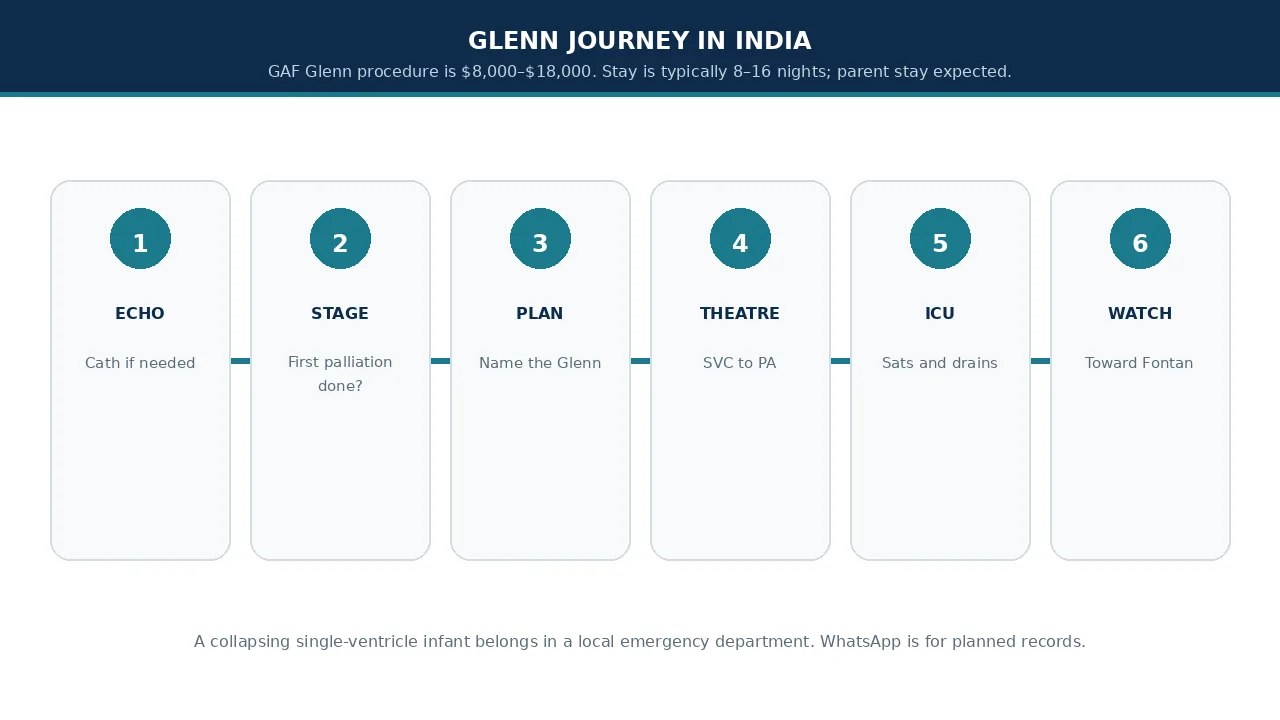
Treatment Process
- 1
Share records
The family provides echocardiography, catheterization and previous operative notes before anyone books travel.
- 2
Congenital team review
A pediatric cardiologist and congenital surgeon review whether Glenn, further observation or local emergency care is honest.
- 3
Name the product
The team writes bidirectional Glenn or hemi-Fontan only after pulmonary-artery and saturation review.
- 4
Itemized estimate
GAF Glenn planning is $8,000–$18,000. Neighbouring Fontan is $9,000–$22,000 when completion is named.
- 5
Travel only if stable
Stable planned cases travel after records review. A collapsing single-ventricle child belongs in a local emergency department.
- 6
Repeat essential tests
The receiving unit confirms echo, cath findings, saturations and fitness after arrival.
- 7
Complete the named Glenn
Superior cavopulmonary connection proceeds only after the product is named.
- 8
Pediatric cardiac ICU
Saturations, drains, fluid balance and rhythm are watched before discharge.
- 9
Interstage follow-up
The family leaves with saturation guidance and who will watch the child toward possible Fontan review.