Treatment Overview

Heart bypass surgery cost in India is planned from the named first-time CABG product, not from a single advertised headline package. Heart bypass surgery is also called Coronary Artery Bypass Grafting (CABG). It creates a new route for blood to reach the heart muscle when one or more coronary arteries are significantly narrowed or blocked.
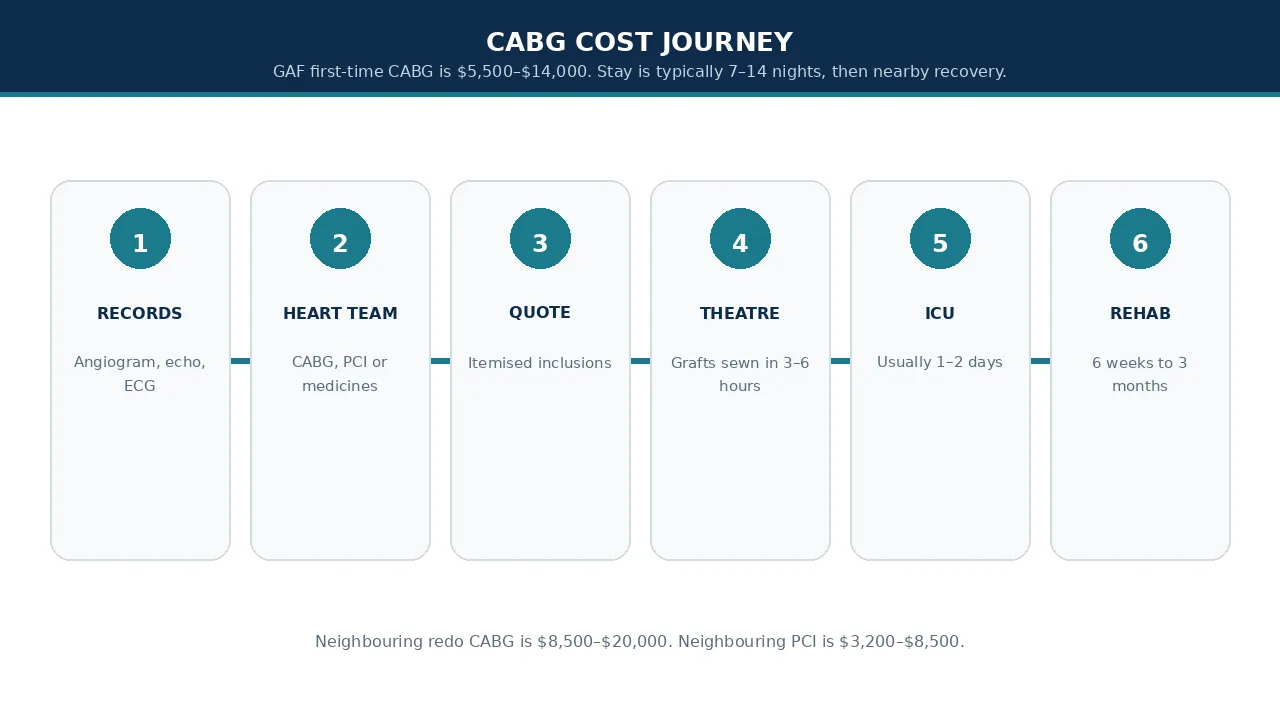
GAF Healthcare planning for CABG is $5,500–$14,000 (typically 7–14 nights, then nearby recovery). US comparison is $70,000–$200,000. Some straightforward first-time cases sit toward the lower end of this sheet. Complex anatomy, premium theatre time, prolonged ICU or extra products sit higher or move onto a neighbouring sheet.
The procedure page for how grafts are sewn sits on CABG Surgery in India. A catheter that opens the artery from inside is a different product. Named PCI sits on Coronary Angioplasty in India. Diagnostic pictures sit on coronary angiography. Combined valve work sits on Heart Valve Replacement Surgery in India. There is no live GAF city-CABG-cost, heart-attack, cardiac-rehabilitation or redo-CABG-only treatment page. This page is the named heart-bypass-surgery-cost product. Mitral replacement lists sit on Mitral Valve Replacement Surgery in India. Tricuspid repair lists sit on Tricuspid Valve Repair in India.
Neighbouring redo CABG is $8,500–$20,000 (typically 10–18 nights) when adhesions and conduit scarcity make a second bypass the honest product. Neighbouring minimally invasive cardiac surgery is $8,000–$20,000 (typically 5–12 nights) when a mini approach can actually complete the grafts. Neighbouring robotic cardiac surgery is $10,000–$24,000 (typically 5–12 nights) on a console the hospital already runs. Neighbouring coronary angioplasty and stenting is $3,200–$8,500 (typically 1–3 nights) when PCI rather than a graft is the product. Neighbouring coronary angiography is $400–$1,200 (typically day-care or overnight). Neighbouring heart valve replacement is $7,000–$18,000 (typically 8–16 nights) when a valve is replaced in the same pathway. These are planning ranges from partner hospital cost sheets, not hospital quotations.
International patients comparing cardiac surgeons commonly start with Delhi NCR, Mumbai, Bengaluru, Chennai and Hyderabad. Partner cardiac surgery hospitals in Delhi NCR, Mumbai and Bengaluru, and in Chennai and Hyderabad, are a typical first filter because CABG needs a cardiac ICU, blood bank and emergency backup. City cost sheets include Delhi NCR, Mumbai, Bengaluru, Chennai and Hyderabad. Kolkata, Pune, Ahmedabad, Chandigarh and Kochi may have cardiac theatres. They are not live GAF catalog cities on this site.
Important: Severe or persistent chest pain, chest pressure, sudden breathlessness, cold sweating, fainting, sudden weakness or pain spreading to the arm, jaw, back or neck belongs in a local emergency department first. WhatsApp at +91 90443 46292 is for planned record review, not a heart-attack emergency.
What is heart bypass surgery?
Heart bypass surgery, medically known as Coronary Artery Bypass Grafting (CABG), is an operation used to improve blood flow to the heart.
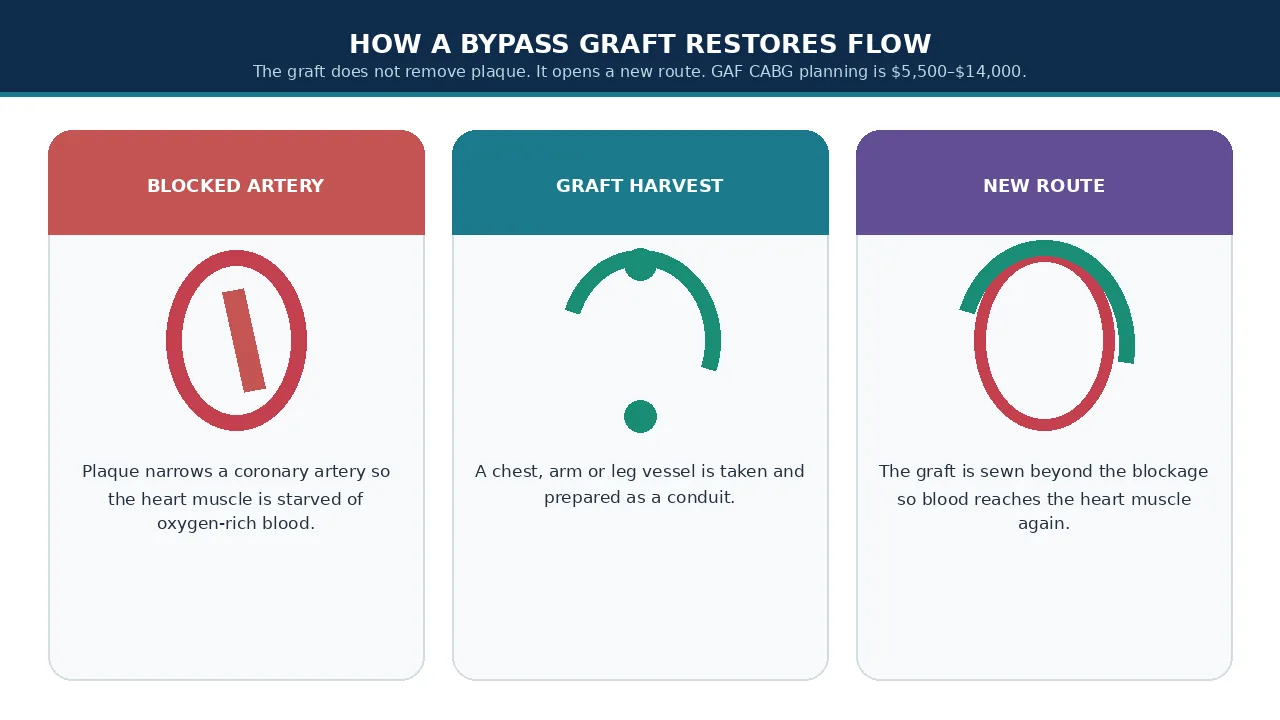
During CABG, a cardiac surgeon takes a healthy blood vessel from another part of the body, such as the chest or leg, and connects it to the coronary circulation so blood can flow around a narrowed or blocked section of a coronary artery.
The bypass does not remove the underlying coronary artery disease. Instead, it creates an alternative route for blood to reach the heart muscle.
CABG is commonly used for significant coronary artery disease, particularly when there are multiple important blockages or when the anatomy makes bypass surgery more appropriate than another form of revascularisation. Decisions about CABG versus angioplasty and stenting should be made after reviewing the coronary anatomy, symptoms, heart function, other medical conditions and the patient's preferences. The American Heart Association and ACC/AHA/SCAI guidelines emphasise patient-centred decision-making and, when the best revascularisation strategy is uncertain, a multidisciplinary Heart Team approach.
How the grafts are sewn, which conduits are used and how recovery is paced sit on CABG Surgery in India. This page names the cost product.
Why is CABG needed?
The coronary arteries supply oxygen-rich blood to the heart muscle. Over time, cholesterol, inflammatory material and other substances can build up inside these arteries, forming plaques.
When a coronary artery becomes significantly narrowed, the heart muscle may not receive enough oxygen, particularly during physical activity. This can cause angina, or chest discomfort.
If a coronary artery becomes critically blocked, it can contribute to a heart attack.
A cardiologist or Heart Team may consider CABG when there is:
- Significant disease involving multiple coronary arteries
- Important left-main coronary artery disease
- Complex coronary anatomy
- Persistent or severe angina despite appropriate medical treatment
- Coronary disease associated with diabetes in selected patients
- Reduced blood supply to important areas of the heart
- Coronary anatomy where CABG is considered more suitable than PCI
- Certain situations following or associated with a heart attack
The decision is individualised. Having a blocked artery does not automatically mean that CABG is required.
Ask whether a Heart Team names CABG or PCI
How much does heart bypass surgery cost in India?
There is no single fixed CABG price in India because hospitals calculate treatment costs differently.
The live GAF first-time CABG sheet is $5,500–$14,000, typically 7–14 nights, then nearby recovery. Comparable US planning is $70,000–$200,000.
Published consumer-health figures in other currencies vary because “CABG cost” may refer to:
- A subsidised or government-linked rate
- A standard private-hospital package
- A premium private hospital
- A basic surgical estimate
- An all-inclusive medical-travel package
- A quotation that excludes investigations or complications
A government-linked tariff is not the retail price charged by every private hospital. A generic internet price should not be treated as a quotation.
| Product | GAF planning | Typical stay |
|---|---|---|
| CABG | $5,500–$14,000 | 7–14 nights, then nearby recovery |
| Redo CABG | $8,500–$20,000 | 10–18 nights |
| Minimally invasive cardiac surgery | $8,000–$20,000 | 5–12 nights |
| Robotic cardiac surgery | $10,000–$24,000 | 5–12 nights |
| Coronary angioplasty and stenting | $3,200–$8,500 | 1–3 nights |
| Coronary angiography | $400–$1,200 | Day-care or overnight |
| Heart valve replacement | $7,000–$18,000 | 8–16 nights |
Ask whether the quotation is first-time CABG or redo
Heart bypass surgery cost by number of grafts
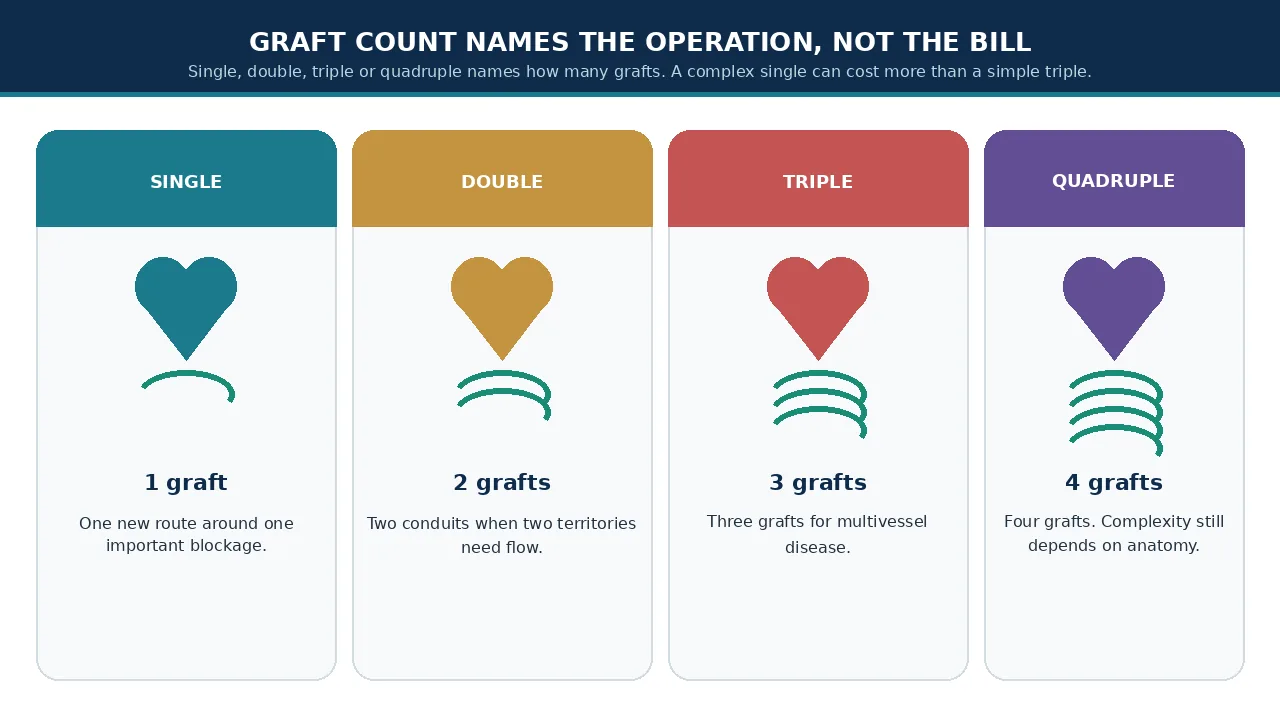
The number of bypasses is one of the factors that can influence the price.
Single bypass
A single bypass involves creating one graft to bypass a significant coronary blockage.
Double bypass
A double bypass involves two bypass grafts.
Triple bypass
A triple bypass involves three grafts.
Quadruple bypass
A quadruple bypass involves four grafts.
The terminology describes the number of bypass grafts rather than simply the number of arteries that appear narrowed on an angiogram.
A higher number of grafts can increase operative complexity, although the final price cannot be calculated simply by multiplying the price of a single bypass. The surgeon's operative plan, graft type, patient's condition, ICU requirements and hospital package are all relevant.
| CABG type | General description | Indicative cost tendency |
|---|---|---|
| Single bypass | 1 graft | Lower end in uncomplicated cases |
| Double bypass | 2 grafts | Moderate |
| Triple bypass | 3 grafts | Moderate to higher |
| Quadruple bypass | 4 grafts | Higher, depending on complexity |
These should be regarded as cost patterns rather than fixed prices. A complex single bypass can cost more than an uncomplicated multiple-graft operation at another hospital. Extra grafts do not automatically move the case onto the redo CABG sheet. Redo CABG is a second-time operation.
Ask which grafts the surgeon is naming
Heart bypass surgery cost by city in India
CABG prices vary between hospitals. For international patients, it is more useful to compare hospital-specific quotations than to assume that one city always has the lowest price.
Live GAF city sheets use the same first-time CABG planning range of $5,500–$14,000:
| City | Live GAF planning range | Typical stay |
|---|---|---|
| Delhi NCR | $5,500–$14,000 | 7–14 nights, then nearby recovery |
| Mumbai | $5,500–$14,000 | 7–14 nights, then nearby recovery |
| Bengaluru | $5,500–$14,000 | 7–14 nights, then nearby recovery |
| Chennai | $5,500–$14,000 | 7–14 nights, then nearby recovery |
| Hyderabad | $5,500–$14,000 | 7–14 nights, then nearby recovery |
Pune, Ahmedabad, Kolkata and Kochi may have cardiac theatres. They are not live GAF catalog cities on this site. There is no live city-CABG-cost treatment page for those cities.
Compare Delhi NCR, Mumbai and Bengaluru CABG quotes
Heart bypass surgery cost in major Indian hospitals
The final quotation should be obtained directly from the hospital after the cardiac team reviews the patient's medical records.
Partner cardiac surgery hospitals in Delhi NCR, Mumbai, Bengaluru, Chennai and Hyderabad are the live GAF first filter. Named groups with established cardiac programmes include Fortis, Medanta, Gleneagles, Apollo, KIMS, MGM and Yashoda partner lists already attached to this page.
Hospital selection should not be based on price alone. Patients should consider the cardiac surgery team, ICU capabilities, emergency backup, multidisciplinary support, experience with complex coronary disease, infection-control systems, rehabilitation and the hospital's ability to manage potential complications.
What is included in heart bypass surgery cost?
A CABG quotation may include some or all of the following:
Usually included
- Cardiac surgeon's professional fee
- Anaesthetist's fee
- Operating theatre charges
- Surgical consumables
- Standard graft materials
- Anaesthesia
- ICU charges for the specified package period
- Ward or room charges
- Routine nursing care
- Standard medications during admission
- Routine laboratory monitoring
- Blood products in some packages
- Post-operative monitoring
Package definitions differ between hospitals. Before paying an advance, ask the hospital for a written quotation showing exactly what is included.
What may not be included in the CABG package?
Some costs may be billed separately.
These can include:
- Pre-operative coronary angiography
- CT scans
- Special imaging
- Additional blood tests
- Blood products beyond package limits
- Extended ICU stay
- Extended hospitalisation
- Treatment of complications
- Additional procedures
- Specialist consultations
- Certain high-cost medicines
- Cardiac rehabilitation
- Follow-up after discharge
- Accommodation for family members
- International patient services
- Flights and local transportation
- Visa-related expenses
- Medical escort services
This is one of the most important questions to ask when comparing two CABG quotations. A package that appears cheaper may simply contain fewer services.
Request a written inclusions list
What factors affect heart bypass surgery cost in India?
1. Number of bypass grafts
A patient requiring multiple grafts may have a more complex operation than someone requiring a single graft.
2. Complexity of coronary disease
Disease affecting the left main coronary artery, multiple vessels or difficult anatomical locations may require more complex surgical planning.
3. Type of CABG
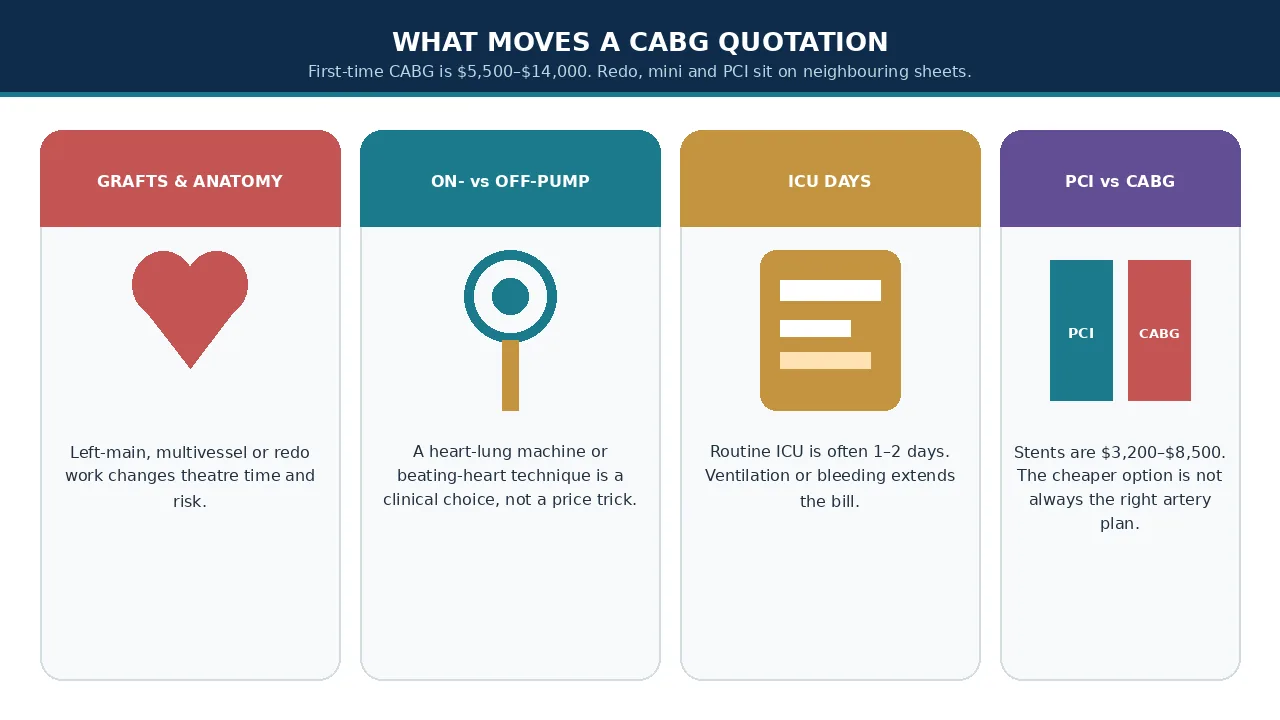
Traditional on-pump CABG, off-pump CABG and selected minimally invasive approaches can have different resource requirements.
4. Hospital
A tertiary cardiac centre with advanced cardiac operating rooms, dedicated cardiac ICUs, perfusion services and multidisciplinary specialists may have a different pricing structure from a smaller hospital.
5. Surgeon's professional fee
Surgeon and anaesthetist fees vary depending on the hospital, expertise and complexity of the case.
6. Room category
Private rooms, deluxe rooms and suites generally cost more than shared or semi-private accommodation.
7. ICU duration
A routine recovery may require a relatively short ICU stay. Patients who need prolonged ventilation, additional monitoring or treatment of complications may incur additional charges.
8. Existing medical conditions
Diabetes, kidney disease, lung disease, peripheral vascular disease, obesity and other medical conditions may affect both treatment complexity and recovery.
9. Emergency surgery
Emergency CABG can require additional resources and may involve a different clinical and financial pathway from planned surgery.
10. Complications
Bleeding, infection, abnormal heart rhythms, kidney problems, respiratory problems or other complications may extend hospitalisation and increase the overall cost.
Mayo Clinic lists complications that can occur after CABG, including bleeding, infection, arrhythmias, kidney injury, stroke and other complications, with risk influenced by the patient's health and whether surgery is performed urgently.
On-pump vs off-pump CABG: does it change the cost?
On-pump CABG
In conventional CABG, a heart-lung bypass machine may temporarily take over the circulation while the surgeon performs the grafting.
Off-pump CABG
Off-pump CABG, sometimes called beating-heart surgery, is performed without using the heart-lung machine in the same way.
Neither technique is automatically appropriate for every patient.
The surgical team considers the patient's coronary anatomy, overall health, surgical risk and the surgeon's experience when deciding which technique is appropriate.
The choice of technique can affect hospital resources and therefore the overall cost, but it should be driven primarily by the clinical situation rather than price.
Minimally invasive CABG cost in India
Some patients may be candidates for minimally invasive or robotic-assisted coronary bypass procedures.
These approaches use smaller incisions than conventional open surgery in selected cases.
The American Heart Association recognises minimally invasive direct coronary artery bypass and robot-assisted coronary bypass as forms of minimally invasive heart surgery.
Neighbouring minimally invasive cardiac surgery is $8,000–$20,000. Neighbouring robotic cardiac surgery is $10,000–$24,000. There is no live GAF minimally-invasive-heart-surgery treatment page.
The cost may be higher because of specialised equipment, advanced operating-room technology, longer or specialised surgical planning, additional technical expertise and specific patient-selection requirements.
Minimally invasive CABG is not suitable for every patient.
Heart bypass surgery vs angioplasty: which costs more?
CABG and angioplasty with stenting are different forms of coronary revascularisation.
Angioplasty / PCI
A catheter is introduced through a blood vessel and used to treat a narrowed coronary artery, often with placement of a stent. Named PCI sits on Coronary Angioplasty in India. Neighbouring coronary angioplasty and stenting is $3,200–$8,500.
CABG
A surgeon creates a new route around the blocked coronary artery using a graft. First-time CABG is $5,500–$14,000.
The cheaper option is not necessarily the clinically appropriate option.
For some patients, PCI may be appropriate. For others, CABG may provide the more suitable revascularisation strategy. The decision depends on coronary anatomy, disease complexity, diabetes and other factors, heart function, previous procedures, surgical risk and patient preferences.
The 2021 ACC/AHA/SCAI revascularisation guideline recommends patient-centred decision-making and multidisciplinary Heart Team discussion when the optimal strategy is unclear.
| Feature | CABG | Angioplasty / PCI |
|---|---|---|
| Treatment type | Surgical graft around a blockage | Catheter balloon and usually a stent |
| GAF planning | $5,500–$14,000 | $3,200–$8,500 |
| Typical stay | 7–14 nights, then nearby recovery | 1–3 nights |
| Donor vessel | Required | Not required |
| Open chest | Usually yes | No |
How is heart bypass surgery performed?
A typical CABG operation takes approximately 3–6 hours, although the duration can vary.
The NHS describes the main stages as follows:
- General anaesthesia is administered.
- The surgeon accesses the heart, traditionally through the breastbone.
- A healthy blood vessel is harvested, commonly from the chest or leg.
- The graft is connected so that blood can flow around the blocked portion of the coronary artery.
- Depending on the surgical approach, a heart-lung bypass machine may be used.
- The chest is closed after the grafts have been completed.
- The patient is transferred to intensive care for monitoring.
The exact surgical approach varies according to the patient's anatomy and the surgeon's treatment plan. Step-by-step theatre detail sits on CABG Surgery in India.
Where do the bypass grafts come from?
Common graft sources include:
Internal mammary artery
An artery from the chest wall can be used as a coronary bypass graft.
Radial artery
The radial artery from the forearm may be used in selected patients.
Saphenous vein
A vein from the leg is another commonly used graft source.
The surgeon decides which grafts are appropriate based on the coronary anatomy and the patient's individual characteristics.
Tests required before heart bypass surgery
Before CABG, the cardiac team generally evaluates:
- Coronary angiography
- ECG
- Echocardiography
- Blood tests
- Kidney function
- Blood sugar and diabetes status
- Chest imaging where appropriate
- Blood pressure
- Lung function in selected patients
- Carotid or vascular assessment when clinically indicated
- Medication history
- Previous cardiac procedures
- Overall surgical risk
The exact testing protocol differs from patient to patient.
For international patients, sending a recent coronary angiography, echocardiogram, ECG, blood reports, discharge summaries and medication list can help a cardiac team provide a preliminary opinion before travel. Neighbouring coronary angiography is $400–$1,200 when pictures still need to be taken in India.
How long does heart bypass surgery take?
The surgery itself commonly takes around 3–6 hours.
The hospital stay is generally around 5–8 days, although this varies according to recovery and complications. GAF CABG planning is typically 7–14 nights, then nearby recovery. The NHS states that patients usually spend about a week in hospital, while Cleveland Clinic reports an average stay of approximately five to seven days.
Emergency surgery or complicated cases may require a longer stay.
Recovery after heart bypass surgery
Recovery happens gradually.
The first few days are spent under close hospital monitoring. Patients are encouraged to begin moving, breathing exercises and physiotherapy as appropriate.
After discharge, fatigue and discomfort are common.
The NHS notes that most people can return to many normal activities after around six weeks, while complete recovery can take approximately two to three months.
Typical recovery timeline
| Period | What may happen |
|---|---|
| Days 1–2 | ICU monitoring and early mobilisation |
| Days 3–7 | Transfer to ward, increasing mobility |
| Week 1 | Discharge may be possible if recovery is uncomplicated |
| Weeks 2–4 | Gradual improvement in strength and activity |
| Around 6 weeks | Many routine activities may resume, depending on medical advice |
| 2–3 months | More complete recovery for many patients |
Recovery differs significantly between individuals.
Cardiac rehabilitation after CABG
Cardiac rehabilitation is an important part of recovery.
It can include:
- Supervised exercise
- Nutrition counselling
- Medication education
- Risk-factor management
- Smoking cessation support
- Weight management
- Blood-pressure management
- Diabetes management
- Emotional and lifestyle support
CABG improves blood flow but does not eliminate the underlying tendency toward coronary artery disease. Long-term prevention remains important. There is no live GAF cardiac-rehabilitation treatment page.
Risks and complications of heart bypass surgery
CABG is a major operation and carries potential risks.
Possible complications include:
- Bleeding
- Infection
- Abnormal heart rhythm
- Heart attack
- Stroke
- Kidney injury
- Breathing problems
- Blood clots
- Wound-healing problems
- Temporary memory or concentration problems
- Prolonged ICU stay
- Need for additional procedures
The individual risk depends on factors including age, heart function, urgency of surgery, kidney and lung health, diabetes, smoking status and overall health. Mayo Clinic and the NHS both emphasise that CABG carries surgical risks and that individual risk varies between patients.
A cardiac surgeon should provide a patient-specific explanation of risks before surgery.
Is heart bypass surgery safe in India?
India has established cardiac surgery programmes in many tertiary-care hospitals, including centres that treat both Indian and international patients.
However, safety should be evaluated at the individual hospital and surgeon level, rather than assuming that every centre has identical outcomes.
When comparing hospitals, ask about:
- Cardiac surgery team
- Dedicated cardiac ICU
- Anaesthesia team
- Perfusion services
- Emergency cardiac support
- Infection-control practices
- Blood-bank availability
- Experience with complex CABG
- Post-operative rehabilitation
- Management of complications
- International-patient support, if required
A lower quoted price should not be the only reason for selecting a hospital.
Why do international patients consider India for CABG?
India has developed a large network of tertiary hospitals offering cardiac surgery.
For international patients, potential considerations include:
- Availability of experienced cardiac teams
- Multiple hospital choices
- Advanced cardiac ICUs
- Access to complex cardiac procedures
- English-speaking medical teams in many hospitals
- International-patient departments
- Competitive treatment costs compared with several high-cost healthcare markets
Published medical-travel estimates show that CABG in India can cost substantially less than treatment in some Western healthcare systems, although comparisons must account for differences in hospital packages, insurance, accommodation, travel and post-operative care. GAF first-time CABG planning is $5,500–$14,000 versus US $70,000–$200,000.
Heart bypass surgery cost in India for international patients
For international patients, the medical bill is only one part of the total treatment budget.
A realistic planning budget should consider:
Medical expenses
- Cardiac consultation
- Diagnostic investigations
- CABG
- ICU
- Hospitalisation
- Medicines
- Blood products where required
- Follow-up
Travel expenses
- Flights
- Airport transfers
- Local transportation
- Visa-related costs
- Accommodation before or after hospitalisation
Companion expenses
- Hotel or serviced apartment
- Food
- Local transportation
Post-operative expenses
- Medicines
- Follow-up consultation
- Wound care
- Rehabilitation
- Additional investigations
For this reason, an international patient should request an itemised treatment estimate, rather than relying on a headline CABG price.
What should be included in an international patient CABG package?
Before travelling to India, ask whether the quotation includes:
- Doctor consultation
- Pre-operative tests
- Surgeon fees
- Anaesthetist fees
- Operation theatre
- CABG procedure
- Grafts and standard consumables
- ICU
- Room
- Nursing
- Routine medicines
- Blood products
- Food
- Follow-up consultation
- Discharge medicines
Also ask what happens financially if:
- ICU stay is extended
- The patient needs a ventilator for longer
- Additional procedures are required
- A complication occurs
- Additional blood products are required
- The patient needs another operation
- The patient stays beyond the package duration
Getting these details in writing can prevent unexpected expenses.
Ask what happens if ICU stay is extended
How much money should you budget for heart bypass surgery in India?
For an international patient, a practical preliminary medical budget could be:
| Expense | Approximate planning budget |
|---|---|
| CABG hospital treatment | $5,500–$14,000 |
| Pre-operative angiography if still needed | $400–$1,200 |
| Medicines after discharge | Variable |
| Accommodation | Depends on city and duration |
| Flights | Depends on origin |
| Local transportation | Variable |
| Rehabilitation | Variable |
| Additional treatment | Based on clinical need |
This is a planning framework rather than a quotation.
The most accurate estimate can only be prepared after a cardiac team reviews the patient's reports.
Send records before anyone books flights
How to reduce unexpected CABG expenses
Patients can reduce financial uncertainty by asking the hospital for an itemised estimate before admission.
Ask these 10 questions:
- What is the total CABG package price?
- How many ICU days are included?
- How many hospital days are included?
- Are surgeon and anaesthetist fees included?
- Are graft materials and consumables included?
- Are blood products included?
- Are pre-operative investigations included?
- What happens if ICU stay is extended?
- Are complications covered or charged separately?
- What is the estimated cost of medicines after discharge?
These questions are particularly important for international patients.
Ask the ten quotation questions with your angiogram
Frequently asked questions about heart bypass surgery cost in India
What is the average cost of heart bypass surgery in India?
Heart bypass surgery generally costs $5,500–$14,000 on the live GAF first-time CABG sheet, depending on the hospital, location, surgical complexity, number of grafts, room category and patient's medical condition. US comparison is $70,000–$200,000. Neighbouring redo CABG is $8,500–$20,000.
Is $5,500 enough for bypass surgery in India?
It may be sufficient for some patients and hospitals at the lower end of the first-time sheet, but it should not be assumed to be enough for every case. Premium private hospitals, complex CABG, additional investigations, prolonged ICU stays or complications can increase the bill.
What is the cost of triple bypass surgery in India?
Triple bypass surgery does not have one fixed national price. The cost depends on the hospital, surgeon, grafts, patient's condition, ICU stay and package. A quotation should be obtained after reviewing the coronary angiogram. The live first-time CABG sheet remains $5,500–$14,000 unless the case is redo, mini or combined valve work.
What is the cost of quadruple bypass surgery in India?
Quadruple bypass can cost more than a simpler CABG because multiple grafts and more complex coronary disease may require additional operative planning. However, the number of grafts alone does not determine the final hospital bill.
Is CABG cheaper than bypass surgery?
CABG and heart bypass surgery are the same procedure. CABG stands for Coronary Artery Bypass Grafting, while "heart bypass surgery" is the commonly used term.
How long does bypass surgery take?
CABG commonly takes approximately 3–6 hours, although the duration depends on the patient's anatomy and the complexity of the operation.
How many days do I need to stay in an Indian hospital after CABG?
Many patients stay approximately 5–8 days, although the exact duration depends on recovery. GAF planning is typically 7–14 nights, then nearby recovery. Cleveland Clinic reports an average stay of five to seven days, while the NHS describes approximately one week for many patients.
How long does it take to recover from heart bypass surgery?
Many patients require approximately six weeks before returning to a substantial portion of their normal activities, while complete recovery can take around two to three months.
Is bypass surgery better than angioplasty?
Neither procedure is universally better for every patient. The appropriate treatment depends on coronary anatomy, disease complexity, symptoms, associated conditions, heart function and individual clinical circumstances. Current revascularisation guidance supports patient-centred decision-making and Heart Team assessment when the best approach is uncertain.
Can international patients undergo CABG in India?
Yes. Many Indian tertiary-care hospitals have international-patient programmes. International patients should send their angiography, echocardiogram, ECG, blood reports and medical history for preliminary evaluation before travelling.
Does heart bypass surgery cure coronary artery disease?
CABG creates a new route for blood flow around blocked coronary arteries, but it does not eliminate the underlying process that caused coronary artery disease. Long-term medicines, risk-factor control, diet, exercise, smoking cessation and follow-up remain important.
Does CABG require open-heart surgery?
Traditional CABG is generally performed through an incision in the chest and breastbone. Selected patients may undergo minimally invasive approaches. The NHS notes that keyhole or minimally invasive approaches are possible in some cases but are not suitable for everyone.
What happens if a patient has diabetes?
Diabetes is an important consideration in coronary disease and may influence the revascularisation strategy and perioperative management. The patient's cardiologist and cardiac surgeon should assess diabetes control, kidney function and overall cardiovascular risk.
Can a patient with kidney disease undergo CABG?
Patients with kidney disease can undergo CABG, but kidney function affects surgical planning and risk assessment. The cardiac team may modify medications, hydration and monitoring according to the patient's condition.
A coordinator can also open WhatsApp at +91 90443 46292 for planned records review.
How to choose a hospital for heart bypass surgery in India
Price should be only one part of the decision.
Before choosing a hospital, evaluate:
Cardiac surgery expertise
Look for a hospital with an established cardiac surgery department and experienced cardiothoracic surgeons.
Cardiac ICU
A dedicated cardiac ICU is important because patients require close monitoring after CABG.
Multidisciplinary care
Complex patients may need cardiologists, cardiac surgeons, intensivists, anaesthetists, nephrologists, pulmonologists and other specialists.
Emergency support
The hospital should have the infrastructure to respond quickly if complications occur.
Rehabilitation
Ask whether cardiac rehabilitation and structured follow-up are available.
International-patient services
International patients may benefit from assistance with medical records, appointments, airport transfers, accommodation and follow-up.
Transparent pricing
Request a written estimate that clearly identifies inclusions and exclusions.
Documents international patients should send before travelling
For a preliminary CABG assessment, patients should ideally provide:
- Coronary angiography report
- Angiography images/CD/link if available
- ECG
- Echocardiogram
- Blood reports
- Kidney-function tests
- Diabetes reports
- Lipid profile
- Previous cardiac records
- Previous angioplasty or stent records
- Current medication list
- Previous discharge summaries
- Details of allergies
- Passport copy when required for hospital processing
The more complete the medical information, the easier it is for the cardiac team to prepare a meaningful preliminary treatment plan.
Heart bypass surgery cost in India vs other countries
India is frequently considered for cardiac medical travel because CABG is available across a broad network of tertiary hospitals and published treatment estimates are lower than in many high-cost healthcare markets.
| Destination | Relative CABG cost pattern |
|---|---|
| India | GAF first-time CABG $5,500–$14,000 |
| USA | GAF comparison $70,000–$200,000 |
| Turkey | Variable; no live GAF sheet |
| Thailand | Variable; no live GAF sheet |
| UAE | Generally higher than India in many private-sector settings |
| Singapore | Generally higher |
| UK | Significantly higher private-sector costs |
International comparisons should be treated carefully because package definitions, insurance systems, hospital infrastructure and post-operative care differ between countries.
What makes India a practical destination for CABG?
India offers a combination of:
- Large tertiary hospitals
- Dedicated cardiac institutes
- Cardiac surgery teams
- Advanced ICUs
- Interventional cardiology
- Cardiac imaging
- Rehabilitation services
- International patient departments
- Multiple treatment locations
- Different hospital and accommodation options
For a patient travelling internationally, the objective should not simply be to find the lowest CABG price. The objective is to identify a suitable cardiac centre, obtain a clear treatment plan and understand the total cost before travelling.
When should you seek urgent medical care?
CABG planning should never delay emergency treatment.
Seek emergency medical care immediately for symptoms such as:
- Severe or persistent chest pain
- Chest pressure or tightness
- Shortness of breath
- Cold sweating
- Fainting
- Sudden weakness
- Severe nausea associated with chest discomfort
- Pain spreading to the arm, shoulder, jaw or back
The World Health Organization describes heart attack as an acute interruption of blood flow to part of the heart muscle and emphasises the need for urgent medical care.
If these symptoms are occurring now, seek emergency medical care in a local emergency department rather than waiting for an online consultation or travel arrangement. WhatsApp at +91 90443 46292 is not an emergency line.
Key takeaways: heart bypass surgery cost in India
- Heart bypass surgery is also called CABG.
- A practical GAF planning range in India is $5,500–$14,000 for first-time CABG, typically 7–14 nights, then nearby recovery.
- US comparison is $70,000–$200,000.
- Neighbouring redo CABG is $8,500–$20,000. Neighbouring PCI is $3,200–$8,500.
- The number of grafts, hospital, surgeon, room category and medical complexity can affect the final cost.
- ICU duration and complications can substantially increase the final bill.
- CABG commonly takes 3–6 hours.
- Hospitalisation is commonly around 5–8 days, with GAF planning typically 7–14 nights.
- Recovery often takes several weeks, with more complete recovery taking around 2–3 months.
- CABG is a major operation and carries potential risks.
- CABG versus angioplasty should be decided based on the patient's coronary anatomy and clinical circumstances, not price alone.
- International patients should obtain a written, itemised hospital quotation before travelling.
- Pre-operative records such as angiography, echocardiography and ECG can help a cardiac team provide a preliminary treatment plan.
Get a personalised heart bypass surgery cost estimate in India
The actual cost of CABG cannot be determined accurately from the diagnosis alone.
A cardiac team needs to review the patient's coronary angiography, echocardiogram, ECG, medical history and current health condition before confirming whether bypass surgery is appropriate and what type of operation may be required.
For international patients, a treatment coordinator can help arrange:
- Medical-record review
- Cardiac surgeon consultation
- Hospital selection
- CABG cost estimate
- Appointment scheduling
- Visa-support documentation where applicable
- Airport transfer
- Accommodation assistance
- Local transportation
- Post-operative follow-up
Send the patient's recent medical reports for a preliminary cardiac evaluation and an itemised treatment estimate.
Share reports for a preliminary CABG estimate
Related GAF Healthcare pages
- CABG Surgery in India
- Coronary Angioplasty in India
- Heart Valve Replacement Surgery in India
- TAVR in India
- Left Ventricular Assist Device (LVAD) Procedure in India
- Pacemaker Implantation in India
- ICD Device Implantation in India
- CABG cost
- Redo CABG cost
- Coronary angioplasty and stenting cost
- Cardiac surgeons in India
- Cardiac surgery hospitals in India
Heart-attack, cardiac-rehabilitation, angiography-treatment, redo-CABG-only and city-CABG-cost treatment pages are not live on this site. Use this page plus the named modality sheets.
Top 10 sources
- American College of Cardiology / American Heart Association / SCAI — 2021 Coronary Revascularization Guideline. Evidence-based guidance on CABG and PCI decision-making.
- European Society of Cardiology — 2023 Acute Coronary Syndromes Guidelines. Current clinical guidance covering invasive treatment and revascularisation.
- World Health Organization — Cardiovascular Diseases. Global cardiovascular disease information and treatment context.
- World Health Organization — Heart Attack. Current information on myocardial infarction and emergency treatment.
- NHS — Coronary Artery Bypass Graft. Procedure, hospitalisation and recovery information.
- Mayo Clinic — Coronary Artery Bypass Graft. Indications, risks and factors affecting CABG decisions.
- Cleveland Clinic — CABG. Hospital stay and recovery information.
- GAF Healthcare CABG cost sheet — CABG (Coronary Artery Bypass Grafting).
- GAF Healthcare redo CABG cost sheet — Redo CABG.
- GAF Healthcare coronary angioplasty and stenting cost sheet — Coronary Angioplasty-Stenting.
Medical disclaimer
The costs on this page are indicative planning ranges compiled from partner hospital cost sheets and should not be treated as a hospital quotation. CABG is a major surgical procedure. The decision to undergo surgery, the surgical technique and the expected cost should be confirmed by a qualified cardiac team after reviewing the patient's medical records.
For an international patient considering CABG in India, a specialist review of current angiography and medical records should be completed before making travel or treatment decisions. New chest pain, sudden breathlessness, fainting or sudden weakness belongs in a local emergency department.
Treatment Process
- 1
Share angiography
The patient provides coronary angiography images, echo, ECG, blood tests and previous cardiac procedure notes before anyone books travel.
- 2
Heart Team review
A cardiac surgeon and cardiologist review whether the case is CABG, PCI, medicines or a combined valve pathway.
- 3
Name the product
The team writes first-time CABG, redo CABG, mini-cardiac surgery or PCI as separate products.
- 4
Itemized estimate
GAF CABG planning is $5,500–$14,000. Neighbouring redo CABG is $8,500–$20,000. Neighbouring PCI is $3,200–$8,500.
- 5
Travel if fit
Stable planned cases travel after records review. New chest pain or sudden breathlessness is a local emergency.
- 6
Repeat essential tests
The receiving unit confirms angiography, echo, bloods and fitness after arrival.
- 7
Deliver the named graft
On-pump, off-pump or selected mini CABG proceeds only after conduits and targets are named.
- 8
Cardiac ICU and ward
Rhythm, drains, walking and medicines are watched before discharge.
- 9
Rehab and follow-up
The patient leaves with a medication list, wound rules, rehab plan and remote-follow-up dates.