
Treatment Overview

Left Ventricular Assist Device (LVAD) implantation in India is an advanced treatment option for carefully selected patients with severe or advanced heart failure whose heart is no longer able to pump enough blood to meet the body's needs.
An LVAD is a surgically implanted mechanical pump that helps the left ventricle circulate blood to the rest of the body. Depending on the patient's condition and treatment goals, an LVAD may be used as a bridge to heart transplantation, bridge to recovery or decision-making, or as long-term destination therapy.
For international patients, LVAD treatment requires more than the operation itself. Evaluation, device selection, surgery, intensive care, anticoagulation, rehabilitation, driveline care, caregiver training and long-term access to an experienced LVAD team are all important parts of treatment.
A pacemaker is a different product. Named pacing lists sit on Pacemaker Implantation in India. A defibrillator sits on ICD Device Implantation in India. Surgical grafts sit on CABG Surgery in India. Valve lists sit on Heart Valve Replacement Surgery in India. There is no live GAF heart-transplant, ECMO or destination-therapy-only treatment page. This page is the named LVAD-implantation product. Itemized bypass-cost lists sit on Heart Bypass Surgery Cost in India.
GAF Healthcare planning for LVAD implantation is $70,000–$140,000 (typically 3–8 weeks with device training). US comparison is $250,000–$600,000. Neighbouring heart transplant surgery is $45,000–$95,000 (typically 6–12 weeks nearby after listing) when listing is the honest next product. Neighbouring ICD implantation is $8,000–$18,000 (typically 1–4 nights). Neighbouring CRT/CRT-D implantation is $10,000–$22,000 (typically 2–5 nights). Neighbouring pacemaker implantation is $3,500–$9,000 (typically 1–3 nights). Neighbouring CABG is $5,500–$14,000 when grafts are named. These are planning ranges from partner hospital cost sheets, not hospital quotations. Device accessories, prolonged ICU, right-heart support and complications are quoted after records review.
International patients comparing cardiac surgeons commonly start with Delhi NCR, Mumbai, Bengaluru, Chennai and Hyderabad. Partner cardiac surgery hospitals in Delhi NCR, Mumbai and Bengaluru, and in Chennai and Hyderabad, are a typical first filter because LVAD work needs a cardiac ICU, device clinic, anticoagulation and emergency backup. City cost sheets include Delhi NCR, Mumbai, Bengaluru, Chennai and Hyderabad. Kolkata, Pune, Ahmedabad, Chandigarh and Kochi may have cardiac theatres. They are not live GAF catalog cities on this site.
Important: Sudden weakness, difficulty speaking, facial drooping, major bleeding, severe breathlessness, unconsciousness, fever with driveline redness or a serious device alarm belongs in a local emergency department first. WhatsApp at +91 90443 46292 is for planned record review, not an LVAD emergency.
What is a left ventricular assist device?
The left ventricle is the main pumping chamber of the heart. It receives oxygen-rich blood and pumps it through the aorta to the brain, kidneys, liver, muscles and other organs.
When advanced heart failure severely weakens the left ventricle, the heart may not be able to maintain adequate circulation despite medicines and other treatments.
An LVAD provides mechanical assistance.
In a typical durable LVAD system:
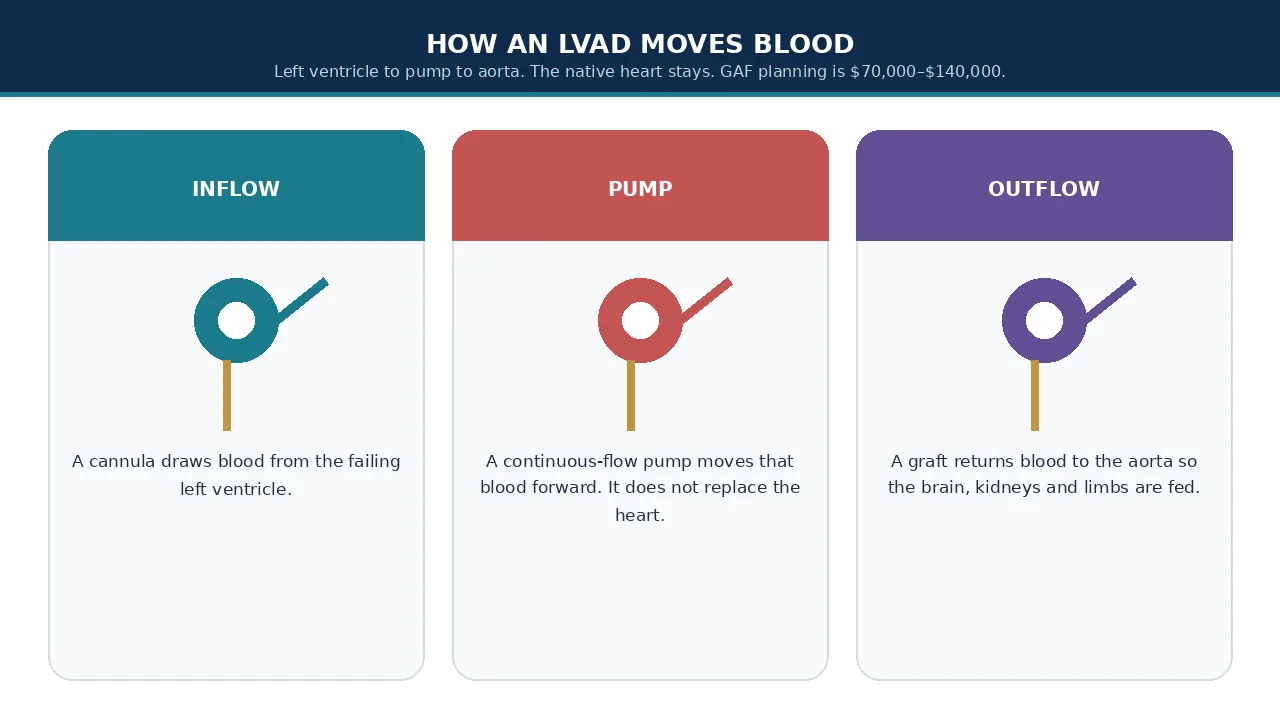
- An inflow cannula draws blood from the left ventricle.
- The implanted pump moves the blood forward.
- An outflow graft carries blood from the pump into the aorta.
- A driveline passes through the skin and connects the implanted pump to an external controller and power source.
- Batteries allow the patient to operate the system outside the hospital.
The LVAD therefore does not simply “replace the heart.” It supports circulation by assisting the failing left ventricle.
When is an LVAD recommended?
LVAD implantation is generally considered for patients with advanced heart failure who remain severely symptomatic or have inadequate circulation despite appropriate medical and device-based treatment.
The decision is complex. A patient may be evaluated when there is evidence of progressive heart failure, repeated hospitalizations, inability to tolerate guideline-directed therapy, worsening organ function caused by poor circulation, or other features suggesting advanced disease.
The 2023 ISHLT mechanical circulatory support guideline emphasizes structured assessment of patient selection, timing, risk management, perioperative care and long-term outpatient management.
An LVAD may be considered when:
- Heart failure has become advanced or refractory.
- The left ventricle has severely reduced pumping ability.
- Symptoms remain significant despite medical treatment.
- The patient has recurrent admissions for worsening heart failure.
- There is evidence of inadequate cardiac output.
- A heart transplant is being considered but cannot occur immediately.
- The patient may benefit from long-term mechanical circulatory support.
- The multidisciplinary team believes the potential benefits outweigh the risks.
Not every person with a low ejection fraction needs an LVAD. Ejection fraction alone does not determine LVAD candidacy.
Ask whether the team is naming an LVAD or something else
Why is an LVAD implanted?
The treatment goal is particularly important when planning LVAD therapy.
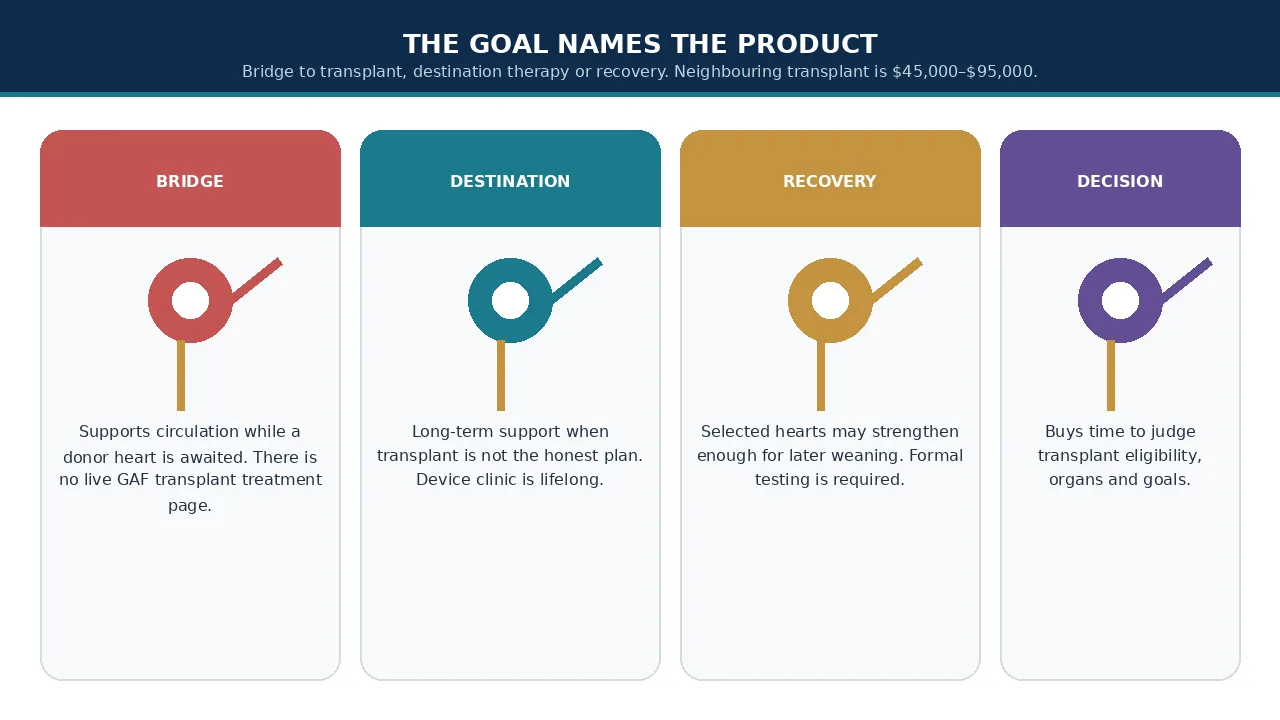
Bridge to transplant. A bridge-to-transplant LVAD supports circulation while a suitable donor heart is being awaited. Neighbouring heart transplant surgery is $45,000–$95,000. There is no live GAF heart-transplant treatment page.
Destination therapy. Some patients with advanced heart failure are not suitable candidates for heart transplantation. For appropriately selected patients, an LVAD may be implanted as long-term or destination therapy rather than as a temporary bridge to transplantation.
Bridge to recovery. In selected situations, mechanical support may provide time for the heart to recover sufficiently to allow reduction or removal of mechanical support. This is highly dependent on the underlying cause of heart failure and the patient's response to treatment.
Bridge to decision. Sometimes the patient's immediate condition does not allow the medical team to determine the definitive long-term strategy. Mechanical circulatory support can provide time to assess recovery potential, transplant eligibility, organ function and other factors.
Who may be evaluated for LVAD implantation?
An LVAD evaluation is usually comprehensive rather than based on one test.
The multidisciplinary team may include advanced heart failure cardiologists, cardiothoracic surgeons, cardiac anesthesiologists, intensivists, LVAD coordinators, perfusionists, pharmacists, nurses, rehabilitation specialists, nutrition specialists, psychosocial professionals and transplant specialists when appropriate.
The purpose is to determine whether the patient is likely to tolerate implantation, manage the device and benefit from mechanical circulatory support.
Tests before LVAD surgery
Echocardiography assesses left and right ventricular function, valve disease, chamber dimensions, intracardiac abnormalities and pressure-related findings.
Cardiac catheterization may assess cardiac output, filling pressures, pulmonary pressures, pulmonary vascular resistance and coronary anatomy.
Blood tests may assess hemoglobin, platelets, kidney function, liver function, electrolytes, coagulation, blood group, infection markers and nutritional status.
Imaging may include chest X-ray, CT and vascular imaging.
Assessment of other organs matters because severe kidney, liver, lung or neurological dysfunction may influence both the risks and the expected benefits of LVAD therapy.
Infection screening. Potential infections should be identified and appropriately treated before implantation where possible.
Psychosocial and caregiver assessment. Living with a durable LVAD requires daily device management: battery changes, controller management, alarm response, driveline dressing, infection prevention, emergency procedures, medication management and follow-up.
The ISHLT guidelines specifically recognize patient optimization, consent, inpatient care and outpatient management as important components of durable mechanical circulatory support.
Send echo, cath and organ-function reports
How is LVAD surgery performed?
LVAD implantation is performed in a specialized cardiac operating room.
The exact surgical technique depends on the device, anatomy, previous operations and the surgical team's approach.
Step 1: Anaesthesia. The patient receives general anaesthesia and is continuously monitored.
Step 2: Surgical access. The surgeon obtains access to the heart and major blood vessels.
Step 3: Connecting the inflow cannula. The inflow portion of the LVAD is positioned so that blood can be drawn from the left ventricle.
Step 4: Pump placement. The mechanical pump is positioned within the chest according to the device design and patient's anatomy.
Step 5: Connecting the outflow graft. The outflow graft is connected to the aorta so that blood assisted by the LVAD can enter the systemic circulation.
Step 6: Driveline placement. The driveline is tunnelled through the body and exits through the skin. It connects the implanted pump to the external controller and power system.
Step 7: Starting the device. The LVAD is activated and the surgical team checks pump function, blood flow, filling pressures, ventricular function, outflow graft function, bleeding and haemodynamic stability.
Step 8: ICU transfer. After surgery, the patient is transferred to a cardiac intensive care unit for close monitoring.
The 2023 ISHLT guidelines include specific recommendations covering intraoperative and immediate postoperative management as well as inpatient and outpatient care.
How does an LVAD work?
A simple way to understand an LVAD is:
Left ventricle → LVAD inflow cannula → mechanical pump → outflow graft → aorta → body
The LVAD assists blood flow rather than functioning as a conventional biological heart.
Modern durable LVADs are generally continuous-flow devices. The patient may therefore not have a traditional palpable pulse in the way someone without an LVAD does.
The clinical team uses other parameters and assessments to evaluate circulation and device function.
Types of LVAD and mechanical circulatory support
Mechanical circulatory support is a broad field.
Devices can be classified according to temporary versus durable support, left-, right- or biventricular support, implantable versus extracorporeal systems and intended duration of support.
For durable LVAD therapy, device technology has evolved considerably over the last two decades. The 2023 ISHLT guideline update incorporates modern durable mechanical circulatory support systems.
HeartMate 3 is one example of a modern durable LVAD system used for short- and long-term mechanical circulatory support in selected patients, including bridge-to-transplant, recovery and destination therapy pathways.
Device availability in India should always be confirmed with the treating hospital because equipment, regulatory status, inventory and clinical programs can change. There is no live GAF HeartMate-only treatment page. Named lists sit on LVAD implantation.
LVAD surgery vs heart transplant
LVAD and heart transplantation are not simply interchangeable treatments.
| Feature | LVAD | Heart transplant |
|---|---|---|
| Treatment type | Mechanical circulatory support | Donor organ transplantation |
| Uses patient's heart | Yes, with mechanical assistance | No |
| Donor organ required | No | Yes |
| Can be bridge to transplant | Yes | No |
| Can be long-term therapy | Yes, in selected patients | Yes |
| Major surgery | Yes | Yes |
| Long-term medication | Device-related medicines and often anticoagulation | Lifelong immunosuppression |
| Device management | Required | No external LVAD system |
| Neighbouring GAF sheet | LVAD implantation $70,000–$140,000 | Heart transplant $45,000–$95,000 |
For some patients, an LVAD is used specifically because transplantation is not immediately available or is not appropriate.
The choice depends on medical eligibility, disease severity, transplant assessment, comorbidities and patient goals. There is no live GAF heart-transplant treatment page.
Ask whether the honest product is LVAD or listing
LVAD surgery risks and complications
LVAD implantation is major surgery, and long-term LVAD therapy has device-specific risks.
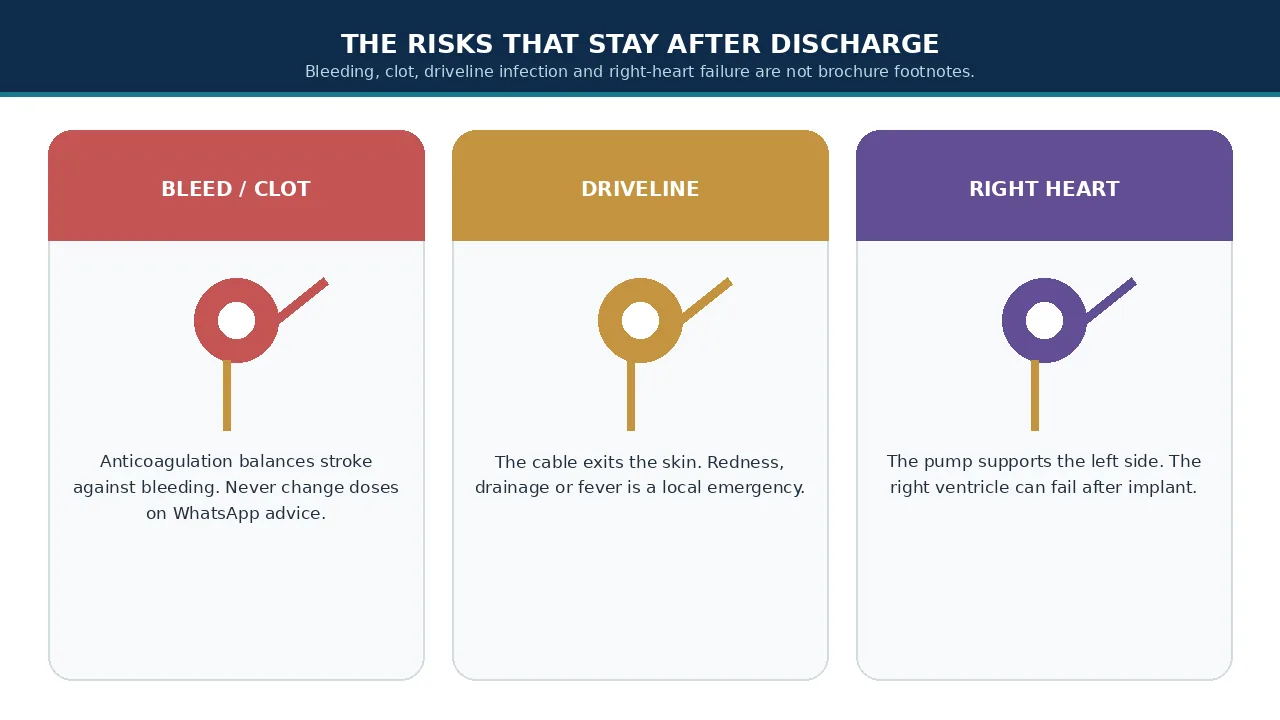
Bleeding. Bleeding can occur during or after implantation. Anticoagulation and the interaction between blood and a mechanical pump can also contribute to bleeding risk.
Blood clots and stroke. Blood clots can interfere with pump function or travel to the brain and cause stroke. Antithrombotic management is therefore an important part of long-term LVAD care.
Infection. The driveline creates a connection between the implanted system and the external environment. Infection may occur around the driveline or more deeply within the device system. Careful driveline hygiene and dressing technique are therefore essential.
Right heart failure. An LVAD supports the left side of the circulation. If the right ventricle cannot adequately pump blood through the lungs after LVAD implantation, right-heart failure may develop. Some patients require medications or temporary right-sided mechanical support.
Arrhythmias. Patients with advanced heart failure may already have abnormal heart rhythms. Arrhythmias can also occur after LVAD implantation. Neighbouring ICD implantation is $8,000–$18,000 when a defibrillator is already part of the patient's care.
Kidney injury. Kidney function can deteriorate around the time of major cardiac surgery or because of changes in circulation.
Device malfunction. Mechanical complications can involve the pump, cannulae, outflow graft, driveline, controller or power source. Any suspected device malfunction requires prompt assessment by the LVAD team.
Recovery after LVAD surgery
Recovery after LVAD implantation is gradual.
Patients commonly spend time in cardiac ICU, a step-down or cardiac ward, rehabilitation and outpatient LVAD follow-up.
GAF LVAD implantation planning is typically 3–8 weeks with device training. Patients with complications or significant preoperative weakness may require longer hospitalization.
LVAD rehabilitation
Physical rehabilitation is an important part of recovery.
The patient may gradually progress from bed mobility to sitting, standing, walking, supervised exercise and independent daily activities.
Cardiac rehabilitation may help improve strength, endurance, mobility, confidence and ability to perform daily activities.
There is no live GAF cardiac-rehabilitation treatment page. Rehab is usually quoted with the hospital stay or as a separate hospital service.
Life after LVAD
A durable LVAD becomes part of the patient's daily routine.
Patients and caregivers need to become comfortable with the equipment before discharge.
Battery management. The patient needs adequate battery power and backup equipment. Spare batteries should be available when leaving home.
Controller management. The controller provides information about the LVAD and can issue alarms. The patient and caregiver must understand what different alarms mean and what action to take.
Driveline care. The skin exit site must be kept clean and protected according to the LVAD team's instructions.
Medication. Many durable LVAD patients require blood-thinning treatment and other cardiovascular medications. Medication must be taken exactly as prescribed because both clotting and bleeding can be dangerous.
Follow-up. Regular LVAD clinic appointments are essential and may include device interrogation, blood tests, medication adjustment, blood-pressure monitoring, echocardiography, driveline assessment, assessment of heart failure symptoms and evaluation for complications.
Can LVAD patients travel?
Some patients with stable durable LVADs can travel. However, travel requires planning.
Before international travel, the patient should discuss fitness to travel, destination, availability of emergency cardiac care, LVAD centre support, battery requirements, spare equipment, medication supply, travel insurance, medical records and emergency contact information.
Patients should not travel internationally immediately after implantation unless their treating team considers it appropriate.
For international patients receiving an LVAD in India, it is particularly important to plan post-discharge follow-up and emergency support before returning home.
LVAD for international patients in India
India is an established destination for complex cardiac care, but LVAD treatment is different from many routine surgical procedures.
Before travel. Send recent echocardiography, cardiac catheterization reports if available, discharge summaries, medication list, previous cardiac surgery records, CT/MRI reports where relevant, blood test results, heart failure history, ICD/CRT information and transplant evaluation documents if applicable.
During treatment. The patient may require specialist consultation, advanced heart-failure evaluation, LVAD assessment, preoperative optimization, device procurement, surgery, ICU care, ward recovery, rehabilitation and device and caregiver training.
Before returning home. The patient should ideally have a written discharge plan, medication and anticoagulation instructions, driveline-care instructions, device documentation, emergency instructions, backup equipment, a follow-up schedule, contact details for the implanting LVAD centre and a plan for local medical support after returning home.
Share records before anyone books travel
WhatsApp coordination for planned, stable cases is available at +91 90443 46292.
LVAD surgery cost in India
The cost of LVAD implantation in India varies substantially because the mechanical pump, accessories, ICU stay, rehabilitation, complications and the patient's underlying condition all change the bill.
GAF LVAD implantation planning is $70,000–$140,000, typically 3–8 weeks with device training. Comparable US planning is $250,000–$600,000. Brochure rupee figures are not international self-pay quotations and are not used on this page.
| Neighbouring GAF sheet | Planning range | Typical stay |
|---|---|---|
| LVAD implantation | $70,000–$140,000 | 3–8 weeks with device training |
| Heart transplant surgery | $45,000–$95,000 | 6–12 weeks nearby after listing |
| ICD implantation | $8,000–$18,000 | 1–4 nights |
| CRT/CRT-D implantation | $10,000–$22,000 | 2–5 nights |
| Pacemaker implantation | $3,500–$9,000 | 1–3 nights |
| CABG | $5,500–$14,000 | 7–14 nights |
Ask the hospital whether the quotation includes the LVAD device, accessories, surgeon fees, anaesthesia, operating-room charges, perfusion, ICU stay, hospital room, investigations, blood products, medicines, anticoagulation, device training, rehabilitation, follow-up and management of expected complications.
Request an itemised LVAD estimate
Factors that can make LVAD treatment more complex
LVAD implantation may become more challenging in patients with severe right-heart dysfunction, significant kidney or liver disease, pulmonary hypertension, active infection, severe peripheral vascular disease, previous major cardiac surgery, significant bleeding risk, frailty, severe malnutrition or certain anatomical abnormalities.
These factors do not automatically mean that LVAD implantation is impossible. Instead, they form part of the multidisciplinary risk assessment.
What is the success rate of LVAD surgery?
There is no single LVAD success rate that applies to every patient.
Outcomes depend on age, cause of heart failure, severity of illness, timing of implantation, right-heart function, kidney and liver function, infection risk, device type, surgical centre experience, postoperative management and long-term adherence.
Clinical studies have demonstrated substantial advances in durable LVAD technology. Results from clinical trials should not be interpreted as an individual patient's expected outcome.
The treating LVAD team should provide the most relevant estimate after reviewing the patient's clinical information.
How long does an LVAD last?
A durable LVAD is designed for long-term mechanical circulatory support, but its actual duration of use varies.
Some patients receive an LVAD while waiting for transplantation. Others may remain on LVAD support as long-term therapy.
Device longevity can depend on device model, patient factors, device-related complications, infection, pump or component problems and clinical strategy.
The objective is not simply to keep the pump running for a predetermined number of years. The LVAD team continually evaluates the patient's health, device performance and overall treatment goals.
Can the LVAD be removed?
In selected patients, heart function may improve sufficiently to consider LVAD removal.
This is not common for every patient and depends heavily on the underlying cause of heart failure and evidence of meaningful myocardial recovery.
A patient should never assume that an improvement in symptoms means the LVAD can be removed. Formal testing by the LVAD team is required.
LVAD and anticoagulation
Blood-thinning therapy is an important component of care for many durable LVAD patients.
Blood comes into contact with a mechanical circulatory system, creating a risk of clot formation. At the same time, excessive anticoagulation can increase bleeding risk.
Therefore, LVAD teams carefully balance thrombosis risk against bleeding risk.
Patients should never change anticoagulation doses without speaking to their treating team.
Warning signs after LVAD implantation
An LVAD patient should know when to seek urgent medical attention.
Potential warning signs include sudden weakness, difficulty speaking, facial drooping, new severe headache, sudden loss of consciousness, severe shortness of breath, chest pain, significant bleeding, black or bloody stools, persistent vomiting of blood, fever, redness or drainage around the driveline, sudden swelling, repeated device alarms, suspected power failure, controller problems and unusual pump readings.
A suspected stroke, major bleeding, severe breathing difficulty, unconsciousness or serious device alarm should be treated as an emergency in a local emergency department, not as a WhatsApp message.
Patients should carry their LVAD emergency information and follow the instructions provided by their implant centre.
What should an LVAD patient keep with them?
Patients commonly need access to the LVAD controller, fully charged batteries, backup batteries, a battery charger, emergency power supply, driveline dressing supplies, medication, LVAD identification information, emergency contact information and implant centre details.
Exact equipment depends on the LVAD system.
Questions to ask the LVAD team before surgery
Before consenting to implantation, patients and families should consider asking:
- Why do I need an LVAD now?
- What happens if I do not receive an LVAD?
- Is the proposed strategy bridge-to-transplant, destination therapy or another pathway?
- Am I being evaluated for a heart transplant?
- Which LVAD system is being proposed?
- Why is this device appropriate for me?
- What are my individual risks?
- How is my right-heart function?
- What is my kidney and liver function?
- How long might I remain in hospital?
- What complications are most relevant in my case?
- What will I need to learn before discharge?
- Who will manage my LVAD after I return home?
- What happens if the device alarms?
- Where should I go in an emergency?
- How often will I need follow-up?
- What medications will I need?
- What are the estimated treatment costs?
- What costs are excluded from the quotation?
- If I am an international patient, when can I safely travel home?
Send those answers with the echo and cath
Choosing an LVAD centre in India
For LVAD treatment, the most useful question is not simply which hospital is famous.
The more relevant question is whether the centre can provide the complete mechanical-circulatory-support pathway: advanced heart-failure expertise, experienced cardiothoracic surgery, a dedicated cardiac ICU, an LVAD coordinator, 24/7 emergency support, a transplant evaluation pathway when listing is the goal, long-term device follow-up and international-patient coordination.
Start with live GAF cardiac surgery hospitals in Delhi NCR, Mumbai, Bengaluru, Chennai and Hyderabad rather than a brochure that lists every Indian metro.
LVAD treatment journey in India
A typical international patient's pathway may look like:
- Medical records submitted
- Advanced heart-failure specialist review
- Travel and hospital planning
- In-person evaluation in India
- Detailed LVAD candidacy assessment
- Device and treatment strategy discussion
- Preoperative optimization
- LVAD implantation
- Cardiac ICU recovery
- Hospital rehabilitation
- Device and caregiver training
- Discharge planning
- Follow-up and device monitoring
- Long-term LVAD care or transplant pathway where applicable
The exact timeline varies significantly according to the patient's clinical condition.
Frequently asked questions
Is LVAD surgery available in India? Yes. Advanced cardiac centres in India perform mechanical circulatory support procedures, although the availability of specific LVAD systems and dedicated programs varies between hospitals.
Who is a candidate for an LVAD? Candidates are generally patients with advanced heart failure who remain severely affected despite appropriate treatment and who are considered suitable for durable mechanical circulatory support after multidisciplinary assessment.
Is LVAD a permanent treatment? It can be. Some patients receive an LVAD as destination therapy, while others receive it as a bridge to heart transplantation or potentially recovery.
Can an LVAD patient live at home? Yes. Selected patients with durable LVADs can be discharged home after adequate recovery and training. They need reliable access to power, medications, device supplies and specialist follow-up.
Can an LVAD patient walk and exercise? Many stable patients participate in physical rehabilitation and gradually resume activities under medical guidance.
Can an LVAD patient travel by air? Some stable LVAD patients can travel by air, but travel should be planned with the LVAD team.
Does an LVAD have a battery? Durable LVAD systems generally connect to external power sources such as batteries and a controller.
Does an LVAD make the heart normal? No. An LVAD supports circulation by mechanically assisting the failing left ventricle. It does not cure every underlying cause of heart failure.
Is LVAD the same as a pacemaker? No. A pacemaker primarily treats abnormal heart rhythms. An LVAD is a mechanical pump that supports blood circulation. Named pacing lists sit on the pacemaker page.
Is LVAD the same as ECMO? No. ECMO is generally used as temporary extracorporeal cardiopulmonary support. A durable LVAD is an implanted system designed for longer-term support. There is no live GAF ECMO treatment page.
What are the biggest risks of LVAD surgery? Important risks include bleeding, infection, stroke or other clot-related complications, right-heart failure, arrhythmias, kidney injury and device malfunction.
How long will I stay in the hospital after LVAD surgery? GAF planning is typically 3–8 weeks with device training. Some patients require substantially longer hospitalization.
How much does LVAD surgery cost in India? GAF Healthcare planning for LVAD implantation is $70,000–$140,000. Neighbouring heart transplant is $45,000–$95,000. An itemized quotation after evaluation is required.
Is the LVAD device included in the surgery cost? Not necessarily in every advertised package. Patients should request an itemized quotation that clearly states whether the device, controller, batteries, ICU, medicines, rehabilitation and follow-up are included.
Can an LVAD patient later receive a heart transplant? Yes, an LVAD can be used as a bridge to transplantation for appropriately selected patients. Neighbouring heart-transplant planning is $45,000–$95,000.
Can the LVAD be removed? In selected patients who demonstrate meaningful cardiac recovery, removal may be considered. This requires formal evaluation by the treating LVAD team.
Which city in India is best for LVAD implantation? There is no single best city. Delhi NCR, Mumbai, Bengaluru, Chennai and Hyderabad are live GAF catalog cities.
When should I go to an emergency department? Sudden weakness, difficulty speaking, facial drooping, major bleeding, severe breathlessness, unconsciousness, driveline infection signs or a serious device alarm belongs in a local emergency department, not in a WhatsApp message.
Is there a GAF heart-transplant or ECMO treatment page? No. Heart-transplant, ECMO and destination-therapy-only treatment pages are not live. Use this page plus the named LVAD and heart-transplant cost sheets.
Key takeaways
- LVAD is a mechanical pump used to support circulation in selected patients with advanced heart failure.
- It assists the left ventricle by moving blood toward the aorta.
- LVAD therapy may be used as bridge to transplant, bridge to recovery/decision or destination therapy.
- Implantation requires major cardiac surgery and specialized postoperative care.
- Important complications include bleeding, infection, stroke, blood clots, right-heart failure, arrhythmias, kidney injury and device malfunction.
- Patients require extensive education about batteries, controllers, alarms, driveline care and medications before discharge.
- GAF LVAD implantation planning is $70,000–$140,000, typically 3–8 weeks with device training.
- International patients should plan not only the operation but also post-discharge LVAD support after returning home.
Planned questions can also go to WhatsApp at +91 90443 46292. Emergency symptoms still belong in a local emergency department.
Related GAF Healthcare pages
- Heart Valve Replacement Surgery in India
- CABG Surgery in India
- Pacemaker Implantation in India
- ICD Device Implantation in India
- Aortic Dissection Repair Surgery in India
- Ventricular Septal Defect (VSD) Surgery in India
- TAVR in India
- LVAD implantation cost
- Heart transplant surgery cost
- Cardiac surgeons in India
- Cardiac surgery hospitals in India
Heart-transplant, ECMO, destination-therapy-only and cardiac-rehabilitation treatment pages are not live on this site. Use this page plus the named modality sheets.
Sources
- International Society for Heart and Lung Transplantation (ISHLT) — 2023 Guidelines for Mechanical Circulatory Support.
- American Heart Association — Implantable Medical Devices / LVAD patient information.
- Mayo Clinic — Ventricular Assist Device: procedure, risks, recovery and long-term care.
- Cleveland Clinic — Left Ventricular Assist Devices and mechanical circulatory support.
- FDA — HeartMate 3 Left Ventricular Assist System approval information.
- ISHLT — Consensus statement on haemocompatibility-related adverse events in durable continuous-flow VADs.
- GAF Healthcare LVAD implantation cost sheet — LVAD Implantation.
- GAF Healthcare heart transplant surgery cost sheet — Heart Transplant Surgery.
- ISHLT/HFSA — Guideline on acute mechanical circulatory support.
- ISHLT — Consensus document on prevention and management of mechanical circulatory support infections.
Medical disclaimer
This article is intended for general educational purposes and does not replace consultation with a qualified cardiologist, advanced heart-failure specialist or cardiothoracic surgeon.
LVAD implantation is a complex treatment. Candidacy, device selection, surgical approach, expected outcomes, risks, duration of hospitalization and cost must be determined individually after reviewing the patient's medical condition.
For an international patient considering LVAD treatment in India, a specialist review of current medical records should be completed before making travel or treatment decisions. A suspected stroke, major bleed, severe breathlessness or device alarm belongs in a local emergency department.
Treatment Process
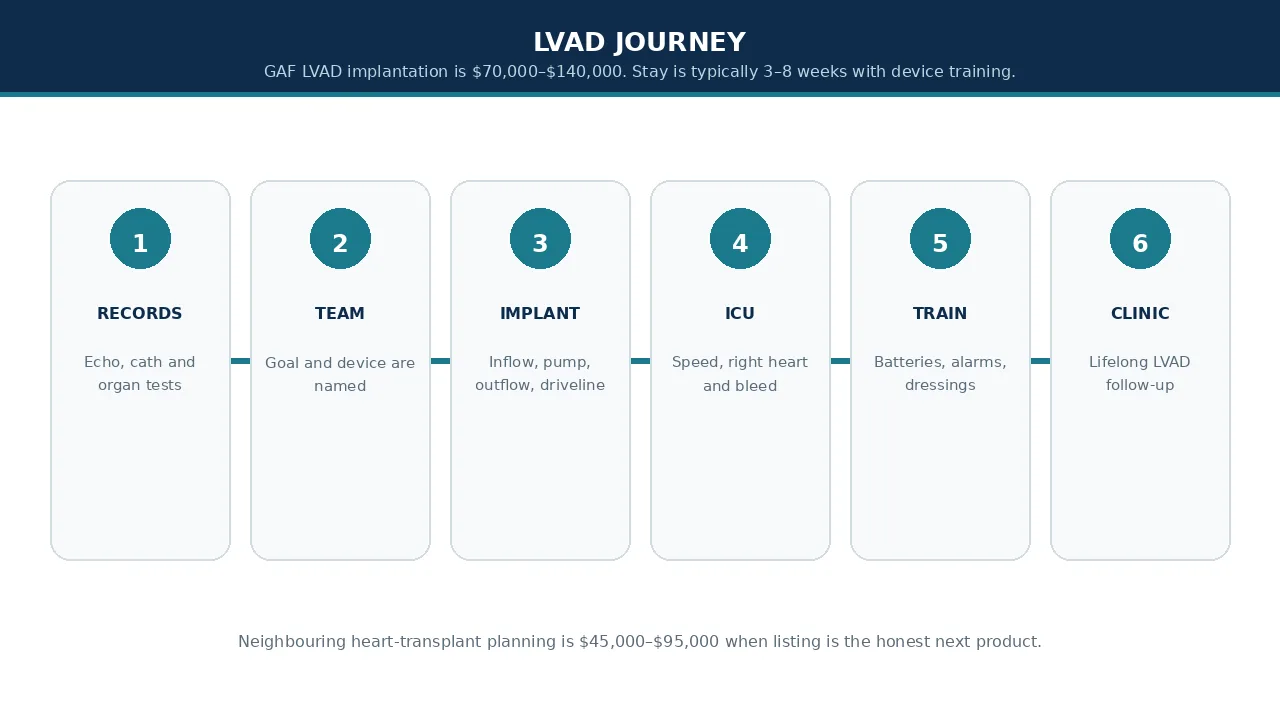
- 1
Share records
The patient provides echocardiography, catheterization, organ-function tests and heart-failure notes before anyone books travel.
- 2
Advanced-failure review
An LVAD team reviews whether the case is bridge to transplant, destination therapy, recovery or decision.
- 3
Name the device and goal
The team writes the pump, accessories and caregiver training plan after right-heart and psychosocial review.
- 4
Itemized estimate
GAF LVAD implantation planning is $70,000–$140,000. Neighbouring heart transplant is $45,000–$95,000.
- 5
Travel if fit
Stable planned cases travel after records review. Stroke signs, major bleeding or device alarms are a local emergency.
- 6
Repeat essential tests
The receiving unit confirms echo, cath, infection screen and caregiver readiness after arrival.
- 7
Implant the named pump
Inflow, pump, outflow and driveline proceed only after the device and goal are named.
- 8
ICU, ward and training
Speed, right-heart function, bleeding, batteries, alarms and driveline dressings are watched before discharge.
- 9
Lifelong LVAD clinic
The patient leaves with anticoagulation, emergency contacts, spare equipment and a home-centre plan.