
Signs of congenital heart disease in babies are changes in colour, breathing, feeding, energy or growth that can appear when a structural heart problem affects circulation. Some defects cause obvious symptoms soon after birth. Others stay quiet for weeks, or cause no symptoms at all.
These signs do not prove a heart defect. Lung infections, feeding problems and other illnesses can look similar. A clinician has to examine the baby and, when needed, arrange an echocardiogram.
Seek emergency medical care immediately if your baby has blue or grey lips or tongue, severe breathing difficulty, collapses, becomes unresponsive or deteriorates suddenly. Do not wait for a routine appointment, and do not send a message instead of getting emergency care.
If a defect is confirmed, the treatment overview is Pediatric Heart Surgery in India. How doctors choose between an operation and a catheter procedure is explained in open-heart surgery vs catheter treatment for children.
Families comparing pediatric cardiologists can start with Delhi NCR, Mumbai, Bengaluru, Chennai and Hyderabad. Hospital lists use the same cities: India, Delhi NCR, Mumbai, Bengaluru, Chennai and Hyderabad.
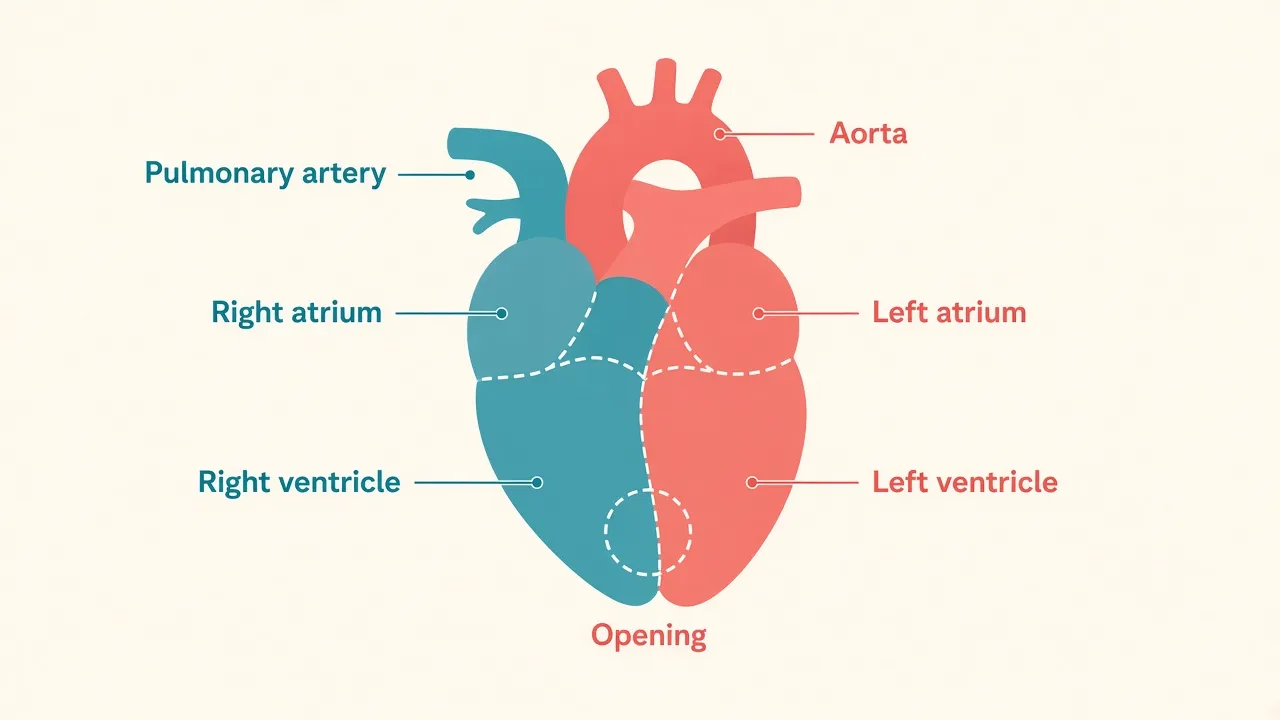
1. What Is Congenital Heart Disease?
Congenital heart disease is a general term for structural differences in the heart or the major blood vessels that develop before birth.
The heart has four chambers, valves that direct blood flow, and major vessels that carry blood to the lungs and the rest of the body. These structures develop together during pregnancy. When a part develops differently, blood may cross an abnormal opening, meet an obstruction, or follow a different route.
Depending on the type and severity, that can affect oxygen levels, circulation, heart function or growth. Some defects are mild and only need monitoring. Others need medicine, a catheter procedure or heart surgery. A smaller group of critical defects needs treatment urgently after birth.
The word congenital means the condition is present at birth. It does not mean the symptoms are visible immediately.
How common are congenital heart defects?
Congenital heart defects are among the most common birth defects. The exact numbers vary by population, definition and which defects are counted. Some are found during pregnancy. Others are found in the newborn period, at a routine examination, or later in childhood.
The practical point for parents is that not every heart defect produces visible symptoms, and severity cannot be judged from a baby's appearance alone.
2. What Are the Early Signs of Congenital Heart Disease in Newborns?
The earliest signs depend on the defect and how it changes blood flow. Some babies become unwell within hours or days. Others develop symptoms over weeks or months. Watch breathing, colour, feeding, energy and growth.
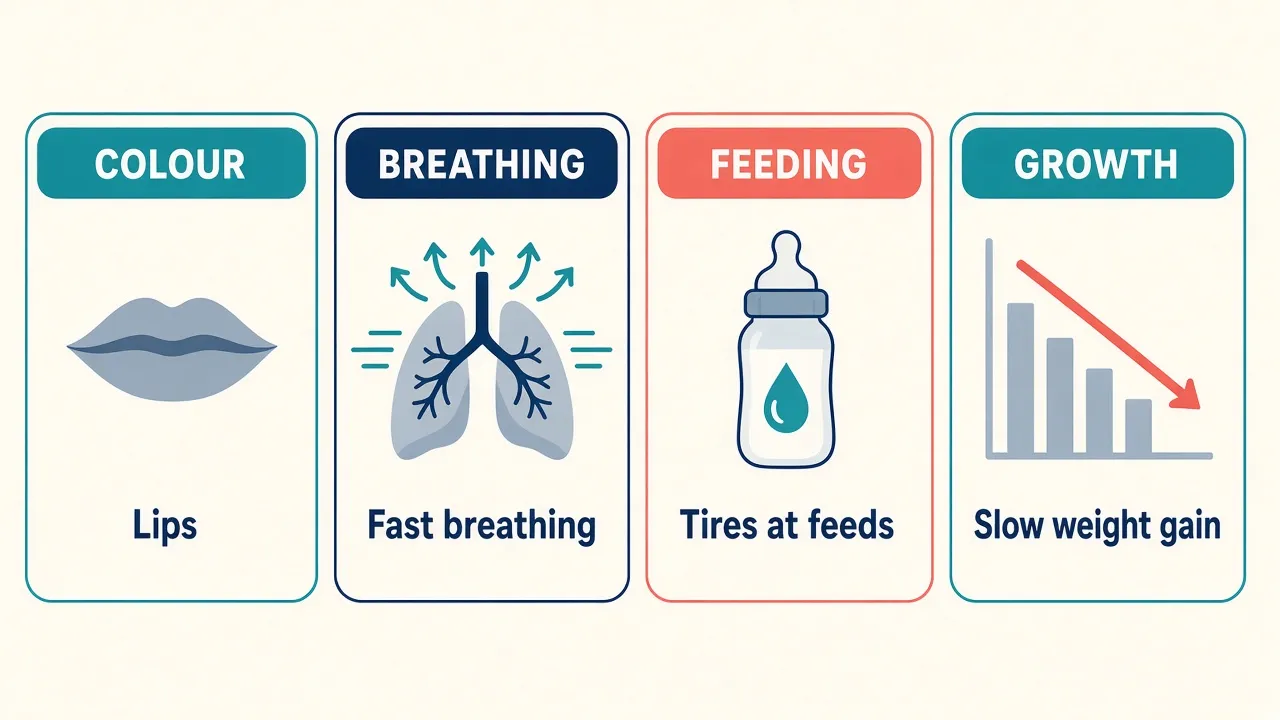
Blue or grey lips, tongue or skin
A bluish or grey colour can be a sign of low oxygen in the blood. Look at the lips, tongue, gums and the inside of the mouth. On darker skin, colour changes are often easier to see on the lips, gums, tongue, palms or soles than on the rest of the skin.
Blue or grey skin only around the mouth can have other explanations. Blue or grey lips or tongue, especially with breathing difficulty, poor feeding or unusual sleepiness, needs urgent assessment. Do not use photographs or online colour charts to decide whether the oxygen level is safe.
Fast or difficult breathing
- Rapid breathing that continues when the baby is calm.
- Skin pulling in between or beneath the ribs.
- Flaring of the nostrils.
- Grunting with breathing.
- Needing frequent pauses to breathe during a feed.
Lung infections and other illnesses also cause breathing problems. The cause cannot be decided from the symptom alone. Severe breathing difficulty, gasping, marked chest retractions, or blue or grey lips or tongue, needs emergency care.
Difficulty feeding
Feeding is hard work for a young baby. Some infants with a significant heart defect tire because feeding adds demand on breathing and circulation. A baby may stop repeatedly, take much longer than usual, finish exhausted, sweat, breathe fast while drinking, or fail to gain weight despite regular feeds.
Occasional feeding trouble has many causes, including latch problems and reflux. Persistent difficulty together with sweating, fast breathing or poor growth deserves a prompt assessment.
Poor weight gain
In some defects the heart works harder, or the lungs receive extra blood. The baby may use more energy, tire during feeds, or take too little milk. Parents may see slow gain or a fall away from the earlier growth pattern. Poor weight gain alone does not diagnose heart disease. A clinician should look at feeding, measurements, hydration and other causes together.
Excessive sweating during feeding
Some babies with significant heart strain sweat during feeds even when the room is not hot. Sweating often sits alongside rapid breathing, tiredness or slow weight gain. Sweating by itself is not proof of a heart defect. Repeated sweating during feeds, with other symptoms, should be discussed with a pediatrician.
Unusual sleepiness or low energy
- Being unusually difficult to wake for feeds.
- A weaker suck.
- Less movement or less responsiveness.
- Unusual limpness.
- Becoming less alert together with breathing or colour changes.
A baby who is unresponsive, extremely difficult to wake, or suddenly very weak needs emergency care.
A heart murmur
A murmur is an extra sound heard with a stethoscope. Some murmurs are harmless. Others point to a structural problem. A murmur does not automatically mean surgery. The clinician may advise observation, another examination, or an echocardiogram. Ask what the murmur means, whether a specialist is needed, and when the next review should be.
Weak pulses, pallor or swelling
Some serious defects reduce blood flow to the body. A baby may look unusually pale, feel cool in the hands and feet, or show other signs of poor circulation. These findings also occur in other serious illnesses. Pallor or cool skin with marked sleepiness, breathing difficulty or sudden deterioration needs emergency care.
Fluid can collect in some children with significant heart problems. A newly swollen abdomen, especially with breathing difficulty, feeding problems or poor growth, should be assessed. Swelling is not present in every congenital heart defect and has other causes.
3. Warning Signs: When Should Parents Seek Medical Help?
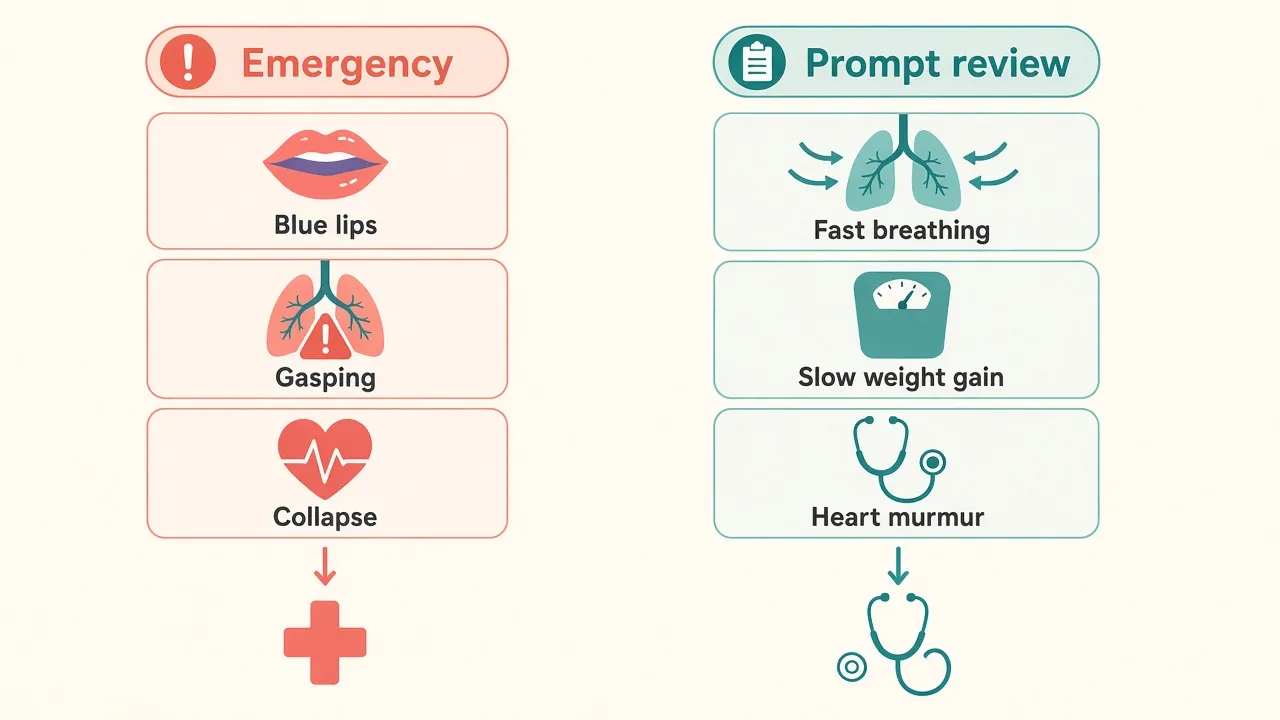
| What you notice | What to do |
|---|---|
| Blue or grey lips or tongue | Seek emergency care, especially if the colour change is new or persistent. |
| Severe breathing difficulty, gasping or marked chest retractions | Go to the nearest emergency department. |
| Collapse, unresponsiveness or sudden marked weakness | Seek emergency care immediately. |
| Sudden deterioration in colour, breathing or responsiveness | Treat it as an emergency. |
| Repeated fast breathing or sweating during feeds | Arrange a prompt assessment, especially if feeding is affected. |
| Persistent feeding difficulty or poor weight gain | Arrange a pediatric assessment without delay. |
| A newly detected heart murmur | Follow the clinician's plan for tests or referral. |
| New symptoms in a baby with a known heart defect | Contact the treating team. Use emergency care for severe symptoms. |
Do not wait for every symptom on this list. A baby can have a serious defect without showing all of them. If you are worried about breathing, colour or responsiveness, get professional help rather than trying to diagnose the problem at home.
4. Why Do Some Babies Show Symptoms Immediately While Others Do Not?
Timing depends on the defect and how it affects circulation. Some defects reduce oxygen from birth and cause cyanosis or serious illness soon after delivery. Others let blood circulate reasonably well at first and then place extra demand on the heart as the baby grows. Symptoms may build over the first weeks.
Some small openings cause no obvious symptoms and can close naturally. Other defects stay important even when a baby looks well. Some serious conditions appear as the circulation changes after birth: a newborn can look healthy and then deteriorate. That is one reason newborn examination and recommended screening still matter when parents have no immediate worry.
5. Which Congenital Heart Defects Can Cause These Symptoms?
Different defects can cause the same signs, such as fast breathing or poor feeding. One diagnosis can also look different from one baby to the next. A specialist has to name the defect. These examples are not a checklist for self-diagnosis.
Atrial septal defect (ASD)
An atrial septal defect is an opening between the upper chambers. Many small ASDs cause no noticeable symptoms in infancy. Larger defects can affect circulation and may need monitoring or treatment. The procedure page is ASD closure in India.
Ventricular septal defect (VSD)
A ventricular septal defect is an opening between the lower chambers. A small VSD may cause few symptoms and can sometimes close. A larger defect can send extra blood to the lungs and contribute to fast breathing, sweating during feeds or poor weight gain. See VSD surgery in India.
Tetralogy of Fallot
Tetralogy of Fallot combines four abnormalities that affect blood flow to the lungs and oxygen delivery. Some babies have blue or grey colour. Timing and severity vary. These children need a specialist plan. The operation is described on TOF repair in India.
Patent ductus arteriosus
The ductus arteriosus helps circulation before birth and usually closes afterwards. If it stays open, the effect depends on its size and the baby's condition. Some ducts need no immediate procedure. Others need monitoring or closure. Read PDA closure in babies and the PDA closure page.
Transposition of the great arteries
In transposition, the two major arteries leave the heart in an abnormal connection. It can cause severe low oxygen soon after birth and may need urgent specialist treatment, often an arterial switch operation. Unexplained blue or grey lips or tongue, breathing difficulty or sudden deterioration must be assessed urgently.
Coarctation of the aorta
Coarctation is a narrowing of the aorta. Severe narrowing can disturb circulation as the newborn circulation changes. Warning signs can include poor feeding, breathing difficulty, pallor or marked sleepiness. The surgical page is coarctation repair in India.
Hypoplastic left heart syndrome
In this condition, important structures on the left side of the heart are underdeveloped. Newborns need specialist care and a planned pathway. Symptoms can appear early and become severe quickly. First-stage palliation is a different operation from closing a small opening, and the planning band is listed with the other named procedures below.
6. Can a Baby Have Congenital Heart Disease Without Any Symptoms?
Yes. Some defects cause few or no noticeable symptoms in infancy. A baby may feed well, breathe comfortably, gain weight and look healthy. The condition may be found when a clinician hears a murmur, or when imaging is done for another reason.
Some defects become clearer as the child grows. Others stay mild and need observation rather than immediate treatment. The absence of symptoms does not rule out every heart defect. Keep routine newborn and infant checks, follow recommended screening, and keep specialist appointments if a heart condition has already been named.
7. How Is Congenital Heart Disease Detected Before or After Birth?
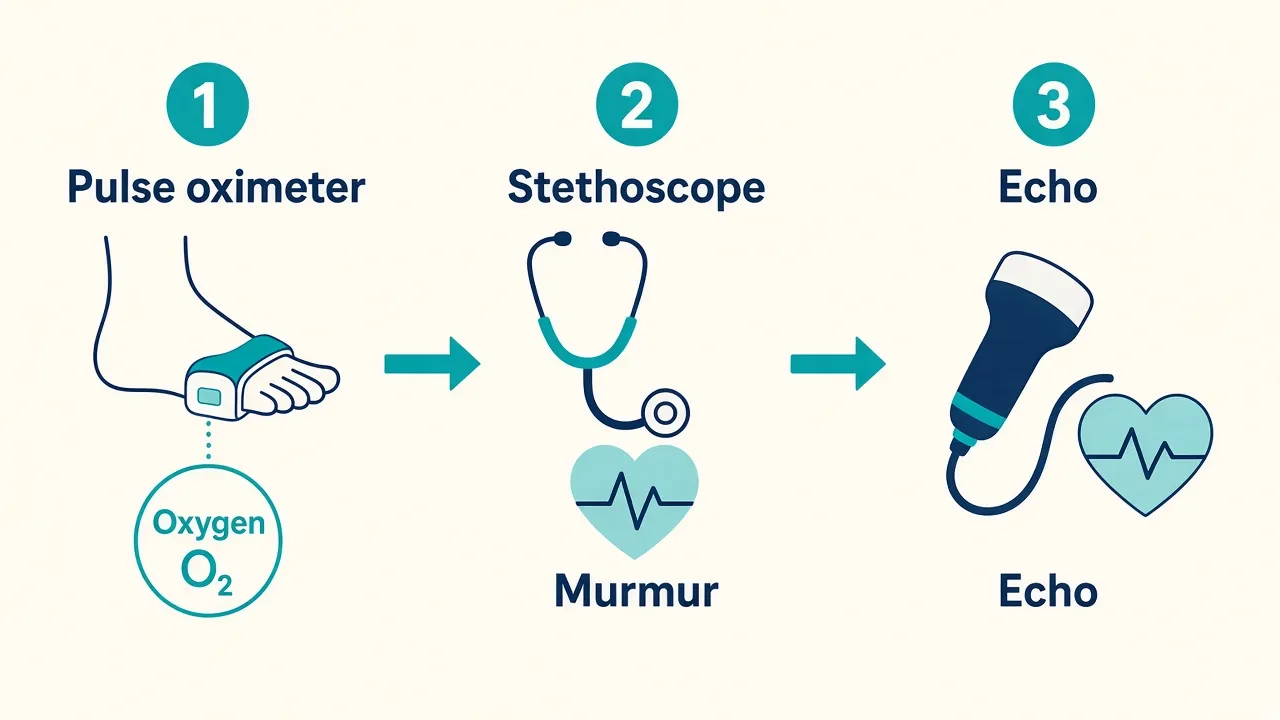
During pregnancy
Routine pregnancy ultrasound can find some structural abnormalities. If a possible defect is seen, or if there are specific risk factors, the obstetrician may recommend a fetal echocardiogram. Not every defect is visible before birth. Some are hard to see on a routine scan, and some become clearer later in pregnancy. When a significant defect is found before birth, the team can plan delivery and the assessment afterwards.
After birth
A clinician checks breathing and colour, listens to the heart and looks at circulation. Examination finds some defects. It does not find every defect, because not all of them cause an obvious murmur or a visible sign.
Pulse oximetry screening
Pulse oximetry estimates oxygen saturation with a small sensor. Newborn screening programmes use it to help find certain critical defects before a baby leaves the birth hospital. It is quick and is often done on a hand and a foot.
It is a screening test, not a complete heart examination. A baby can pass and still have a congenital heart defect. The result has to be read with the history, the examination and any symptoms.
Echocardiography and other tests
An echocardiogram uses ultrasound to show chambers, valves, major vessels and blood flow. It is a main test for confirming and describing many defects. A pediatric cardiologist may recommend it after symptoms, a murmur, a prenatal finding or another abnormal test.
- An ECG, to look at the heart's electrical activity.
- A chest X-ray, to look at the heart and lungs.
- Blood tests when they change the decision.
- CT or MRI for selected complex defects.
- Cardiac catheterisation in specific situations.
Not every child needs every test. The clinician chooses what is needed to guide the next step. If you are gathering files for a review, the second-opinion guide lists which echo images and reports to send.
8. What Happens If a Newborn Fails Pulse Oximetry Screening?
A result outside the screening range does not automatically confirm a heart defect. Low oxygen can also occur with lung conditions, infection and other problems. An abnormal result still has to be handled under the hospital's screening protocol. The team may repeat the measurement when that is appropriate and arrange further assessment.
If the baby is unwell, or the result suggests a serious problem, the assessment is urgent. Do not leave without understanding the recommendation. A normal result is reassuring in one respect and does not exclude every heart defect. Continue routine newborn care, and seek assessment if concerning symptoms appear later.
9. What Should Parents Do If They Suspect a Heart Problem?
Parents do not need to name the defect. The useful steps are to notice a change, get the right level of care, and share a clear history.
- **Decide whether it is an emergency.** Blue or grey lips or tongue, severe breathing difficulty, collapse, unresponsiveness or sudden deterioration needs emergency care now. Do not wait for a clinic, an overseas records review or a second opinion.
- **Call a pediatrician for persistent concerns.** Repeated tiring at feeds, unusually fast breathing, sweating during feeds, or weight that is not increasing as expected, needs a prompt visit. Say when it started, whether it is becoming more frequent, and whether it happens during feeding, sleep or activity.
- **Share the history.** Birth history and gestational age, pregnancy-scan concerns, any neonatal intensive care, feeding pattern and how long feeds take, weight records, oxygen readings, earlier murmurs, family history of congenital heart disease, medicines and existing diagnoses. Do not delay urgent care to collect papers.
- **Ask whether a pediatric cardiologist is needed.** Referral is reasonable when a defect is suspected or a test needs specialist interpretation.
- **Follow the plan.** That may be observation, repeat imaging, medicine, a catheter procedure or surgery. A comfortable moment does not mean a critical defect can wait.
10. What Treatment Is Available for Congenital Heart Disease?
Treatment depends on the defect, its severity, the baby's age and the effect on circulation. Open-heart surgery vs catheter treatment for children compares the two approaches. Recovery after an operation is covered in heart surgery recovery in India.
Monitoring, medicines, catheter treatment and surgery
Some mild defects are watched without an immediate procedure. The clinician should say which changes to report and how often the child is reviewed. Medicines may ease certain symptoms. They do not close or correct every structural defect. Use them only as prescribed.
Some defects can be treated with a catheter through a blood vessel, using a device, balloon or stent when the anatomy fits. Other defects need surgery to repair structure or improve blood flow. Timing ranges from urgent newborn treatment to a planned operation later in infancy or childhood. The surgeon should explain the purpose, the expected benefit, the main risks and the follow-up.
Early diagnosis lets the team understand the defect and choose the right time for treatment. For critical defects, early recognition matters because specialist care may be needed soon after birth. Early diagnosis does not mean every defect needs immediate surgery.
Planning costs in India
GAF Healthcare does not publish one price for congenital heart disease. The pediatric cardiac surgery cost directory lists planning bands for named procedures. These ranges are for planning after a diagnosis. They are not a quotation, and they are not a reason to travel before a clinician says the baby is stable.
| If the diagnosis leads to this procedure | India planning band | Expected stay | US comparison band |
|---|---|---|---|
| PDA closure | US$3,500–US$8,500 | 3–8 nights; parent stay expected | US$20,000–US$60,000 |
| ASD closure | US$4,000–US$9,500 | 5–10 nights; parent stay expected | US$30,000–US$80,000 |
| VSD closure | US$4,500–US$11,000 | 6–12 nights; parent stay expected | US$35,000–US$90,000 |
| Coarctation repair | US$6,000–US$15,000 | 6–14 nights; parent stay expected | US$40,000–US$110,000 |
| TOF repair | US$6,500–US$16,000 | 8–16 nights; parent stay expected | US$50,000–US$140,000 |
| Arterial switch | US$12,000–US$26,000 | 10–21 nights; parent stay expected | US$80,000–US$200,000 |
| Norwood procedure | US$18,000–US$40,000 | 3–8 weeks in a paediatric cardiac ICU | US$120,000–US$280,000 |
Named rows include PDA closure, ASD closure, VSD closure, coarctation repair, TOF repair, the arterial switch operation and the Norwood procedure. The broader congenital category is on India, Delhi NCR and Mumbai. A symptom such as poor feeding does not place a baby in any of these bands until the defect is known.
11. Does Every Baby With a Heart Defect Need Surgery?
No. Some small defects close or stay stable. Others need regular monitoring. Some suit a catheter procedure. Others need open-heart surgery or a different operation. The decision uses the type and size of the defect, its effect on flow and oxygen, symptoms and growth, other heart abnormalities, the risk of waiting, and the child's age and health.
Ask what the diagnosis means now, what could change, and which findings would make treatment necessary. Two babies with the same general diagnosis can need different plans.
12. Can Congenital Heart Disease Be Prevented?
Not every congenital heart defect can be prevented. Many occur for reasons that are not fully understood. A parent should not assume they caused the condition.
Before and during pregnancy, clinicians may advise managing conditions such as diabetes, reviewing medicines, following vaccination and infection-prevention guidance, avoiding alcohol, smoking and recreational drugs, taking folic acid as advised, and attending antenatal visits and scans. These steps support a healthier pregnancy. They cannot guarantee that a baby will be born without a heart defect. If a previous child has a congenital heart condition, or there is a relevant family history, ask whether extra prenatal assessment or genetic counselling is appropriate.
13. What Should Parents Know About Congenital Heart Disease in India?
Families in India may first notice symptoms at home, at a newborn examination, at a vaccination visit, or when a pediatrician looks into poor feeding or slow growth. Access to a specialist differs by place. If a defect is suspected, ask whether a pediatric cardiologist and an echocardiogram are needed.
When a critical defect is suspected, follow the urgent referral. Travel to another city has to be arranged with the treating team and must not delay emergency stabilisation. If the baby is unstable, assessment and stabilisation at an appropriate nearby facility come first. A stable baby may be able to attend a planned consultation, and the receiving centre can say which records to send.
14. Seeking Pediatric Cardiac Care in India as an International Family
India is an option for some international families seeking pediatric cardiac assessment and treatment. The pathway depends on the diagnosis, how urgent it is, and whether the baby is stable enough to travel. A serious or critical defect should not be the reason for an international trip unless the treating clinicians have said travel is appropriate.
- **Before travel.** Gather echocardiography reports and images, discharge summaries, oxygen readings, medicines, growth and feeding notes, and reports of any earlier procedures. Extra examination may still be required.
- **Ask for a specialist review.** The receiving team should explain the diagnosis, the tests still needed, the urgency and the possible treatments. A records review does not replace an examination when one is required.
- **Request a written estimate when a procedure is proposed.** Ask what is included, the likely admission and intensive care, and the extra costs if the stay is longer. Children with the same diagnosis do not all receive the same procedure or the same bill.
- **Plan follow-up before going home.** Take the treatment summary, medicine plan, warning signs and follow-up schedule. Ask how the hospital can write to the local pediatrician or cardiologist.
GAF Healthcare coordinates record sharing, consultations, estimate requests and practical travel planning. Diagnosis, treatment recommendations and the decision about travel belong to the treating clinicians. If the baby has emergency symptoms, get local emergency care rather than waiting for a remote review.
15. Frequently Asked Questions About Congenital Heart Disease in Babies
What is the first sign of congenital heart disease in a baby?
There is no single first sign. Some babies develop blue or grey lips or tongue, rapid breathing, feeding difficulty or unusual sleepiness. Others have no obvious symptoms and are found on screening or at a routine examination. The timing depends on the defect.
How can I tell if my newborn has a heart problem?
You cannot confirm a heart defect at home. Watch for blue or grey lips or tongue, difficult breathing, tiring during feeds, persistent feeding problems or poor weight gain. A clinician examines the baby and arranges tests when they are needed. Photographs are not an oxygen test.
Is blue colour around a baby's mouth always a sign of heart disease?
No. Colour around the mouth can have several explanations. Blue or grey lips or tongue, especially with breathing difficulty or reduced responsiveness, can indicate a serious problem and needs emergency assessment.
Can a baby have a heart defect and still look healthy?
Yes. Some defects cause few or no symptoms in infancy. Routine newborn examinations, recommended screening and follow-up of abnormal findings still matter. A well-looking baby can have a defect that needs a plan.
Does sweating during feeding mean a baby has a heart problem?
Not by itself. Sweating has many causes. Repeated sweating during feeds, particularly with rapid breathing, tiredness or poor weight gain, should be discussed with a pediatrician.
Why does a baby with a heart defect breathe fast?
Some defects change circulation or increase blood flow to the lungs, which can contribute to rapid breathing. Lung infections and other conditions do the same. A clinician has to find the cause.
Can congenital heart disease be detected before birth?
Some defects are seen on pregnancy ultrasound or fetal echocardiography. Prenatal screening does not find every defect, so assessment after birth can still be necessary.
Can pulse oximetry miss a congenital heart defect?
Yes. Pulse oximetry can pick up low oxygen linked with certain critical defects. It does not detect every defect. A normal screen does not replace examination or later assessment of symptoms.
Does every heart murmur mean that a baby has congenital heart disease?
No. Some murmurs are harmless. Others suggest a structural problem. A clinician interprets the murmur and decides whether an echocardiogram or a cardiology referral is needed. A murmur is not an automatic indication for surgery.
Can a small hole in the heart close on its own?
Some small ventricular septal defects and other selected openings close naturally. The chance depends on the type, location and size. Follow the clinician's advice about how often to repeat the echocardiogram.
Does every congenital heart defect require surgery?
No. Some defects need observation, some need medicine or a catheter procedure, and others need surgery. The plan depends on the diagnosis and its effect on the heart, not on the word congenital alone.
What should I do if my baby has difficulty feeding and is not gaining weight?
Arrange a pediatric assessment promptly, especially if there is also rapid breathing, sweating during feeds or unusual tiredness. If there is severe breathing difficulty, blue or grey lips or tongue, collapse or reduced responsiveness, seek emergency care.
Can congenital heart disease appear weeks after birth?
Yes. Some defects become symptomatic after the circulation changes following birth, or as the baby's needs increase. A baby who was well at first can develop symptoms later.
Can congenital heart disease be treated in India?
Many congenital heart conditions can be evaluated and treated in India. The procedure and the hospital depend on the defect and the facilities it needs. Planning bands on the pediatric directory include US$3,500–US$8,500 for PDA closure and US$12,000–US$26,000 for an arterial switch. Emergency care should not be delayed in order to travel.
When should I consult a pediatric cardiologist?
A pediatric cardiology visit may be recommended if a defect is suspected, a screening result is abnormal, a murmur needs further tests, or symptoms suggest a heart problem. Emergency symptoms need immediate care rather than a routine appointment.
16. Final Advice for Parents: Trust the Signs, Not Online Self-Diagnosis
Parents know their baby's usual behaviour. If feeding has changed, breathing looks unusual, feeds are exhausting, or growth has slowed, it is reasonable to ask for a medical assessment.
These symptoms do not automatically mean congenital heart disease. They deserve attention when they persist, when they are severe, or when they come with other warning signs. Some defects are mild and only need monitoring. Others need specialist treatment soon after birth. Examination and the right tests separate those situations.
Seek emergency medical care immediately for blue or grey lips or tongue, severe breathing difficulty, collapse, unresponsiveness or sudden deterioration. Do not wait for a routine appointment, and do not try to arrange medical travel first.
GAF Healthcare can help international families coordinate consultations and explore treatment arrangements in India when clinically appropriate. The child's treating team must guide diagnosis, treatment and decisions about travel.
Sources used for this guide
- [CDC — About congenital heart defects](https://www.cdc.gov/heart-defects/about/index.html)
- [CDC — Screening for critical congenital heart defects](https://www.cdc.gov/heart-defects/screening/index.html)
- [American Heart Association — Symptoms and diagnosis of congenital heart defects](https://www.heart.org/en/health-topics/congenital-heart-defects/symptoms--diagnosis-of-congenital-heart-defects)
- [MedlinePlus — Congenital heart defects](https://medlineplus.gov/congenitalheartdefects.html)
- [NHS — Congenital heart disease](https://www.nhs.uk/conditions/congenital-heart-disease/)