
Treatment Overview
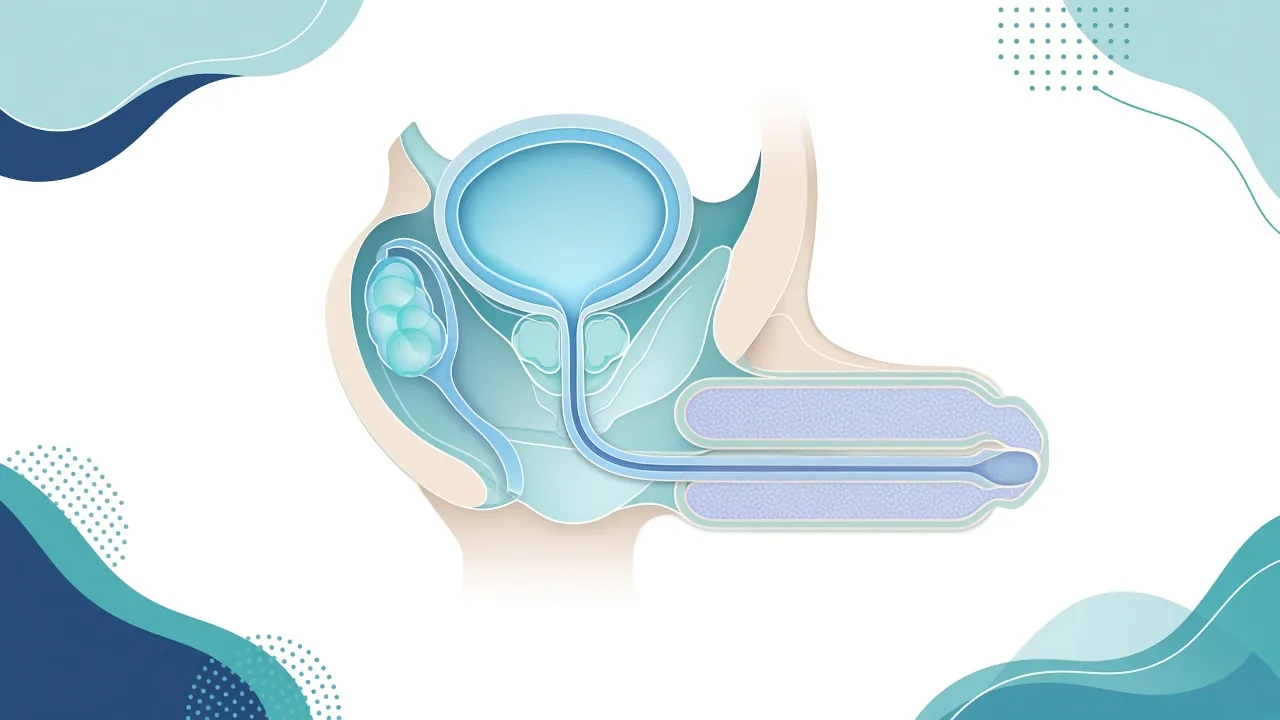
Penile implantation in India is surgery for selected men with erectile dysfunction (ED) who cannot achieve or keep an erection firm enough for intercourse, particularly when tablets, injections, vacuum devices or other treatments have not given a satisfactory result.
A penile implant, also called a penile prosthesis, is placed inside the corporal chambers. Unlike a tablet taken before sex, the device provides mechanical rigidity when the patient wants it. It does not create desire, raise testosterone or restore a biological erection.
India has urology and andrology lists and access to malleable and inflatable systems. GAF Healthcare planning for penile implant is $5,000–$12,000 (typically 1–3 nights). US comparison is $18,000–$40,000. Neighbouring varicocele surgery is $1,500–$4,200. Neighbouring urethroplasty is $3,500–$9,000. Neighbouring TURP is $2,500–$6,200. Neighbouring HoLEP is $3,800–$8,500. Neighbouring GreenLight laser is $3,200–$7,800. Persistent ED after prostate cancer surgery is a different product from the cancer operation itself; named lists sit on Radical Prostatectomy in India ($7,000–$18,000, typically 3–7 nights). These are planning ranges from partner hospital cost sheets, not hospital quotations.
This page is the named penile-implant product. There is no live GAF erectile-dysfunction or Peyronie's treatment page. Named TURP lists sit on TURP Surgery in India. Named HoLEP lists sit on HoLEP Surgery in India. Named GreenLight lists sit on GreenLight Laser Surgery in India. Those neighbouring sheets must not be used as an implant quotation.
International patients comparing penile-implant surgeons commonly start with Delhi NCR, Mumbai, Bengaluru, Chennai and Hyderabad. Partner urology hospitals in Delhi NCR, Mumbai and Bengaluru, and in Chennai and Hyderabad, are a typical first filter because this work needs a named prosthetic list, infection-control and device training. City sheets include Delhi NCR, Mumbai, Bengaluru, Chennai and Hyderabad. Pune, Kolkata, Ahmedabad and Jaipur may have andrology theatres. They are not live GAF catalog cities on this site.
Medical note: A penile implant is not the first treatment for ED. Fever with pus or spreading redness, heavy bleeding, inability to pass urine, chest pain, shortness of breath or fainting belongs in a local emergency department first. WhatsApp at +91 90443 46292 is for planned record review, not an infected prosthesis emergency.
Share ED history and prior treatment records for an implant review
What Is Penile Implantation?
Penile implantation places a prosthesis inside the corpora cavernosa — the paired chambers that normally fill with blood during an erection.
The device does not depend on that blood-flow pathway. It creates mechanical rigidity so intercourse is possible despite the underlying ED.
The two principal categories are:
- Malleable or semi-rigid implants
- Inflatable prostheses, either two-piece or three-piece
The European Association of Urology describes prosthesis implantation as an option when other ED treatments fail, are unsuitable, or a fully informed patient prefers a definitive mechanical solution.
Message GAF Healthcare on WhatsApp
Who May Need a Penile Implant?
Implantation is generally considered for significant ED when less-invasive options have not produced a satisfactory result.
Potential candidates include men whose ED is associated with:
- Diabetes
- Cardiovascular or severe vascular disease
- Nerve damage, spinal cord injury or neurological disease
- Pelvic surgery, including radical prostatectomy
- Radiation for prostate cancer
- Pelvic trauma
- Peyronie's disease with ED
- Long-standing ED that does not respond to other treatments
It may also be considered by men who can still use other treatments but prefer a more predictable mechanical solution after counselling.
A penile implant is not normally the first treatment. The urologist should look for reversible causes and discuss tablets, injections and vacuum devices first.
Request a records review before anyone books travel
When Is a Penile Implant Recommended?
A prosthesis may be discussed when:
- PDE5 inhibitor tablets do not work adequately or cannot be used safely
- Intracavernosal injections are ineffective, inconvenient or unacceptable
- A vacuum device does not provide satisfactory function
- ED is severe and persistent
- ED follows prostate cancer treatment and other approaches have not worked
- Severe Peyronie's disease is accompanied by ED
- The patient understands that implantation changes the anatomy and that natural erections will not return
The EAU recommends that patients be fully informed about benefits and harms before implantation.
Erectile Dysfunction Before Surgery
ED is a persistent inability to obtain or maintain an erection adequate for satisfactory sexual activity — not a single failed attempt.
Assessment commonly includes medical and sexual history, medication review, examination, blood pressure, glucose or HbA1c, lipids, testosterone when appropriate, cardiovascular risk, previous pelvic or prostate surgery, curvature, sensation and a review of treatments already tried. Validated scores such as the International Index of Erectile Function (IIEF) may be used.
The EAU recommends a comprehensive medical and sexual history, focused examination and appropriate laboratory evaluation before any prosthetic decision.
Penile Implant Types
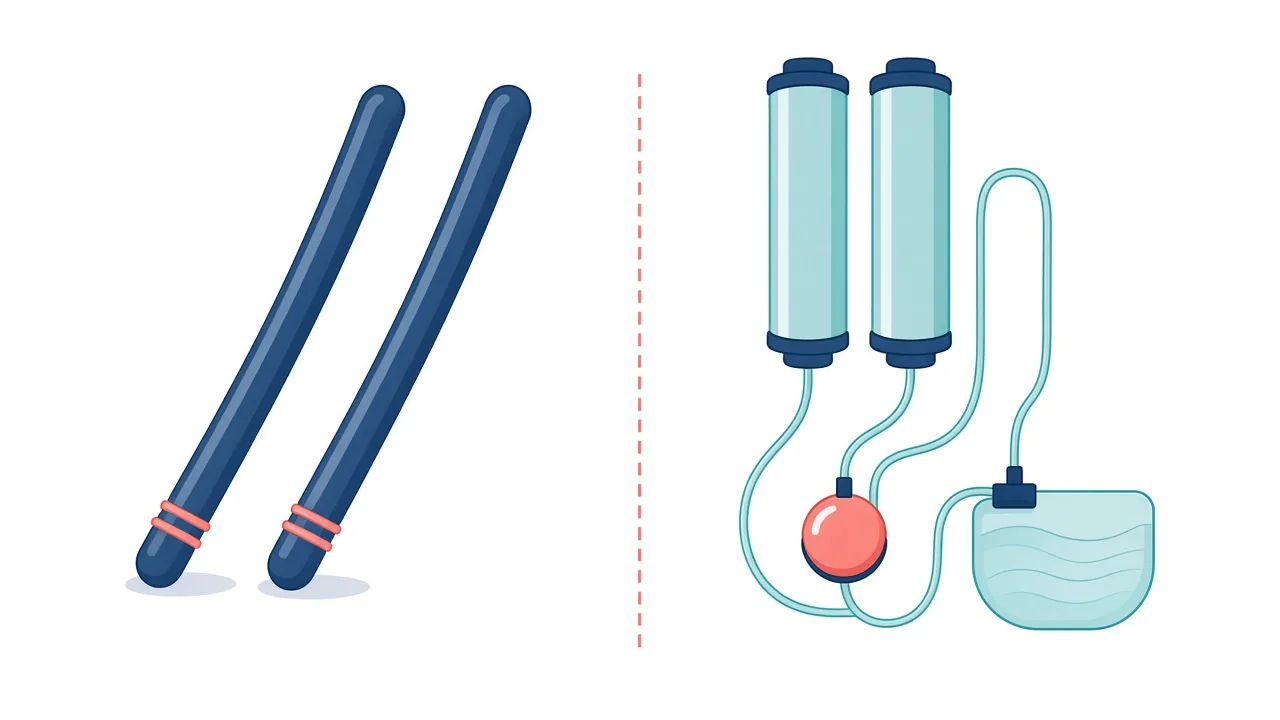
Understanding the device is the most important part of planning.
Malleable or semi-rigid implant
Two bendable rods sit in the corpora. The penis stays relatively firm and is positioned by hand — upward for intercourse, downward for concealment.
Advantages include a simpler mechanism, no pump or reservoir, easier use for men with limited hand dexterity, usefulness in some medically complex cases, and a usually lower device cost.
The limitation is persistent firmness. Concealment can be less convenient than with an inflatable device. The EAU notes that semi-rigid prostheses are simpler to implant and use, while concealability can be a disadvantage.
Inflatable penile implant
An inflatable prosthesis is designed to be firm when required and softer afterwards. Options are two-piece and three-piece systems.
Three-piece inflatable prosthesis
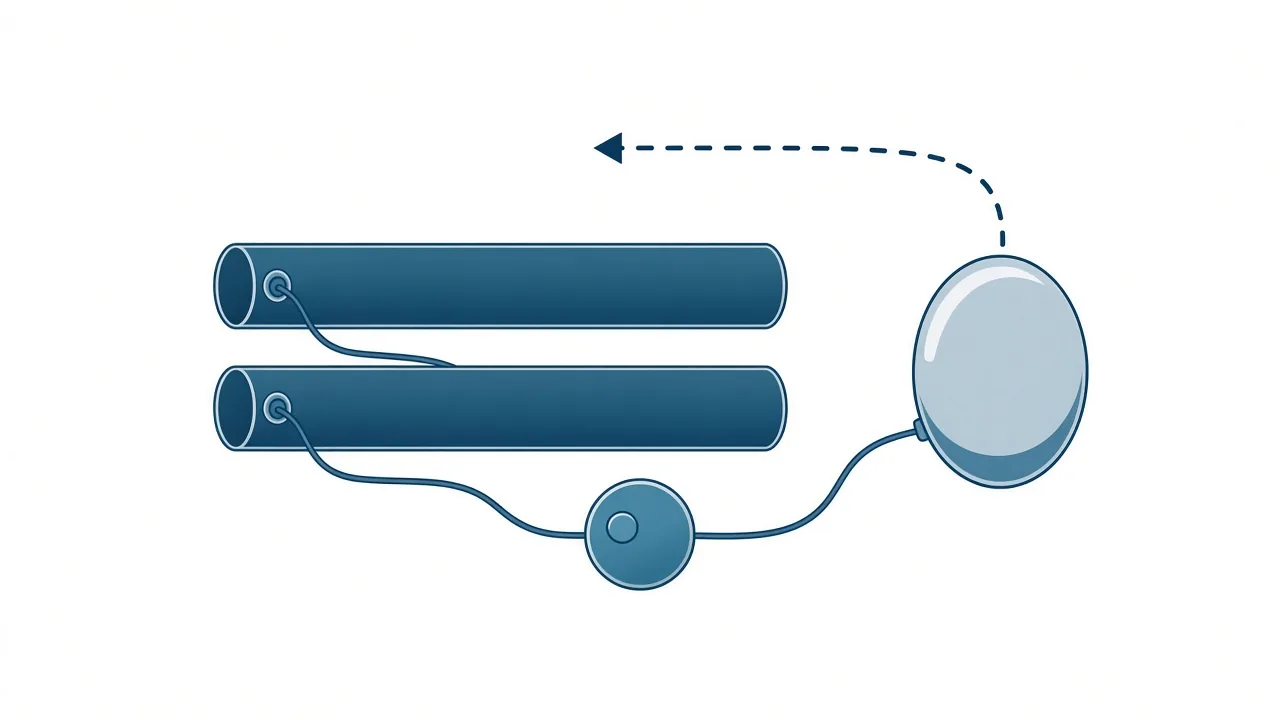
A three-piece system generally has:
- Two cylinders inside the penis
- A pump in the scrotum
- A fluid reservoir in the lower abdomen or pelvis
The patient works the pump to move fluid into the cylinders. After intercourse, the release mechanism returns fluid to the reservoir.
Advantages include a more natural-looking flaccid state, controlled rigidity, no need for a tablet before intercourse, and high reported satisfaction when the patient is well selected.
Limitations include more components, greater mechanical complexity, higher cost, the need for adequate hand function, and extra thought about reservoir placement after previous abdominal or pelvic surgery.
Two-piece inflatable implant
A two-piece system stores fluid with the penile components rather than using a separate abdominal reservoir. The EAU lists two-piece devices as an option when reservoir placement is less desirable, including some men with previous abdominal surgery.
Ask whether a malleable, two-piece or three-piece device is the named product
Malleable vs Inflatable
| Feature | Malleable | Inflatable |
|---|---|---|
| Mechanism | Lower | Higher |
| Pump | No | Yes |
| Reservoir | No | Two-piece integrated; three-piece separate |
| Flaccid appearance | Less natural | More natural |
| Hand function needed | Lower | Higher |
| Typical cost | Usually lower | Usually higher |
| Concealment | Can be harder | Generally easier |
| Erection control | Manual positioning | Pump-controlled |
There is no universally preferred device. Choice depends on anatomy, medical history, hand function, previous surgery, expectations, lifestyle, cost and the surgeon's prosthetic experience.
How Does a Penile Implant Work?
The prosthesis creates mechanical rigidity. It does not produce an erection through sexual stimulation or increased blood flow.
With a three-piece implant the patient locates the scrotal pump, compresses it repeatedly, waits for the cylinders to fill, then uses the release mechanism afterwards so the penis returns to a softer state.
Modern inflatable devices can provide rigidity many men find satisfactory for intercourse. Appearance and sensation still vary. An implant is not a penis-enlargement procedure. Some men perceive shortening compared with a previous full erection, especially after prostate surgery, fibrosis or Peyronie's disease. The EAU recommends counselling about possible size change.
Can a Penile Implant Treat Peyronie's Disease?
In selected men, yes. Peyronie's disease can cause curvature, ED, shortening, pain and difficulty with penetration.
When significant ED does not respond to medicines or injections, implantation can be considered. Cylinder placement itself may improve mild-to-moderate curvature. If significant curve remains, the surgeon may add modelling, plication or incision and grafting.
The EAU recommends prosthesis implantation, with or without additional straightening, in appropriately selected men with Peyronie's disease and ED that does not respond to pharmacotherapy. There is no live GAF Peyronie's treatment page.
Penile Implant After Prostate Cancer Surgery
Erectile dysfunction is a recognised consequence of radical prostatectomy and other prostate cancer treatments. Even after nerve-sparing surgery, recovery can take months and may not be enough for intercourse.
Conservative options include PDE5 inhibitors, vacuum devices, injections and a structured rehabilitation programme. A prosthesis is considered when ED persists despite those options.
The decision should weigh time since prostate surgery, baseline function, age, health, nerve-sparing status, response to other treatments, preference and sexual goals. The cancer pathway sits on Prostate Cancer Treatment in India. Robotic technique detail sits on Robotic Prostatectomy in India. Rising PSA after prostatectomy sits on Prostate Cancer Recurrence After Surgery.
Share records so the team can name the device after prostate-cancer treatment
How Is Penile Implant Surgery Performed?
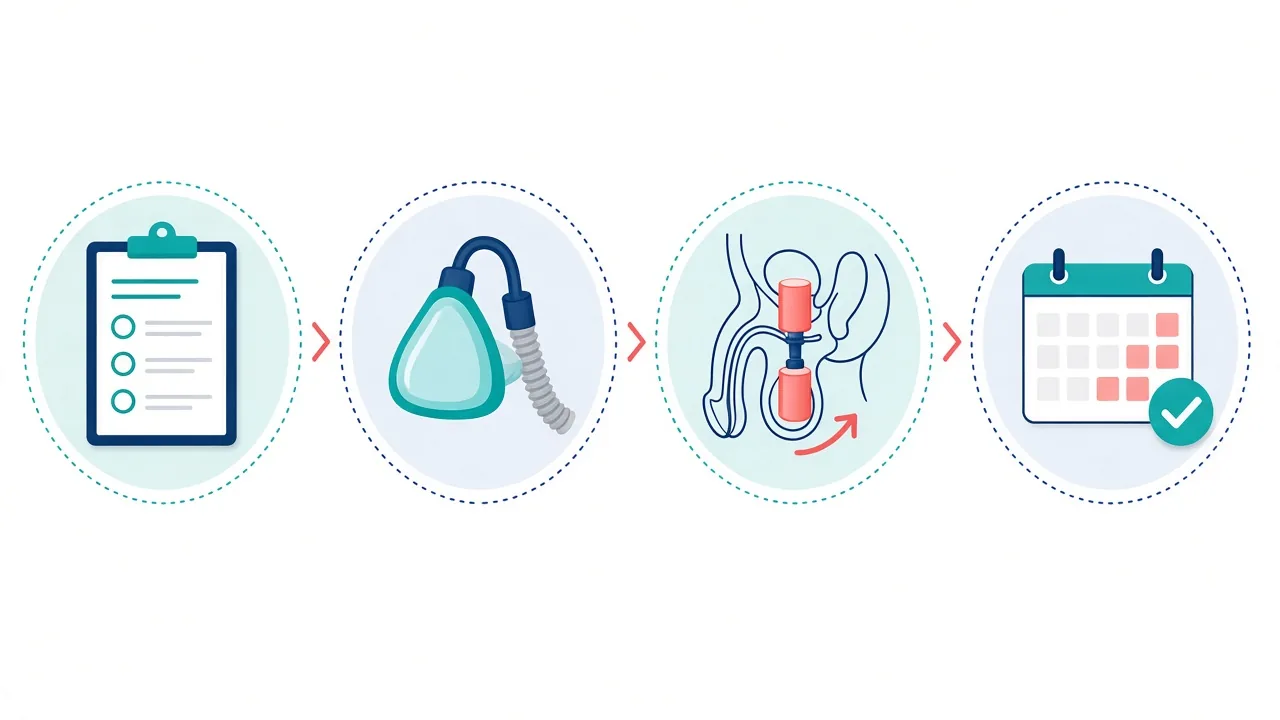
The exact approach varies. The sequence is usually:
Step 1: Preoperative evaluation. ED history, previous treatments, medicines, prior surgery, anatomy, curvature, urinary symptoms, infection risk, diabetes control and expectations.
Step 2: Device selection. Malleable versus inflatable, two-piece versus three-piece, dimensions, brand, expected function, cost, warranty and revision possibilities. The model should be written on the quotation.
Step 3: Anaesthesia. General or spinal/regional anaesthesia. Antibiotic prophylaxis is commonly used.
Step 4: Placement. The corpora are prepared. Cylinders or rods are sized and positioned. For a three-piece device the pump is placed in the scrotum and the reservoir in the agreed pelvic or abdominal location. The system is tested before closure.
Step 5: Recovery. Some patients go home the same day; others stay overnight. GAF planning is 1–3 nights.
Primary uncomplicated surgery commonly takes about 1–2 hours. Revision, corporal fibrosis, Peyronie's work or previous pelvic surgery can take longer. Operating time alone is not a quality score.
Hospital Stay and Recovery
GAF planning for hospital stay is 1–3 nights. An overnight stay is more likely when medical conditions are significant, the procedure is complex, pain needs observation, or the patient has travelled internationally.
First few days. Swelling, bruising, tenderness and scrotal discomfort are common and usually improve.
First 1–2 weeks. Light daily activity resumes. Heavy lifting and strenuous exercise stay restricted.
Around 4–6 weeks. Many patients can begin using an inflatable implant and resume sexual activity once the surgeon confirms healing and teaches the pump. Mayo Clinic describes a similar window for strenuous activity, sexual activity and device teaching.
Desk work may resume in about a week if comfortable. Physically demanding work needs a longer pause.
Fever with shaking chills, pus, spreading redness, heavy bleeding, inability to pass urine, sudden device displacement, severe glans colour change, chest pain or fainting belongs in a local emergency department.
Message GAF Healthcare on WhatsApp
Sexual Function, Ejaculation and Fertility
The implant addresses rigidity. It does not automatically restore ejaculation, orgasm, desire or fertility.
If prostate surgery, neurological disease or medicines already prevent ejaculation, the implant does not correct that. Many men still have penile sensation and orgasm; outcomes vary.
A prosthesis is not a fertility treatment. Men who may want biological children should discuss that separately before surgery.
Risks and Complications
Penile prosthesis surgery is established for refractory ED and is not risk-free.
Possible complications include infection, bleeding, haematoma, pain, swelling, urethral injury, mechanical malfunction, displacement, erosion, cylinder or reservoir problems, glans complications, perceived shortening, need for revision and anaesthetic complications.
The two major long-term concerns are infection and mechanical failure.
The EAU cites contemporary infection rates of about 2–3% in primary low-risk cases at high-volume centres, with some coated devices reported around 1–2%. A 2026 systematic review found an overall infection rate of about 4.3% among diabetic patients in the included literature, with higher rates at higher mean HbA1c. Diabetes does not automatically block surgery; glucose should be optimised first.
If a device becomes infected, removal is often required. In selected cases a salvage washout and same-episode replacement can succeed in more than 80% of carefully chosen patients.
How Long Does a Penile Implant Last?
No mechanical device lasts forever in every patient. Longevity depends on type, generation, age, technique, use, previous surgery and follow-up.
One long-term inflatable series estimated revision-free survival of about 68.5% at 10 years and 59.7% at 15 years. Other reviews of modern devices have reported about 90% overall survival at five years and about 87% at ten years. Treat the implant as a long-lasting device, not a guaranteed lifetime device.
Mechanical failure may need component or complete replacement. Failure does not mean the original operation was dishonest.
The EAU reports very high satisfaction in counselled patients — about 92–100% patient and 91–95% partner satisfaction in the cited literature. Those figures are not a personal guarantee.
Advantages and Limits
Potential advantages include predictable rigidity, no dependence on a tablet for the mechanical erection, long-term use, high satisfaction when selection is honest, and a defined option after prostate cancer treatment or selected Peyronie's disease with ED.
Limits include the need for surgery, the fact that natural erections do not return, infection and mechanical failure, cost — especially for imported three-piece systems — and the fact that desire, sensation, ejaculation and orgasm are separate problems.
Request an itemized implant estimate that names the model
Penile Implant Cost in India
GAF Healthcare planning for penile implantation in India is $5,000–$12,000, typically 1–3 nights. US comparison is $18,000–$40,000. This is a preliminary planning range, not a fixed quotation. It depends on implant type, brand, hospital, surgeon, medical complexity, Peyronie's or revision work and room category.
A hospital quotation may include surgeon and anaesthesia fees, theatre, the prosthesis, consumables, antibiotics, room, monitoring and a follow-up visit. Not every package includes every line. International patients should ask about airport transfers, hotel, extra nights, preoperative tests, complication management and who teaches the pump.
The implant itself is usually the largest cost driver. Malleable devices generally cost less than inflatable systems. Imported three-piece prostheses sit at the upper end of the same GAF sheet unless the hospital writes a separate itemized quote.
When comparing hospitals, ask who will implant the device, how often that surgeon performs prosthetic urology, whether malleable and inflatable stock are both available, what infection-control protocol is used, what happens if revision is needed, and how follow-up is handled after returning home.
City name is a weaker driver than the named model. Delhi NCR, Mumbai, Bengaluru, Chennai and Hyderabad are the live GAF catalog cities. Pune and Kolkata are not live catalog cities on this site.
Message GAF Healthcare on WhatsApp
What to Look for in a Surgeon and Hospital
Ask about urology and andrology training, prosthetic volume, inflatable and malleable experience, revision and Peyronie's work, infection-control, access to more than one system, and who will manage an infected or failed device.
A suitable hospital needs a urology service, modern theatres, laboratory and imaging support, emergency cover and nursing used to prosthetic aftercare. Do not choose a list from a website ranking or a headline price.
International Patient Pathway
- Send records. ED history, previous treatments, medicines, diabetes and heart history, previous pelvic or prostate surgery, and any curvature notes.
- Specialist review. A urologist or andrologist decides whether a prosthesis is honest versus further conservative treatment.
- Name the product. Malleable, two-piece or three-piece, with the model written down.
- Itemized estimate. GAF planning is $5,000–$12,000.
- Travel if fit. Stable planned cases travel after records review. An infected wound, inability to pass urine or chest pain is a local emergency.
- Repeat essential tests. Labs, HbA1c and fitness after arrival.
- Deliver the named implant.
- Device teaching. The patient leaves with implant identification, wound instructions and who will follow them at home.
A useful planning framework is 1–3 nights in hospital and a longer total India stay for review and travel clearance. The treating surgeon should confirm fitness to fly. Do not book a return flight from an average recovery time.
Share records for a case-specific implant plan
Recovery Timeline
| Period | What may happen |
|---|---|
| Day 0–1 | Monitoring, pain control, wound care |
| Days 2–7 | Swelling and discomfort ease |
| Weeks 1–2 | Light activity if comfortable |
| Weeks 2–4 | Energy returns; avoid strain as instructed |
| Weeks 4–6 | Healing check and device teaching |
| Around 4–6 weeks | Sexual activity if the surgeon clears it |
| Beyond 6 weeks | Gradual return to normal activity |
Complex or revision surgery can take longer.
Questions to Ask Before Surgery
- What is causing my erectile dysfunction?
- Have reasonable non-surgical options been tried?
- Which implant do you recommend, and why?
- Is it malleable, two-piece or three-piece, and which model?
- What is included in the quoted cost?
- What is my infection risk, including diabetes control?
- How long is the expected stay?
- When can I work, exercise and have sex?
- When will I learn to operate the device?
- What happens if it fails or becomes infected?
- What implant documentation will I receive?
- How is follow-up handled if I return home?
Frequently Asked Questions
Is penile implant surgery safe? It is an established treatment for refractory ED. Modern devices, antibiotics and coatings have reduced complications. Infection, mechanical failure and other surgical risks remain possible.
Is implantation permanent? It is intended as a long-term treatment. The device may eventually need revision or replacement.
How long does a penile implant last? Longevity varies. Published modern series show substantial survival at 5 and 10 years. Individual results differ.
Can I have sex normally after implantation? Many selected patients resume intercourse after healing. Clearance is commonly around 4–6 weeks.
Does a penile implant increase sexual desire? No.
Does it restore natural erections? No. It provides mechanical rigidity.
Can I still orgasm or ejaculate? Many men can still orgasm. Ejaculation depends on the underlying condition and previous treatment, not on the implant alone.
Does it affect fertility? It is not a fertility treatment.
Which is better, malleable or inflatable? Neither is universally better. Inflatable systems offer more control and a softer flaccid state. Malleable systems are simpler to operate.
Can diabetic patients have an implant? Selected men can. Glucose should be managed because infection risk tracks glycaemic control.
Can it be used after prostate cancer surgery? Yes, when ED persists after conservative treatment. The prostatectomy list is a different product.
Can it treat Peyronie's disease? It can help selected men who also have significant ED. Extra curvature work is sometimes required.
Can the implant be removed? Yes. Removal is another operation.
Can I have an MRI afterwards? Compatibility depends on the model. Keep the implant card and tell radiology staff before any scan.
How much does it cost in India? GAF Healthcare planning is $5,000–$12,000, typically 1–3 nights. US comparison is $18,000–$40,000. Individual hospital quotations vary with the named model.
When should I go to an emergency department? Fever with pus or spreading redness, heavy bleeding, inability to pass urine, sudden device displacement, severe glans colour change, chest pain, shortness of breath or fainting belongs in a local emergency department.
Which city in India is right? There is no single preferred city. Delhi NCR, Mumbai, Bengaluru, Chennai and Hyderabad are live GAF catalog cities.
Key Takeaways
- A penile implant restores mechanical rigidity for selected men with refractory ED. It does not restore desire, a biological erection, ejaculation or fertility.
- Malleable and inflatable (two-piece or three-piece) devices are different products. The model should be named before anyone books travel.
- Infection and mechanical failure are the main long-term concerns. Diabetes control matters.
- GAF planning in India is $5,000–$12,000, typically 1–3 nights.
- Persistent ED after prostate cancer treatment is a neighbouring use, not a substitute for the cancer operation.
- International patients should obtain an itemized quotation that names the prosthesis.
Why Choose GAF Healthcare for Penile Implantation in India?
GAF Healthcare coordinates the journey around the clinical requirement: record review, a named urology or andrology list, hospital selection, an itemized estimate, admission support and follow-up planning.
The first step is to establish whether a prosthesis is honest for this patient's ED, or whether further tablets, injections or a vacuum trial should come first.
Share ED history, prior treatment records, diabetes results and any prostate-surgery notes for a case-specific assessment.
Share records for a case-specific implant assessment
Planned questions can also go to WhatsApp at +91 90443 46292. Emergency symptoms still belong in a local emergency department.
Medical Disclaimer
This page provides general educational information about penile implantation in India. It does not diagnose erectile dysfunction or determine whether a prosthesis is appropriate for an individual patient.
Treatment decisions should be made with a qualified urologist or andrologist after reviewing history, examination, previous treatments, diabetes control and expectations.
Published treatment costs are indicative and can change between hospitals, cities, implant models and individual cases. A hospital's written quotation should be obtained before treatment or travel arrangements are finalized.
Treatment Process
- 1
Share records
The patient provides ED history, prior treatments, diabetes results and any prostate-surgery notes before anyone books travel.
- 2
Andrology review
A urologist or andrologist reviews whether a prosthesis, further tablets, injections or a vacuum trial is the honest product.
- 3
Name the device
The team writes malleable, two-piece or three-piece only after anatomy, hand function and infection risk are reviewed.
- 4
Itemized estimate
GAF penile-implant planning is $5,000–$12,000. Neighbouring varicocele is $1,500–$4,200 when fertility, not rigidity, is the product.
- 5
Travel if fit
Stable planned cases travel after records review. Fever with pus, inability to pass urine or chest pain is a local emergency.
- 6
Repeat essential tests
The receiving unit confirms labs, HbA1c and fitness after arrival.
- 7
Deliver the named implant
The named malleable or inflatable prosthesis proceeds only after the model is written down.
- 8
Ward and wound care
Pain, swelling and urine flow are watched before discharge.
- 9
Device teaching
The patient leaves with implant identification, pump instructions when healing allows, and who will follow them after returning home.