Treatment Overview

GreenLight laser surgery in India is a minimally invasive treatment for men with urinary symptoms caused by an enlarged prostate — benign prostatic hyperplasia (BPH) or benign prostatic obstruction (BPO). The procedure, commonly called GreenLight photoselective vaporization of the prostate (PVP), uses 532-nm laser energy to vaporize obstructing tissue and widen the channel for urine.
Compared with traditional TURP, GreenLight PVP can offer less bleeding, a shorter catheter time and a shorter stay in appropriately selected patients. The 2026 European Association of Urology guideline recognizes 80W, 120W and 180W GreenLight vaporization as surgical alternatives to TURP for selected men with moderate-to-severe lower urinary tract symptoms and prostate volumes of 30–80 mL.
This page is the named GreenLight product. It is not prostate cancer surgery. Cancer lists sit on Prostate Cancer Treatment in India and Radical Prostatectomy in India. There is no live GAF Aquablation, UroLift or BPH-only treatment page. Named TURP lists sit on TURP Surgery in India. Named HoLEP lists sit on HoLEP Surgery in India. Those neighbouring sheets must not be used as a GreenLight quotation.
GAF Healthcare planning for GreenLight laser surgery is $3,200–$7,800 (typically 1–3 nights). US comparison is $14,000–$28,000. Neighbouring TURP is $2,500–$6,200 (typically 2–4 nights). Neighbouring HoLEP is $3,800–$8,500 (typically 2–4 nights). Neighbouring radical prostatectomy is $7,000–$18,000 when the product is cancer, not BPH. Neighbouring penile implant is $5,000–$12,000 when rigidity, not flow, is the product. These are planning ranges from partner hospital cost sheets, not hospital quotations.
International patients comparing GreenLight surgeons commonly start with Delhi NCR, Mumbai, Bengaluru, Chennai and Hyderabad. Partner urology hospitals in Delhi NCR, Mumbai and Bengaluru, and in Chennai and Hyderabad, are a typical first filter because this work needs a named laser list, prostate-volume review and catheter plan. City sheets include Delhi NCR, Mumbai, Bengaluru, Chennai and Hyderabad. Pune, Kolkata, Ahmedabad and Jaipur may have laser theatres. They are not live GAF catalog cities on this site.
Medical note: The decision should not rest on the laser name or a headline price. Prostate size, anatomy, medicines, anticoagulants, bladder function and the urologist's PVP volume decide the product. Heavy bleeding, inability to pass urine after catheter removal, fever with shaking chills, chest pain or fainting belongs in a local emergency department first. WhatsApp at +91 90443 46292 is for planned record review, not an acute retention or bleed emergency.
Share ultrasound, uroflow and medication list for a GreenLight review
What Is GreenLight Laser Surgery?
GreenLight laser surgery relieves urinary obstruction from an enlarged prostate.
The prostate surrounds the urethra just below the bladder. As it enlarges it can narrow the passage and cause a weak stream, hesitancy, frequency, urgency, nocturia and incomplete emptying.
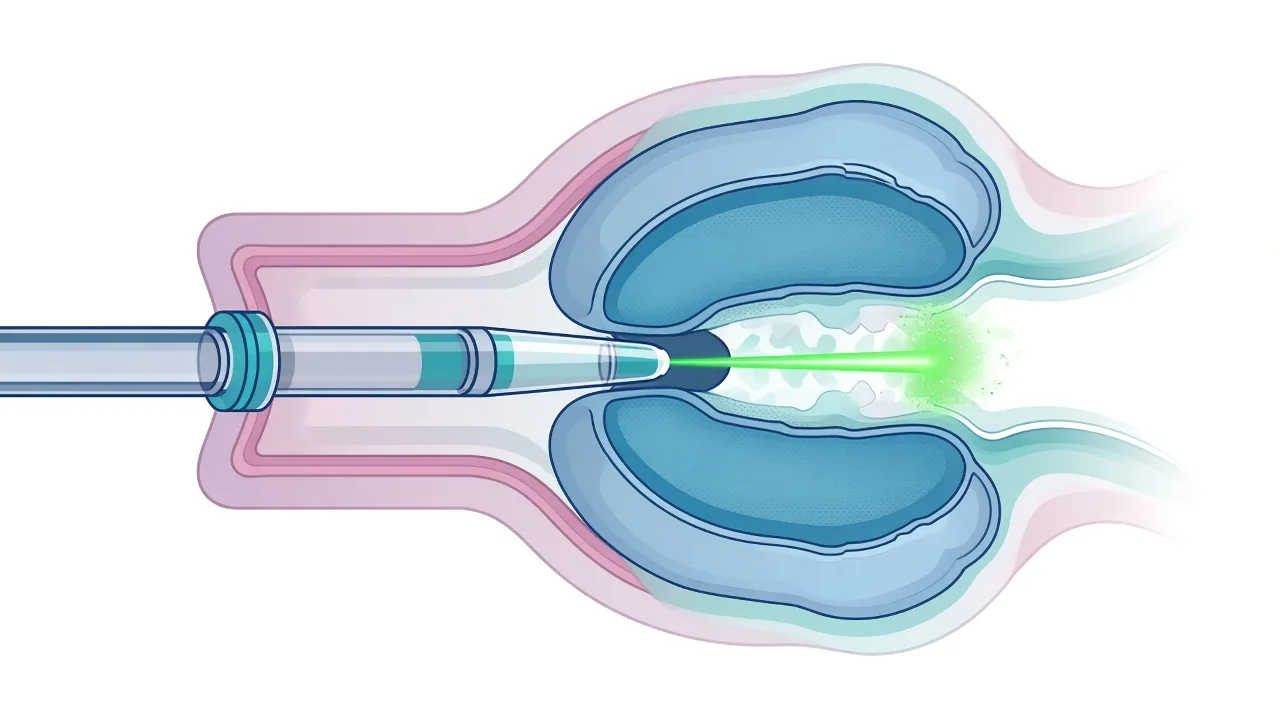
During PVP a thin instrument is passed through the urethra. A fiber delivers 532-nm energy, which is strongly absorbed by blood-containing tissue. The surgeon vaporizes the obstructing adenoma and creates a wider channel. There is no external incision. Mayo Clinic describes laser PVP as a cystoscopic procedure that removes the tissue blocking the urethra.
Message GAF Healthcare on WhatsApp
Why Is It Called GreenLight?
The name refers to the 532-nanometre wavelength. Energy is preferentially absorbed by haemoglobin, so the surgeon can vaporize tissue and coagulate small vessels at the same time. That blood-control property is why PVP has been studied as an alternative to TURP when minimizing perioperative bleeding matters.
What Conditions Does It Treat?
GreenLight PVP is for benign enlargement causing bladder-outlet obstruction and bothersome lower urinary tract symptoms:
- Weak or intermittent stream
- Hesitancy and straining
- Frequency, urgency and nocturia
- Incomplete emptying
- Urinary retention
- Recurrent infections or bladder stones tied to obstruction
Not every urinary symptom is BPH. Overactive bladder, infection, urethral stricture, neurological disease and prostate cancer can overlap. Those need a different pathway — cancer work sits on Prostate Cancer Diagnosis and Prostate Cancer Treatment in India.
GreenLight does not remove prostate cancer. A raised PSA does not automatically block PVP, but the cause of the PSA should be reviewed before anyone books a laser list.
Request a records review before anyone books travel
Who May Be a Candidate?
A urologist may consider GreenLight PVP when a man has moderate-to-severe symptoms, confirmed benign obstruction, poor response or intolerance to medicines, recurrent retention or infection, bladder stones from BPH, or other complications of persistent obstruction.
The 2026 EAU guideline gives strong recommendations for 80W, 120W and 180W vaporization as alternatives to TURP in men with moderate-to-severe LUTS/BPO and prostates of 30–80 mL. A gland outside that range is not automatically ineligible. Evidence, anatomy and the surgeon's assessment become more important as volume rises.
When GreenLight May Not Be the Right Product
The urologist may name another procedure when:
- The prostate is very large
- There is a significant median lobe or complex anatomy
- Bladder function is severely impaired
- Symptoms come mainly from another condition
- An active infection or urethral stricture needs treatment first
- Prostate cancer is suspected
- HoLEP or TURP is the more honest tool for that anatomy
The EAU notes a lack of randomized trials for prostates above 100 mL. For those glands, HoLEP or another enucleation list may deserve the first conversation. Named TURP lists sit on TURP Surgery in India. Named HoLEP lists sit on HoLEP Surgery in India.
GreenLight PVP vs TURP vs HoLEP
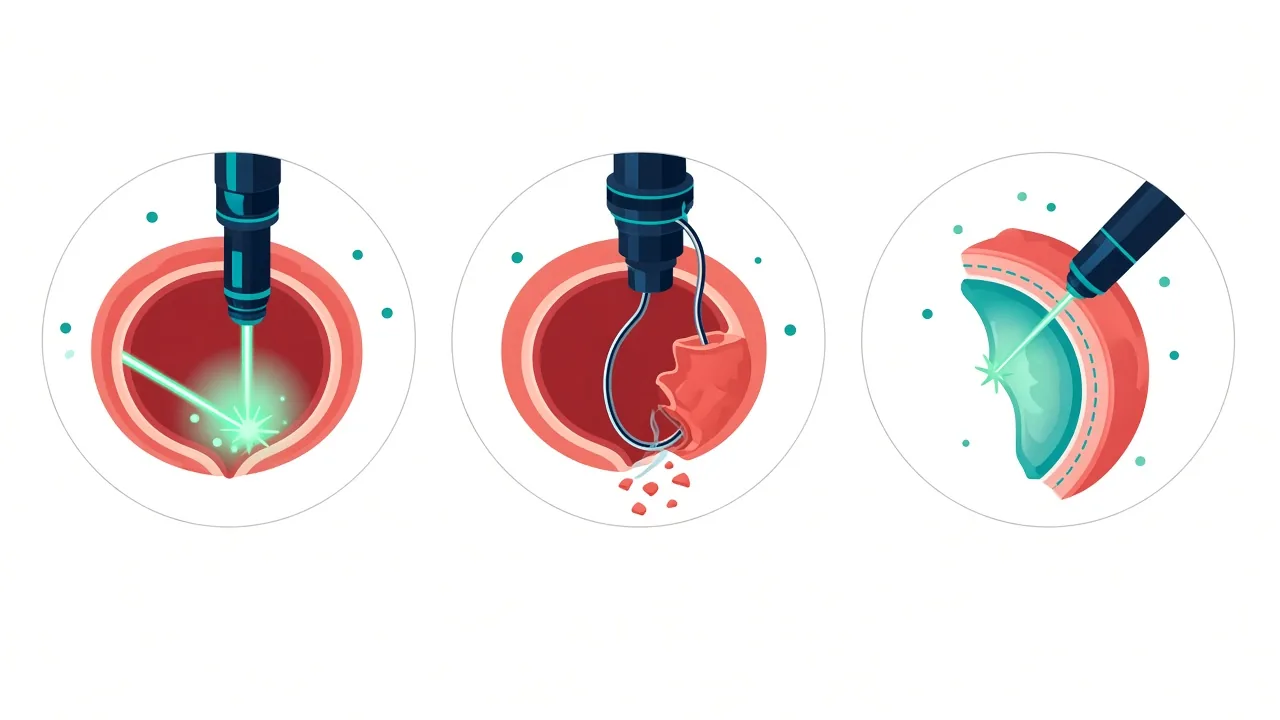
TURP has been a standard surgical treatment for obstructive BPH. Both PVP and TURP aim to restore flow. Randomized work has found similar IPSS and peak-flow improvements at two years, with shorter stay and earlier catheter removal after PVP. Meta-analyses report lower blood loss, shorter catheterization and shorter hospitalization with PVP, and broadly comparable symptom and flow results.
| Feature | GreenLight PVP | TURP |
|---|---|---|
| Access | Through the urethra | Through the urethra |
| External incision | No | No |
| Principle | Laser vaporization | Resection of chips |
| Bleeding | Generally favourable | Higher in many comparisons |
| Catheter / stay | Often shorter | Often longer |
| Tissue for pathology | Limited | Resected chips available |
| Large-gland role | Depends on size and experience | Depends on size and experience |
HoLEP uses a different laser and an anatomical enucleation: the adenoma is separated from the capsule and removed. In a randomized study of prostates larger than 60 mL, HoLEP produced greater volume reduction and higher flow at 12 months, with comparable symptom scores. For very large glands some urologists therefore name HoLEP first. That does not make HoLEP universally preferable.
Other BPH tools — bipolar TURP, ThuLEP, Aquablation, prostatic urethral lift or simple prostatectomy — may be discussed. There are no live GAF pages for those products. The 2026 EAU guideline emphasizes individualized selection and shared decision-making, including recovery, retreatment and centre-specific outcomes.
Ask whether GreenLight, TURP or HoLEP is the named product
How Is GreenLight Laser Surgery Performed?
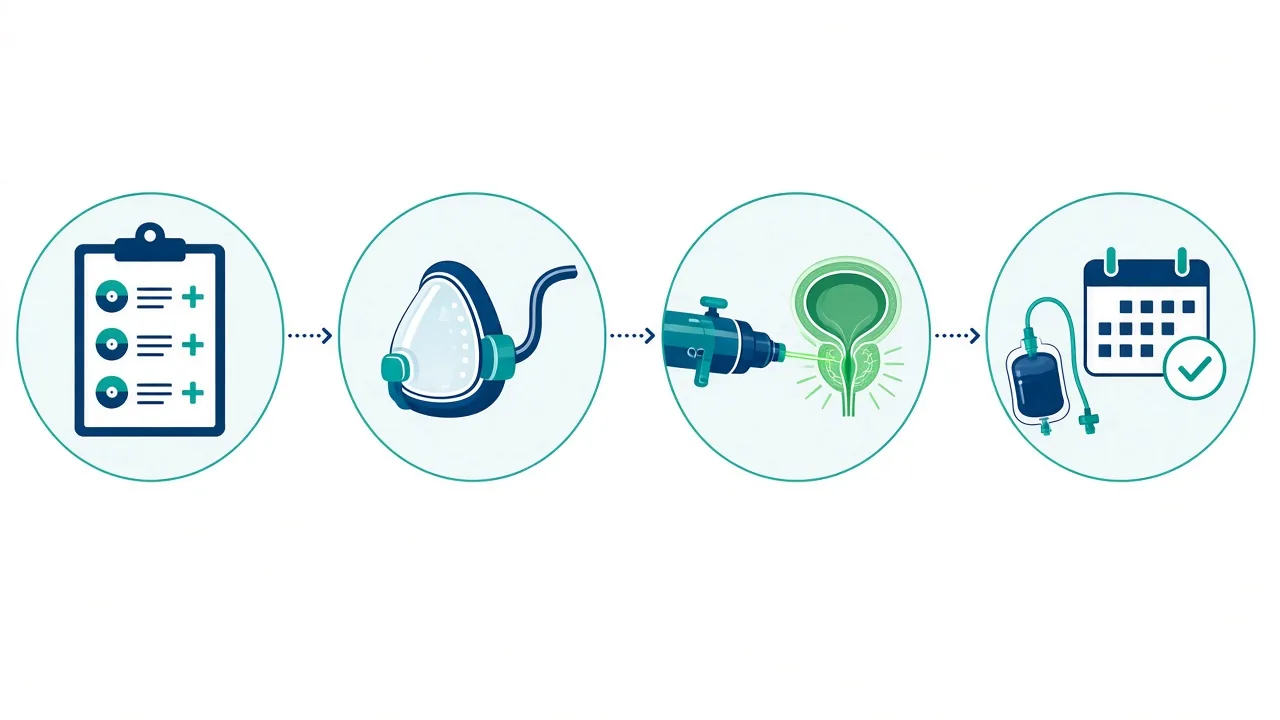
The sequence is usually:
- Preoperative assessment. Symptoms, medicines, previous prostate procedures and anticoagulant use.
- Anaesthesia. The team names the technique from fitness and the planned list.
- Cystoscopic access. A cystoscope enters through the urethra.
- Visualization. Prostate, bladder neck and obstructing tissue are mapped.
- Laser vaporization. The 532-nm fiber vaporizes the obstructing adenoma.
- Channel. A wider passage is created between bladder and urethra.
- Haemostasis. The laser coagulates small vessels.
- Catheter. A temporary catheter is often left.
- Recovery. Urine colour, output, pain and the ability to void are watched.
Operating time depends on prostate size, anatomy, previous procedures and the platform. A website promising a fixed duration for every gland is not an honest quotation.
Tests Before Surgery
Work-up is individual. It commonly includes symptom history and IPSS, urine testing, PSA when age and risk justify it, ultrasound for volume and residual, uroflowmetry, and cystoscopy or urodynamics when the story is unclear.
On the day, instructions for warfarin, apixaban, rivaroxaban, dabigatran, aspirin, clopidogrel and other blood-thinners matter. Patients should never stop those medicines on their own.
Share volume, residual and blood-thinner details
Recovery
The EAU evidence base reports shorter catheterization and stay versus TURP. Recovery still varies.
First few days. Burning, frequency, urgency, mild blood in the urine, bladder discomfort and tiredness are common.
First few weeks. Frequency and urgency usually ease. Intermittent blood can return during healing.
Longer term. The aim is better flow and fewer obstructive symptoms. Longstanding obstruction can leave the bladder slow to recover.
GAF planning for stay is 1–3 nights. Catheter time depends on urine colour, bleeding, bladder function, gland size and whether the patient already had retention. Do not book a return flight from an average number.
Strenuous exercise, heavy lifting and sexual activity stay restricted until the treating urologist clears them.
Fever with shaking chills, heavy bleeding, inability to pass urine after catheter removal, chest pain, shortness of breath or fainting belongs in a local emergency department.
Message GAF Healthcare on WhatsApp
Possible Benefits and Risks
Potential advantages include no external incision, relief of obstruction, a favourable bleeding profile, shorter catheterization and stay versus TURP in many studies, possible use in selected anticoagulated patients, and relatively rapid recovery. These are potential advantages, not guarantees. The EAU notes that evidence in anticoagulated men is encouraging but limited; the cardiologist, physician, anaesthetist and urologist should write one plan.
Possible complications include bleeding, clots, infection, temporary urgency or burning, retention, urethral stricture, bladder-neck contracture, incontinence, need for another procedure, persistent symptoms, retrograde ejaculation, changes in sexual function in some men, and anaesthesia-related events.
Randomized evidence has not shown a consistent major difference in erectile function between GreenLight PVP and TURP. Retrograde ejaculation can still occur: semen may enter the bladder so visible ejaculate is reduced or absent. Men who want biological children should discuss fertility before surgery. A GreenLight list is not a fertility treatment and is not the same product as penile implantation.
Large Prostates, Retention and Blood Thinners
The EAU gives strong recommendations for 30–80 mL glands and notes limited randomized evidence above 100 mL. For a very large prostate the urologist may name HoLEP, another enucleation, GreenLight only in an experienced centre, or simple prostatectomy.
If the patient is already on a catheter, removing the obstruction does not guarantee immediate normal voiding. Longstanding retention can weaken the bladder.
GreenLight vaporization appears safe in selected men on antiplatelet or anticoagulant therapy. That is not permission to continue or stop those medicines without a written perioperative plan.
Request an itemized GreenLight estimate after volume review
GreenLight Laser Surgery Cost in India
GAF Healthcare planning is $3,200–$7,800, typically 1–3 nights. US comparison is $14,000–$28,000. This is a preliminary planning range, not a fixed quotation. It depends on the platform, fiber and consumables, surgeon, hospital, room category, stay, tests and whether another BPH procedure is named instead.
A quotation should state whether the urologist fee, anaesthesia, laser fiber, room, medicines, catheter and follow-up are inside the package. Complication management and a conversion to TURP or HoLEP are usually separate.
Do not treat a single “GreenLight cost in India” headline as a universal price. City name is a weaker driver than prostate volume and the named platform. Delhi NCR, Mumbai, Bengaluru, Chennai and Hyderabad are the live GAF catalog cities.
Message GAF Healthcare on WhatsApp
What International Patients Should Send
Before travel, share a recent urology note, PSA, prostate ultrasound with volume, post-void residual, uroflow, urine test, full medication list including blood-thinners, previous cystoscopy or prostate-procedure reports, and cardiac or kidney results when relevant. If a catheter is already in place, send the reason and the date it was inserted.
A useful planning framework is 1–3 nights in hospital and a longer total India stay for catheter removal and travel clearance. The treating surgeon should confirm fitness to fly.
- Send records.
- A urologist reviews whether GreenLight, TURP, HoLEP or no endoscopic list is honest.
- The platform and expected catheter plan are written down.
- An itemized estimate is issued. GAF planning is $3,200–$7,800.
- Stable planned cases travel after that review. Acute retention with pain, fever or heavy bleeding is a local emergency.
- Essential tests are repeated after arrival.
- The named PVP is delivered.
- The patient leaves with catheter instructions and who will follow them at home.
Share records for a case-specific GreenLight plan
Questions to Ask Before Surgery
- Is the obstruction definitely from BPH?
- What is my prostate volume, and is there a significant median lobe?
- How much residual urine remains after voiding?
- Which GreenLight system will you use?
- Would HoLEP or TURP be more appropriate?
- Will tissue be available for pathology?
- How long will the catheter stay, and how long should I remain in India?
- What are my bleeding and retention risks, including blood-thinners?
- What sexual side effects should I expect?
- What happens if a complication develops after I return home?
Frequently Asked Questions
Is GreenLight laser surgery safe? It is an established treatment for benign prostate obstruction. Trials support effectiveness and a favourable perioperative profile versus TURP in selected patients. No surgery is risk-free.
Is GreenLight surgery better than TURP? Both can improve symptoms substantially. PVP often has less bleeding and a shorter catheter or stay. TURP has longer follow-up experience and provides chips for pathology. The honest option depends on the gland and the patient.
Is GreenLight surgery better than HoLEP? Not universally. HoLEP can be particularly useful for larger prostates. GreenLight PVP has a well-established role in selected 30–80 mL glands.
Can GreenLight treat prostate cancer? No. Prostate cancer needs a separate pathway.
Can it be performed without an incision? Yes. The instrument enters through the urethra.
Can I undergo GreenLight surgery if I take aspirin? Possibly. Do not stop aspirin or any anticoagulant without medical advice.
Does it affect ejaculation? It can. Retrograde ejaculation is a recognized consequence of procedures that relieve prostate obstruction.
Can a very large prostate have GreenLight surgery? Possibly, but evidence is thinner above 100 mL. HoLEP may be discussed.
How much does GreenLight laser surgery cost in India? GAF Healthcare planning is $3,200–$7,800, typically 1–3 nights. US comparison is $14,000–$28,000.
How long should an international patient stay? There is no universal number. Stay depends on gland size, catheter removal, recovery and the surgeon's travel clearance.
When should I go to an emergency department? Heavy bleeding, inability to pass urine after catheter removal, fever with shaking chills, chest pain, shortness of breath or fainting belongs in a local emergency department.
Which city in India is right? There is no single preferred city. Delhi NCR, Mumbai, Bengaluru, Chennai and Hyderabad are live GAF catalog cities.
Key Takeaways
- GreenLight PVP vaporizes obstructing BPH tissue through the urethra. It is not cancer surgery.
- EAU 2026 supports 80W, 120W and 180W vaporization as TURP alternatives for selected 30–80 mL glands.
- PVP often has less bleeding and a shorter catheter or stay than TURP. Neither tool is universally better. Large glands may need HoLEP or another enucleation list.
- GAF planning in India is $3,200–$7,800, typically 1–3 nights.
- Blood-thinners, volume, residual and sexual priorities should be written down before travel.
Why Choose GAF Healthcare for GreenLight Laser Surgery in India?
GAF Healthcare coordinates record review, a named urology list, an itemized estimate, admission support and follow-up planning. The first step is to establish whether GreenLight is honest for this prostate, or whether TURP, HoLEP or no endoscopic list should be named instead.
Share ultrasound, uroflow, residual, PSA and the medication list for a case-specific assessment.
Share records for a case-specific GreenLight assessment
Planned questions can also go to WhatsApp at +91 90443 46292. Emergency symptoms still belong in a local emergency department.
Medical Disclaimer
This page provides general educational information about GreenLight laser surgery in India. It does not diagnose BPH or determine whether PVP is appropriate for an individual patient.
Treatment decisions should be made with a qualified urologist after reviewing symptoms, prostate volume, residual, medicines and overall health.
Published treatment costs are indicative and can change between hospitals, cities, laser platforms and individual cases. A hospital's written quotation should be obtained before treatment or travel arrangements are finalized.
Treatment Process
- 1
Share records
The patient provides ultrasound volume, residual, uroflow, PSA and the blood-thinner list before anyone books travel.
- 2
Urology review
A urologist reviews whether GreenLight, TURP, HoLEP or no endoscopic list is the honest product.
- 3
Name the product
The team writes GreenLight PVP only after volume, anatomy and anticoagulant plan are reviewed.
- 4
Itemized estimate
GAF GreenLight planning is $3,200–$7,800. Neighbouring TURP is $2,500–$6,200 when resection chips are the named product.
- 5
Travel if fit
Stable planned cases travel after records review. Acute retention with pain, fever or heavy bleeding is a local emergency.
- 6
Repeat essential tests
The receiving unit confirms labs, urine and fitness after arrival.
- 7
Deliver the named PVP
532-nm vaporization proceeds only after the platform is named.
- 8
Catheter care
Urine colour, output and the ability to void are watched before discharge.
- 9
Follow-up
The patient leaves with catheter instructions and who will follow flow and residual after returning home.