
Last updated: 13 September 2026 · Content curated by Dr. Shabnam Choudhary · Medically reviewed by Dr. Saffiyyah Chaudhary
Quick Answer
VIU (Visual Internal Urethrotomy) in India is typically planned at $1,200–$3,500 per procedure, with 0–2 nights as the stored hospital-stay guide. The range usually covers the named surgeon, anaesthesia, theatre time, standard consumables, quoted ward nights and routine pathology; imaging before arrival, upgraded devices, extra nights and treatment after departure are commonly separate. $6,000–$15,000 is the comparison reference.
A first short stricture is the ideal case; longer or previously treated strictures raise recurrence and may make VIU a poor choice. Laser platforms add equipment charges without clear durability advantage for most short strictures.
- India cost range
- $1,200–$3,500
- Typical starting point
- $1,200
- Typical hospital stay
- 0–2 nights
- Procedure time
- Commonly about 15–30 minutes of theatre time
- Recovery
- Mild burning and blood-tinged urine settle within a few days.
Major cost factors: stricture length and prior treatment, cold knife versus laser, adjuncts and self-dilatation programme, catheter duration. International patients should also budget for accommodation, airport transfers, a medical visa, medicines and follow-up.
Often quoted separately: changed operative scope; complications and re-intervention; premium devices and consumables; later treatment; travel and living.
Why request a cost through GAF rather than a hospital?
Writing to one campus gets you that campus’s package. A GAF request is reviewed against your records and returned as suitable doctor and hospital options with an indicative, itemised estimate. There is no obligation to book.
- Doctor review first. The number follows a reading of your imaging, test results and clinical records, not a brochure range.
- Hospital options. You can compare listed campuses before you travel, instead of starting over with each international desk.
- International-patient coordination. Visa letters, records routing and companion logistics sit with the same request.
A urethral stricture is a ring or segment of scar tissue within the spongy tissue around the urethra that contracts and narrows the lumen. Cutting through the scar releases the constriction and allows the urethra to expand; the intention is that the cut heals open with fresh lining. Scar often re-forms, which is why the procedure works best for short, first-time strictures with little surrounding fibrosis.
This is not urethroplasty, which is the durable open repair and a separate slug. The stored range is a single-procedure band; repeat urethrotomies, a self-dilatation programme, catheter care after departure and eventual urethroplasty when the stricture recurs are not presumed inside it.
This guide compares quotations; it cannot diagnose, choose an approach or decide timing. A urologist must connect symptoms, imaging and laboratory findings and explain individual uncertainty.
What Is VIU (Visual Internal Urethrotomy)?
VIU (visual internal urethrotomy) is an endoscopic procedure for a short urethral stricture: a urethrotome is passed along the urethra under direct vision and the scar is cut with a cold knife or laser at one or more points to reopen the channel, after which a catheter is left briefly while the cut heals.

When Might VIU (Visual Internal Urethrotomy) Be Considered?
VIU may be considered for a first, short (commonly under about one and a half centimetres) bulbar stricture with limited scar depth, for patients unfit for or not wanting open reconstruction, for a stricture causing retention that needs rapid relief, and occasionally for a short recurrence after urethroplasty.
How the operation is performed, recovery and variations →
VIU (Visual Internal Urethrotomy) cost in India
$1,200–$3,500 is the stored India planning range for VIU, per procedure, and $6,000–$15,000 the stored self-pay comparison. Neither is a guaranteed package; a changed approach, extra imaging, a longer stay or a second stage alters the final amount.
A usable estimate names the surgeon, campus, approach, urethrotomy, catheter and early review, anaesthesia, ward nights, pathology and follow-up, with professional, facility, device, imaging and pharmacy lines separated so two hospitals can be compared line by line.
Budget separately for flights, visa, insurance, transfers, companion, lodging, meals, extra nights and local follow-up unless expressly included.
Planning Range ≠ Final Hospital Quotation. Examination, current imaging, urine culture and anaesthesia review by a named urologist come before candidacy, approach, risks and a final offer are meaningful.
Planning range or quotation?
The $1,200–$3,500 figure is an indicative planning range. A final hospital quotation is itemised, issued after a consultant reviews your records, and still subject to what is found clinically.
Get a Personalized Cost Estimate
What is usually included in a VIU (Visual Internal Urethrotomy) package?
No two hospitals draw the line in the same place, so read an estimate for what it excludes as carefully as for what it covers. The pattern below is what listed campuses typically bundle into a surgical estimate for this procedure. Anything not written into your estimate should be assumed to be extra until the hospital confirms otherwise.
Usually included
Usually included
Named urology consultation
Consultation with the operating urologist, records review and examination when explicitly listed.
Usually included
Pre-anaesthetic assessment
Stated blood tests, ECG, urine culture and anaesthesia review; unlisted cardiac or pulmonary work-up is extra.
Usually included
Theatre and anaesthesia
Operating time, anaesthetist, standard consumables and recovery-room care within the written scope.
Usually included
Ward stay as quoted
Stated nights in the named room category, nursing, routine medicines and standard catheter or wound care.
Usually included
Routine imaging and pathology
Listed fluoroscopy, ultrasound or histopathology only; unlisted CT, PET or special stains are separate.
Usually included
Urethrotomy, catheter and early review
The stated cold-knife or laser urethrotomy, cystoscopy, catheter and the first voiding check when itemized.
May be charged separately
May be separate
Changed operative scope
Conversion to open surgery, a second stage or a different operation found after arrival.
May be separate
Complications and re-intervention
Unplanned ICU, transfusion, re-operation, prolonged drainage, readmission or extra imaging unless expressly covered.
May be separate
Premium devices and consumables
Upgraded stents, catheters, laser fibres, implants or single-use scopes beyond the written specification.
May be separate
Later treatment
Device removal after departure, adjuvant therapy, repeat procedures and long-term medicines unless itemized.
May be separate
Travel and living
Flights, visa, insurance, transfers, companion, lodging, meals, extra nights and care after returning home.
May be separate
Repeat urethrotomy, dilators and urethroplasty
Further urethrotomies, a self-dilatation kit, catheter care after departure and eventual open reconstruction are separate unless written.
Catalog inclusions listed for this pathway: urology consultation and records review; named surgeon on camera before travel; theatre, laser or transplant stay as quoted; stent, histology, graft or device follow-up as indicated; discharge summary to your home physician.
What can increase the cost?
These are the drivers that actually move a bill for this operation, in rough order of how often they do it. Most of them are clinical decisions rather than commercial ones, which is why an honest estimate is written after a records review rather than before it.
- Stricture length and prior treatment
- A first short stricture is the ideal case; longer or previously treated strictures raise recurrence and may make VIU a poor choice.
- Cold knife versus laser
- Laser platforms add equipment charges without clear durability advantage for most short strictures.
- Adjuncts and self-dilatation programme
- Anti-scarring injections, drug-coated balloons or dilator kits are separate lines.
- Catheter duration
- A catheter removed in clinic days later may add a visit or a delayed departure.
- Retention and infection
- Emergency presentation with an infected, obstructed bladder changes the sequence and stay.
- Conversion to urethroplasty
- If the stricture proves long or dense, the team may recommend open repair instead, a different invoice.
- Diagnostics before and after
- CT urography, MRI, cystoscopy, urodynamics or biopsy each add lines when not bundled.
- Anaesthesia and fitness
- Age, heart or lung disease, diabetes and anticoagulation change work-up, monitoring and ICU probability.
- Hospital category and room
- Campus tier, room class and city all shift nursing, facility and consumable pricing.
- Length of stay and recovery
- Extra nights for drainage, fever, bleeding or slow bladder recovery are billed daily unless capped.
VIU (Visual Internal Urethrotomy): approaches and where they differ
The approach is selected for the examined patient, not from a quality ladder. Each option carries its own consumables, theatre time, stay and follow-up, so a quotation must name it.
Swipe to compare surgical approaches →
| Approach | Relative complexity | GAF planning range | Notes |
|---|---|---|---|
| Cold-knife urethrotomy | Individual assessment determines suitability | No separate GAF sheetRelative complexity only | The standard technique with a sharp blade. Quick, inexpensive and widely available. |
| Laser urethrotomy | Individual assessment determines suitability | No separate GAF sheetRelative complexity only | Holmium or thulium laser incision; tissue effects differ, and platform charges are higher. Outcomes are broadly similar. |
| Urethrotomy with adjuncts | Individual assessment determines suitability | No separate GAF sheetRelative complexity only | Injection of anti-scarring agents or drug-coated balloon dilatation at the time of cutting; evidence and availability vary. |
| Urethral dilatation | Individual assessment determines suitability | No separate GAF sheetRelative complexity only | Stretching the stricture with graded dilators rather than cutting; similar durability for short strictures. |
Planning ranges appear only where GAF Healthcare already publishes a cost sheet for that operation. Other rows describe relative clinical complexity and should not be read as prices.
Reconstructive urology: the subspecialty behind VIU (Visual Internal Urethrotomy)
Reconstructive urology repairs strictures, fistulas, injuries and congenital or acquired defects of the urethra, ureter and bladder, often with grafts or bowel segments. Staging, tissue quality and previous operations determine the plan.
Why urethrotomy often needs to be repeated — and why repeating it is discouraged
Cutting scar exposes raw tissue that heals by forming more scar. For a short first-time stricture, a single urethrotomy may hold for years; for longer strictures or after a previous cut, recurrence within months is common. Each repeat lengthens the scar and reduces the chance that any later repair will succeed.
Most reconstructive urologists therefore treat urethrotomy as a one-time, or at most two-time, option and move to urethroplasty when it fails. Patients travelling for treatment should understand this before choosing the cheaper, quicker procedure.
Clean intermittent self-dilatation after VIU
Some urologists ask patients to pass a lubricated catheter or dilator themselves at regular intervals for several months to keep the healed channel open. It can reduce early recurrence but requires teaching, supplies and commitment, and it carries small risks of infection and trauma.
Ask whether your team recommends it, how long for and where supplies will come from after you return home.
Risks and side effects of VIU (Visual Internal Urethrotomy)
Risks include bleeding, infection, extravasation of irrigation fluid into the perineum, a false passage, urethral pain, erectile changes (uncommon), incontinence when the cut extends near the sphincter (rare), and — the most common problem — recurrence of the stricture, which becomes more likely with each repeat urethrotomy.
Ask before travel who pays for re-intervention, transfusion, ICU, prolonged drainage, readmission or a second stage.
VIU (Visual Internal Urethrotomy) cost: India vs other medical tourism destinations
India and United States values use stored GAF planning ranges; the other countries require direct quotations. Compare the same diagnosis, approach, devices, anaesthesia, ward category, pathology and complication terms for VIU; a lower headline with a different approach is not like-for-like.
Swipe to compare destinations →
| Country | Approximate cost | Relative cost position | Important cost considerations |
|---|---|---|---|
| India | $1,200–$3,500 | Baseline | GAF catalog planning range. The stored figure is a national planning range for the operation, hospital stay and standard consumables as written. It does not fix the approach, device, pathology scope or a final quotation. |
| Turkey | Confirmation requiredIndicative planning estimate* | Higher than India | Quotation required. Compare surgeon, endoscopic or robotic approach, laser or implant, stent and catheter management, pathology and complication terms rather than a headline package. |
| Thailand | Confirmation requiredIndicative planning estimate* | Higher than India | Quotation required. International coordination does not establish stone-free confirmation, catheter follow-up or continuity of oncology or transplant care after return. |
| United Arab Emirates | Confirmation requiredIndicative planning estimate* | Higher than India | Quotation required. Professional, theatre, device, imaging, pharmacy and follow-up charges are often billed separately and require written confirmation. |
| Singapore | Confirmation requiredIndicative planning estimate* | Higher than India | Private self-pay varies. Request an estimate tied to the imaged anatomy, chosen approach, named device or laser and the expected number of admissions. |
| Germany | Confirmation requiredIndicative planning estimate* | Higher than India | Private billing varies. Eligibility, professional billing, implant scope and postoperative urology follow-up require direct provider confirmation. |
| United Kingdom | Confirmation requiredIndicative planning estimate* | Higher than India | Private self-pay varies. Overseas patients should verify acceptance, quotation boundaries, urgent access and handover to a local urologist before travelling. |
| United States | $6,000–$15,000 | ≈4.5× India | Stored self-pay reference. Surgeon, anaesthesia, facility, device and pathology charges may be separate; $6,000–$15,000 is a comparison range, not a bundled quotation. |
International comparisons are indicative. Currency, changed findings, a different device or approach and length of stay can change the final amount.
Why do international patients consider India for VIU?
Some patients consider India for VIU because named urologists, endoscopic and laser platforms, robotic systems, transplant programmes and a national self-pay range are visible in one place. Price alone is not a clinical reason to travel, and listing does not establish acceptance.
Evaluate surgeon, licensure, campus, device traceability, ICU and dialysis backup where relevant, pathology quality, urgent access and home handover. No provider is ranked and no outcome is promised; unstable disease, insufficient records or suitable local care can make travel inappropriate.
Hospitals and urology centres for VIU (Visual Internal Urethrotomy) in India
Cards follow exact live entity relationships for VIU (Visual Internal Urethrotomy). A general urology or accreditation label does not establish current acceptance, device stock or outcomes.
Campuses for this pathway are being confirmed. Ask the desk which houses currently quote it.
VIU (Visual Internal Urethrotomy) specialists in India
Profiles appear only when VIU (Visual Internal Urethrotomy) is an exact current CMS procedure relationship. Verify subspecialty scope, availability and campus; placement is not a ranking or outcome claim.
Named consultants for this pathway are being matched. Request a dossier and we will advise which campuses can quote it.
VIU (Visual Internal Urethrotomy) cost by city in India
Delhi NCR, Mumbai, Bengaluru, Chennai and Hyderabad use $1,200–$3,500 because no verified city tariff is stored. Their overlays add campus geography, transfers, lodging, climate and follow-up logistics without inventing local prices. Doctor and hospital cards resolve only from CMS entities carrying an exact current VIU (Visual Internal Urethrotomy) relationship.
Swipe to compare Indian cities →
Delhi NCR
$1,200–$3,500
India planning band — not a city quote
Typical stay 0–2 nights
No verified Delhi NCR-only tariff for VIU is stored. Use $1,200–$3,500 as the national planning range until a named provider issues an itemized estimate; it is not a city price.
0 hospitals · consultant match on request
Mumbai
$1,200–$3,500
India planning band — not a city quote
Typical stay 0–2 nights
No verified Mumbai-only tariff for VIU is stored. Use $1,200–$3,500 as the national planning range until a named provider issues an itemized estimate; it is not a city price.
0 hospitals · consultant match on request
Bengaluru
$1,200–$3,500
India planning band — not a city quote
Typical stay 0–2 nights
No verified Bengaluru-only tariff for VIU is stored. Use $1,200–$3,500 as the national planning range until a named provider issues an itemized estimate; it is not a city price.
0 hospitals · consultant match on request
Chennai
$1,200–$3,500
India planning band — not a city quote
Typical stay 0–2 nights
No verified Chennai-only tariff for VIU is stored. Use $1,200–$3,500 as the national planning range until a named provider issues an itemized estimate; it is not a city price.
0 hospitals · consultant match on request
Hyderabad
$1,200–$3,500
India planning band — not a city quote
Typical stay 0–2 nights
No verified Hyderabad-only tariff for VIU is stored. Use $1,200–$3,500 as the national planning range until a named provider issues an itemized estimate; it is not a city price.
0 hospitals · consultant match on request
Costs vary considerably by hospital, specialist, clinical complexity, insurance, room or day-care category, and what is included in the package.
Choosing a city for VIU
What should international patients budget beyond the urology procedure?
International planning starts with records and a named clinical question. A remote opinion is provisional until in-person examination, current imaging and anaesthesia review confirm the plan.
- Send records
- Provide retrograde urethrogram or urethroscopy report showing stricture length and site and kidney-function results.
- Remote triage
- A named urologist reviews whether VIU is a reasonable question.
- Treatment plan
- A written plan names approach, devices, stay and what could change it.
- Itemize quotation
- Surgeon, campus, anaesthesia, ward nights, pathology and exclusions.
- Plan travel
- Flexible flights, lodging near the campus and a companion.
- Arrive and examine
- Examination, urine culture, repeat imaging and anaesthesia review.
- Confirm consent
- Approach, risks, catheter or stent plan and possible changes.
- Complete procedure
- The consented VIU with the stated monitoring.
- Early recovery
- Urine output, bleeding, pain, fever and drain or catheter function.
- Review results
- Imaging, pathology or function results and any second stage.
- Clear travel
- Written travel fitness, medicines and the removal plan for any device.
- Handover home
- Operative note, pathology and follow-up schedule for a local urologist.
- Treatment episode$1,200–$3,500
- Pre-operative testsOften inside the estimate — confirm
- Hospital stay0–2 nights typically bundled
- Additional procedures or extended careQuoted separately if advised
- Accommodation for companionVaries by city and length of stay
- Local transportationAirport and daily hospital transfers
- FlightsDepends on origin
- Medical visaFee set by the issuing consulate
Planning estimate — not a hospital quotation.
Get a Personalized Treatment Estimate
What does medical travel for VIU in India involve?
The sequence below is how a records-first pathway normally runs. The order matters: everything before arrival exists so that you are not making decisions in an unfamiliar hospital corridor with a suitcase beside you.
Define the problem
Symptoms, imaging and previous treatment.
Collect records
Imaging, laboratories and operative history.
Identify clinician
Named urologist and campus.
Assess candidacy
Anatomy, function, infection and anaesthesia fitness.
Choose approach
Options for your findings, not a brochure default.
Compare quotes
Same approach, devices, nights and follow-up.
Plan travel
Flexible travel, lodging and a companion.
Confirm consent
Findings, risks and what could change.
Complete treatment
Procedure and monitored recovery.
Manage devices
Catheter, stent or drain instructions.
Attend review
Imaging, pathology or function checks.
Handover home
Operative record and follow-up schedule.
Documents to prepare
- Retrograde urethrogram or urethroscopy report showing stricture length and site
- Uroflowmetry and post-void residual results
- Previous urethrotomy, dilatation or catheter-trauma history
- Urine culture and any history of urinary retention
- Recent kidney-function tests (creatinine, eGFR, electrolytes)
- Urine analysis and culture with antibiotic sensitivities
- Current medicines, allergies and anticoagulant or antiplatelet details
- Past operative reports, discharge summaries and anaesthesia records
Clinical detail
How the procedure is performed
Under spinal or general anaesthesia, a guidewire or ureteric catheter is passed through the narrowing under vision. The urethrotome blade or laser fibre incises the scar, typically at the twelve o'clock position and sometimes at additional points, until a standard cystoscope passes easily. The bladder is inspected and a catheter is placed.
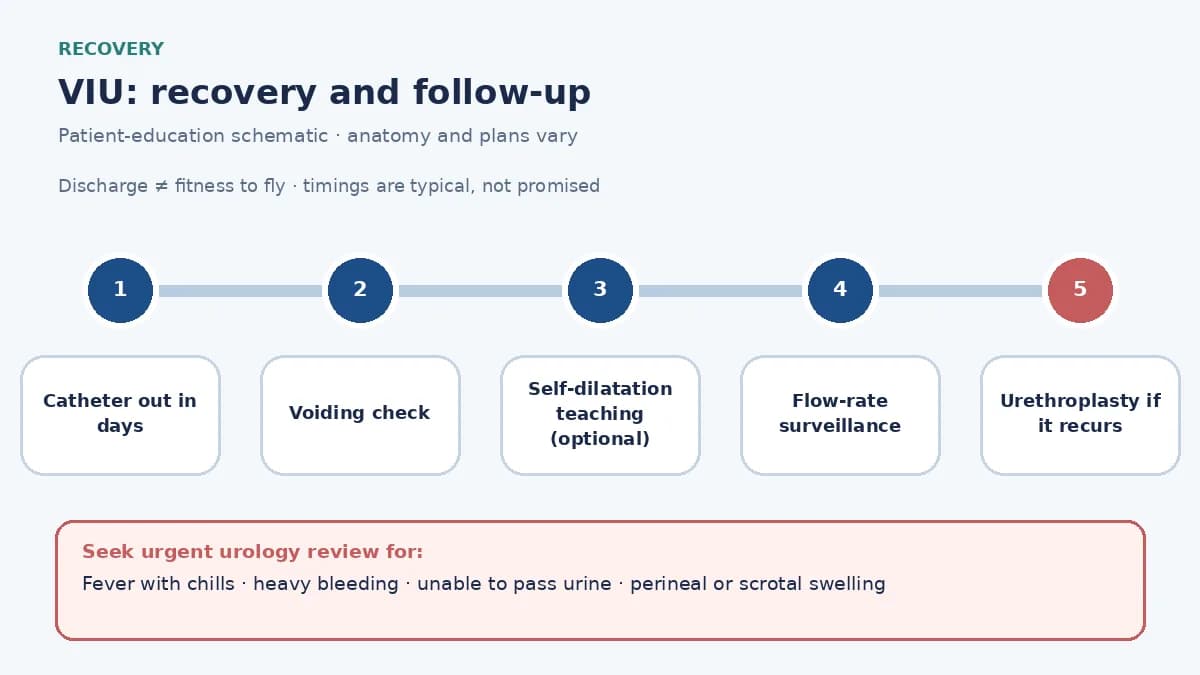
Monitoring covers bleeding, voiding and infection. The catheter is usually removed after one to five days, and the flow rate is checked at intervals. Some urologists teach clean intermittent self-dilatation for weeks to months to reduce early recurrence, which patients should understand before choosing this route.

Main variations
- Cold-knife urethrotomy
- The standard technique with a sharp blade.
- Laser urethrotomy
- Holmium or thulium laser incision; tissue effects differ, and platform charges are higher.
- Urethrotomy with adjuncts
- Injection of anti-scarring agents or drug-coated balloon dilatation at the time of cutting; evidence and availability vary.
- Urethral dilatation
- Stretching the stricture with graded dilators rather than cutting; similar durability for short strictures.
Preparation
Assessment includes a retrograde urethrogram or urethroscopy to confirm the stricture is short and single, uroflowmetry and post-void residual, urine culture, kidney-function tests and a review of previous urethrotomies or dilatations, because prior failed treatment strongly favours urethroplasty instead.
Clinicians direct anticoagulants, antiplatelets, diabetes medicines, fasting and hygiene. A positive urine culture is usually treated first and can postpone surgery.
Hospital stay and recovery
Most patients go home the same day or after one night; the stored 0–2 nights reflects that. The catheter may stay a few days and be removed in clinic. Mild burning and blood-tinged urine settle within a few days. Flying is usually discussed once the catheter is out, voiding is confirmed and there is no fever or heavy bleeding, often within a week of the procedure.
Keep catheter, stent or wound care clean. Seek urgent urology help for fever with chills, heavy bleeding or clots, inability to pass urine after the catheter is removed, or severe perineal or scrotal swelling.
How to compare VIU (Visual Internal Urethrotomy) quotes from Indian hospitals
Print these and work through them on the video call. A house that answers without hedging is telling you something useful about how it will behave when something goes wrong.
- Who is the operating urologist, and at which exact campus?
- Why does VIU fit my findings better than the alternatives?
- Which approach is planned, and what would make you change it on the day?
- Is the quotation for one operation, one stage or a complete pathway?
- What happens to the schedule if my urine culture is positive?
- Which devices, stents, catheters or implants are assumed, by name?
- How many ward nights are quoted, and in which room category?
- Is ICU or high-dependency care included if needed?
- When will any catheter, stent or drain be removed, and is that included?
- What is charged if the operation is converted or a second stage is needed?
- Which symptoms require urgent review, and where would that happen?
- When may I lift, exercise, resume sexual activity, work and fly?
- Who coordinates follow-up with my urologist after I return home?
- Is my stricture short enough for VIU to be a reasonable first choice, and what is the recurrence risk in your experience?
- Will I be taught self-dilatation, and is a dilator kit included?
- If this recurs, do you offer urethroplasty, and how is that quoted?
Frequently asked questions
How much does VIU (Visual Internal Urethrotomy) cost in India?
VIU (Visual Internal Urethrotomy) is typically planned at $1,200–$3,500 per procedure. This stored national range is not a quotation; approach, devices, ward nights, pathology and written terms determine the final amount.
What is VIU (Visual Internal Urethrotomy)?
VIU (visual internal urethrotomy) is an endoscopic procedure for a short urethral stricture: a urethrotome is passed along the urethra under direct vision and the scar is cut with a cold knife or laser at one or more points to reopen the channel, after which a catheter is left briefly while the cut heals.
When is VIU considered?
VIU may be considered for a first, short (commonly under about one and a half centimetres) bulbar stricture with limited scar depth, for patients unfit for or not wanting open reconstruction, for a stricture causing retention that needs rapid relief, and occasionally for a short recurrence after urethroplasty.
Is VIU in India automatically cheaper than at home?
It may cost less than some self-pay markets, but quotations are not automatically comparable. Compare approach, surgeon, devices, ward category, pathology and complication terms; $6,000–$15,000 is the stored comparison reference.
What assessment is needed before VIU?
Assessment includes a retrograde urethrogram or urethroscopy to confirm the stricture is short and single, uroflowmetry and post-void residual, urine culture, kidney-function tests and a review of previous urethrotomies or dilatations, because prior failed treatment strongly favours urethroplasty instead.
How long is the hospital stay after VIU?
Most patients go home the same day or after one night; the stored 0–2 nights reflects that. The catheter may stay a few days and be removed in clinic. Discharge is based on clinical criteria, not a package calendar.
What are the important risks of VIU?
Risks include bleeding, infection, extravasation of irrigation fluid into the perineum, a false passage, urethral pain, erectile changes (uncommon), incontinence when the cut extends near the sphincter (rare), and — the most common problem — recurrence of the stricture, which becomes more likely with each repeat urethrotomy.
When can an international patient fly home after VIU?
There is no fixed flight day. Flying is usually discussed once the catheter is out, voiding is confirmed and there is no fever or heavy bleeding, often within a week of the procedure. The treating team must document travel fitness.
Is VIU a permanent cure for a urethral stricture?
Often not. It relieves the narrowing, and for a short first stricture may last years, but recurrence is common. Urethroplasty is the more durable option when strictures recur.
How soon can I travel after VIU?
Usually within days once the catheter is out and voiding is confirmed. A catheter removed in clinic a few days later, or a self-dilatation plan, should be settled before the return flight is fixed.
Dr. Shabnam Choudhary, BDS, is a dental professional who graduated from Al-Ameen Medical College, Bijapur, Karnataka. She contributes to the curation and development of medically informative healthcare content, helping ensure that information is structured clearly and presented in a patient-friendly manner.
Content Curator
Dr. Shabnam Choudhary
BDS
Al-Ameen Medical College, Bijapur, Karnataka
Rajiv Gandhi University of Health Sciences (RGUHS), Bengaluru

Dr. Saffiyyah Chaudhary, BDS, is a dental professional who graduated from Al-Ameen Medical College, Bijapur, Karnataka. She provides medical review of healthcare content to help ensure that clinical information is accurate, understandable, and appropriately presented for patients and their families.
Medically Reviewed By
Dr. Saffiyyah Chaudhary
BDS
Al-Ameen Medical College, Bijapur, Karnataka
Rajiv Gandhi University of Health Sciences (RGUHS), Bengaluru

Related treatment costs
Urethroplasty cost in India
$3,500–$9,000 · stay 3–7 nights
TURP (Transurethral Resection of the Prostate) cost in India
$2,500–$6,200 · stay 2–4 nights
Urinary Tract Reconstruction cost in India
$6,000–$16,000 · stay 5–12 nights
Cost note
Cost ranges on this page are for preliminary planning and comparison only. The final treatment cost depends on the patient's diagnosis, treatment plan, hospital, doctor, procedure complexity and other clinical factors. A personalized quotation should be obtained before making treatment or travel decisions.
This page is general information about treatment costs and pathways. It is not a diagnosis, a treatment recommendation or a substitute for an individualised medical opinion. Decisions about whether this procedure is appropriate for you belong to a qualified doctor who has reviewed your records.
Last updated 13 September 2026. Cost data is maintained separately from this article and refreshed as listed campuses revise their planning ranges.
VIU (Visual Internal Urethrotomy) cost sheet · All treatment costs in India · Urology costs