
Not every breast cancer forms a clear, easily felt lump. Invasive lobular carcinoma (ILC) is a good example. ILC begins in the milk-producing lobules of the breast and then grows into the surrounding breast tissue. It accounts for roughly 10% to 15% of invasive breast cancers and has some features that make it different from the more common invasive ductal carcinoma. One of the biggest challenges is that ILC may grow in a diffuse or single-file pattern rather than forming a firm, round mass. As a result, some patients notice only subtle changes in the breast, and the cancer can sometimes be harder to see on routine imaging. The good news is that ILC is treatable. Treatment is based primarily on the stage, tumor grade, ER/PR status, HER2 status and other clinical factors. Depending on the individual case, treatment may include surgery, radiation therapy, hormone therapy, chemotherapy or targeted treatment. For international patients considering treatment in India, the first step should be a careful review of the pathology and imaging. With lobular cancer, understanding exactly how extensively the tumor involves the breast can be particularly important when planning surgery. This guide supports the Breast Cancer Treatment in India pathway.

These lobules connect to the milk ducts, which carry milk toward the nipple.
Invasive lobular carcinoma begins in the cells lining these lobules.
The word invasive means that the cancer cells have moved beyond the lobule where they started and entered the surrounding breast tissue.
This is different from lobular carcinoma in situ (LCIS).
LCIS remains within the lobules and is generally considered a marker of increased breast cancer risk rather than an invasive breast cancer itself.
That distinction is important when reading a pathology report.
ILC vs Invasive Ductal Carcinoma
The two names describe where the cancer began.
Feature Invasive Lobular Carcinoma Invasive Ductal Carcinoma Starting point Milk-producing lobules Milk ducts Growth pattern Often single-file or diffuse More often forms a defined mass Frequency About 10–15% of invasive breast cancers Most common invasive breast cancer Palpable lump May be subtle or absent More commonly forms a noticeable mass Hormone receptors Frequently hormone receptor-positive Variable Imaging Can be more difficult to define Often easier to visualize as a mass Treatment Based on stage and biomarkers Based on stage and biomarkers
The differences are useful for understanding the disease, but they do not mean that every ILC behaves in exactly the same way.
The patient's individual pathology and stage remain central to treatment decisions.
Why Does ILC Grow Differently?
One important feature of lobular cancer is loss of a cell-adhesion protein called E-cadherin.
When this protein is absent, cancer cells can lose some of the normal connections that hold neighboring cells together.
As a result, the cells can grow in a more dispersed, single-file pattern instead of forming a compact mass.
This helps explain why a person with ILC may have significant cancer in the breast without having an obvious hard lump.
What Are the Symptoms of ILC?
ILC can be difficult to recognize because its symptoms may be subtle.
Possible changes include:
- Thickening of part of the breast
- Fullness or swelling
- A change in breast size or shape
- A firm area that is difficult to define
- Skin changes
- Nipple inversion
- Nipple discharge
- A change in breast texture
- A lump in some cases
- Swollen lymph nodes
Some people have no noticeable symptoms and are diagnosed through breast imaging.
If a breast change persists, it should be assessed rather than assuming that it is simply a normal variation.
Does ILC Always Cause a Lump?
No.
This is one of the most important things to understand about lobular breast cancer.
ILC often grows in thin strands through the breast rather than creating a rounded tumor.
Instead of saying:
"I found a lump."
A patient may describe:
"This part of my breast feels thicker."
Or:
"My breast looks slightly different."
Or:
"There is a firm area, but I cannot really feel a lump."
These subtle changes still deserve evaluation.
Why Can ILC Be Difficult to Detect?
The diffuse growth pattern can make ILC less obvious on physical examination and some imaging tests.
The American Cancer Society notes that ILC can be harder to feel during a breast examination or see on mammography or ultrasound because it tends to spread through the breast in thin strands.
This does not mean that mammography is ineffective.
It means that the entire clinical picture matters.
If symptoms and imaging do not match, doctors may recommend additional evaluation.
Mammography for Invasive Lobular Carcinoma
Mammography is commonly used to investigate breast abnormalities.
However, ILC may not always appear as a clearly defined mass.
It can instead cause:
- Architectural distortion
- Asymmetry
- An area of increased density
- Subtle changes in breast tissue
Because the imaging appearance can be less obvious, the radiologist needs to interpret the images alongside the physical examination and other available information.
Is Ultrasound Useful for ILC?
Yes.
Ultrasound can help investigate a suspicious area and can also be used to examine lymph nodes.
However, ultrasound may not fully show the extent of lobular cancer in every patient.
If the clinical findings, mammogram and ultrasound do not provide a clear picture, additional imaging may be considered.
Why Is MRI Sometimes Used for ILC?
MRI can be particularly useful when doctors need to understand the extent of disease within the breast.
This matters because ILC can be more diffuse than a typical mass-forming tumor.
MRI may help identify:
- Additional areas of cancer
- The overall extent of the tumor
- Disease in another part of the same breast
- Findings that are difficult to characterize on conventional imaging
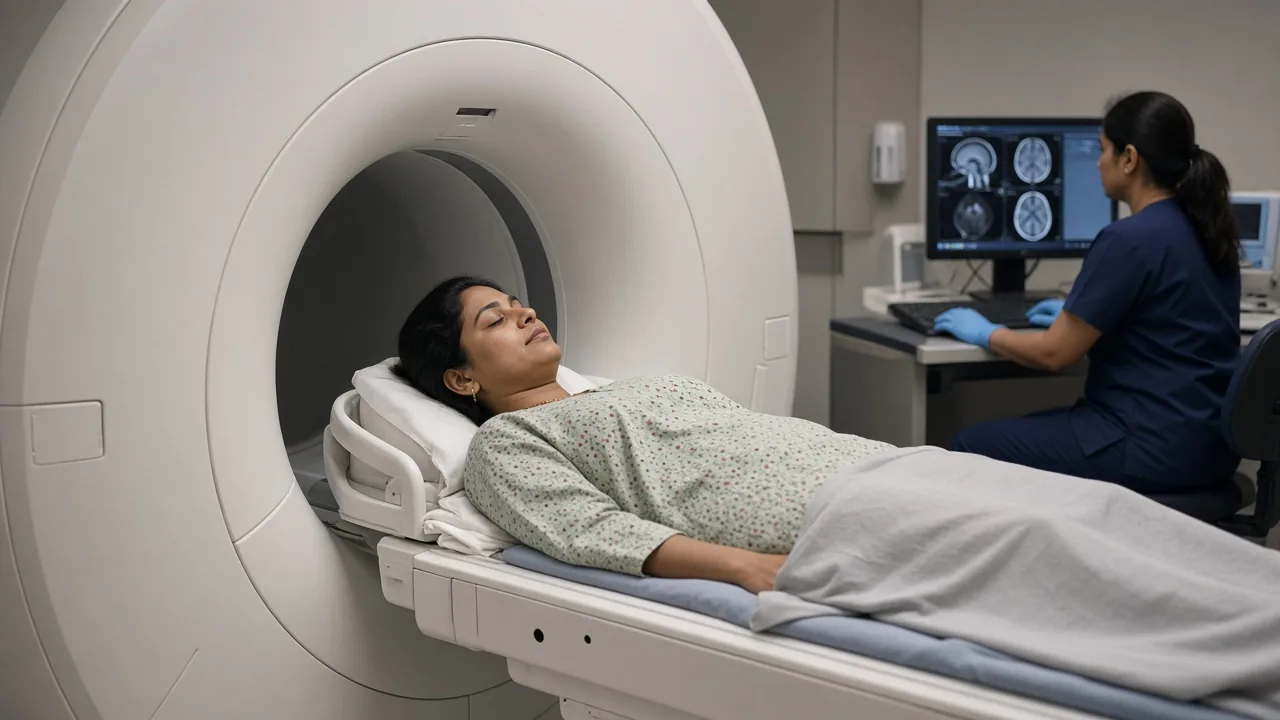
NCI notes that the linear growth pattern of lobular carcinoma can make mammography less sensitive and increase the utility of MRI for assessing the extent of disease.
MRI is not automatically required for every patient.
The decision depends on the clinical and imaging findings.
How Is Invasive Lobular Carcinoma Diagnosed?
Imaging can identify a suspicious area.
But the diagnosis requires tissue.
A typical diagnostic pathway may include:
- Clinical breast examination
- Mammography
- Ultrasound
- MRI when appropriate
- Core needle biopsy
- Pathology examination
- ER and PR testing
- HER2 testing
- Tumor grading
- Staging investigations when required
The biopsy is the key step that confirms the diagnosis.
What Does the Pathology Report Tell You?
A pathology report may contain several pieces of information.
Important findings include:
Histological type
This confirms whether the tumor is lobular, ductal or another histological type.
Grade
Grade describes how abnormal the cancer cells appear and gives information about their biological behavior.
ER status
This determines whether the tumor expresses estrogen receptors.
PR status
This determines whether progesterone receptors are present.
HER2 status
This identifies whether the tumor has HER2 overexpression or amplification.
Tumor size
The size of the invasive component contributes to staging.
Lymphovascular invasion
The pathologist may report whether cancer cells are seen within lymphatic or blood vessels.
Lymph-node status
If lymph nodes are removed, pathology can determine whether cancer cells are present.
These findings are interpreted together rather than individually.
Is Invasive Lobular Carcinoma Usually ER-Positive?
Many ILCs are hormone receptor-positive.
The American Cancer Society notes that ILCs are usually hormone receptor-positive and generally tend to grow more slowly than many other breast cancers.
However, "usually" does not mean "always."
A patient's own pathology report determines whether hormone therapy is relevant.
Does HER2 Matter in ILC?
Yes.
Although many ILCs are hormone receptor-positive and HER2-negative, HER2 testing is still important.
HER2 status can affect treatment decisions.
NCI identifies ER, PR and HER2 among the key biomarkers used to classify breast cancers and guide treatment.
If a tumor is HER2-positive, HER2-targeted therapy may become part of treatment.
How Is ILC Staged?
The stage describes how far the cancer has progressed.
Breast cancer staging considers factors including:
- Tumor size
- Lymph-node involvement
- Distant spread
- Tumor grade
- ER status
- PR status
- HER2 status
NCI distinguishes between clinical prognostic staging before treatment and pathological prognostic staging after surgery.
This is why two patients with the same histological type can receive very different treatment plans.
Does ILC Need Genetic Testing?
Genetic testing is not automatically required simply because a tumor is lobular.
However, some patients may be offered hereditary cancer testing based on factors such as:
- Age at diagnosis
- Family history
- Multiple cancers in the family
- Personal history of certain cancers
- Bilateral breast cancer
- Other clinical or genetic features
The decision should be based on established genetic-testing criteria rather than the word "lobular" alone.
How Is Early-Stage ILC Treated?
For operable ILC, surgery is often an important part of treatment.
Depending on the tumor and breast anatomy, the surgical options may include:
- Breast-conserving surgery
- Mastectomy
- Sentinel lymph-node biopsy
- Other lymph-node procedures when indicated
The choice depends on the extent of disease within the breast, tumor size, imaging findings, lymph-node status and other clinical factors.
Can ILC Be Treated With Lumpectomy?
Yes.
Lobular histology by itself does not automatically require mastectomy.
Breast-conserving surgery can be considered when the cancer can be removed with appropriate margins while preserving an acceptable amount of breast tissue. NCI notes that all histological types of invasive breast cancer may be treated with breast-conserving surgery followed by radiation when appropriate.
However, ILC can sometimes be more extensive than it initially appears.
This is one reason careful imaging before surgery can be important.
When Is Mastectomy Considered for ILC?
Mastectomy may be considered when:
- The tumor is extensive
- Multiple areas of cancer are present
- Clear margins cannot be achieved with breast-conserving surgery
- The breast would be significantly distorted by removing the tumor
- The patient has other factors affecting surgical choice
The decision should be based on the actual extent of disease rather than the diagnosis of ILC alone.
Why Are Surgical Margins Important in ILC?
The surgeon needs to remove the cancer with an appropriate margin of surrounding tissue.

This can sometimes be challenging when ILC spreads in a diffuse pattern.
If cancer cells remain at the surgical margin, additional surgery may be considered.
The final pathology report helps determine whether the margins are satisfactory.
Does ILC Require Lymph-Node Surgery?
Lymph-node evaluation is commonly considered for invasive breast cancer.
For many patients with clinically node-negative disease, sentinel lymph-node biopsy is used to check the first draining lymph nodes.
If lymph nodes contain cancer, the treatment plan may change depending on the number of involved nodes and other features.
More extensive axillary surgery is not automatically required for every patient.
Does ILC Require Chemotherapy?
Not necessarily.
This is an important point because patients sometimes assume that every invasive cancer automatically requires chemotherapy.
The decision depends on:
- Stage
- Tumor grade
- ER/PR status
- HER2 status
- Lymph-node involvement
- Tumor biology
- Patient factors
- Sometimes genomic testing
NCI specifically notes that tumor histology, stage, grade and molecular status all contribute to treatment selection.
Because many ILCs are hormone receptor-positive and may have other biological characteristics, chemotherapy decisions need to be individualized.
Can Genomic Tests Help Decide About Chemotherapy?
For some patients with hormone receptor-positive, HER2-negative invasive breast cancer, genomic assays can provide additional information about the likelihood of benefit from chemotherapy.
Examples include tests such as Oncotype DX and MammaPrint.
NCI lists gene-expression profiling among molecular approaches used in breast cancer.
Whether such a test is appropriate depends on the individual cancer.
It is not automatically necessary for every patient with ILC.
Hormone Therapy for Invasive Lobular Carcinoma
Hormone therapy is particularly relevant when ILC is estrogen receptor-positive or progesterone receptor-positive.
Depending on menopausal status and other factors, treatment may include:
- Tamoxifen
- Aromatase inhibitors
- Ovarian suppression in selected premenopausal patients
The treatment may continue for several years.
The exact medicine and duration depend on the individual's cancer and treatment history.
Why Is Hormone Therapy Important in ILC?
Many ILC tumors depend on hormone signaling for growth.
When a tumor is hormone receptor-positive, endocrine therapy can reduce stimulation of those cancer cells.
NCI identifies hormone receptor status as an important factor in predicting response to endocrine therapy and planning treatment.
For patients taking long-term hormone therapy, side effects and adherence should be discussed regularly with the oncology team.
What If ILC Is HER2-Positive?
If testing shows that the cancer is HER2-positive, HER2-directed treatment may be included.
Treatment may involve a combination of:
- HER2-targeted therapy
- Chemotherapy
- Surgery
- Radiation
- Hormone therapy when the tumor is also hormone receptor-positive
The exact sequence depends on stage and the individual tumor profile.
What If ILC Is Triple-Negative?
Triple-negative ILC is less common.
In this situation, the tumor does not express estrogen receptors, progesterone receptors or HER2.
Treatment is therefore different from the hormone receptor-positive ILC that is more commonly encountered.
Depending on stage and other factors, chemotherapy and immunotherapy may be considered.
NCI notes that treatment selection is based on stage and molecular characteristics rather than histological type alone.
Can ILC Be Treated With Radiation?
Yes.
Radiation therapy may be recommended after breast-conserving surgery.
It can also be recommended after mastectomy in selected patients depending on tumor size, lymph-node involvement and other risk factors.
Radiation is a local treatment, while chemotherapy and many drug treatments are systemic.
What Happens If ILC Has Spread to Lymph Nodes?
Lymph-node involvement affects staging and can influence the treatment plan.
Depending on the number of involved nodes and tumor biology, treatment may include combinations of:
- Surgery
- Radiation
- Chemotherapy
- Hormone therapy
- HER2-targeted treatment
- Other systemic therapies
The presence of lymph-node involvement does not by itself determine the entire treatment plan.
Can Invasive Lobular Carcinoma Spread to Other Organs?
Yes.
Because ILC is an invasive cancer, it can spread through the lymphatic system or bloodstream.
The American Cancer Society notes that ILC can spread to sites such as the bones, liver, lungs and brain and may also have a greater tendency than ductal carcinoma to involve certain less typical sites, including the digestive tract, ovaries or lining of the abdomen.
If distant spread is suspected, staging investigations are performed to determine where the cancer is located.
Does ILC Behave Differently After Treatment?
ILC can have a somewhat different pattern of recurrence compared with invasive ductal carcinoma.
The American Cancer Society notes that when ILC recurs, it may recur later than ductal carcinoma, sometimes more than 10 years after the original diagnosis.
This is one reason long-term follow-up remains important.
Oncology teams in Delhi NCR, Mumbai, Bengaluru, Chennai and Hyderabad can confirm the next step. Hospitals in Delhi NCR and Mumbai handle international follow-up.

It also reinforces why completing recommended hormone therapy and follow-up should be discussed carefully with the treating team.
What Is Metastatic Invasive Lobular Carcinoma?
Metastatic ILC means the cancer has spread from the breast to distant parts of the body.
Treatment at this stage is primarily systemic.
Depending on the tumor's biology, treatment may include:
- Hormone therapy
- Targeted therapy
- Chemotherapy
- Immunotherapy in appropriate settings
- Other systemic treatments
Radiation or surgery can still be useful for particular symptoms or specific sites of disease.
The treatment goal and sequence depend on the extent of metastatic disease and tumor biology.
Invasive Lobular Carcinoma Treatment in India
India has multidisciplinary cancer centers where ILC can be evaluated and treated.
A comprehensive team may include:
- Breast surgical oncologist
- Medical oncologist
- Radiation oncologist
- Breast radiologist
- Pathologist
- Reconstructive surgeon
- Genetic counselor when indicated
- Oncology rehabilitation team
For international patients, the ability to review pathology and imaging before travel can save time.
It also allows the hospital to determine whether additional tests are needed before surgery.
Why Is Pathology Review Important for International Patients?
If your biopsy was performed outside India, an Indian cancer center may recommend reviewing the original pathology.
This can help confirm:
- Invasive lobular carcinoma
- Tumor grade
- ER status
- PR status
- HER2 status
- Other pathological features
If necessary, the hospital may request the original slides or tissue blocks.
A pathology review can be particularly useful when treatment recommendations differ between doctors.
What Should International Patients Bring to India?
Try to bring:
- Original pathology report
- Biopsy slides
- Tissue blocks, if available
- Mammography images
- Ultrasound images
- MRI images
- CT/PET scans, if performed
- Previous consultation notes
- Surgical records
- Medication list
- Genetic test results, if available
Digital copies are useful, but original pathology material may be needed for review.
How Much Does Invasive Lobular Carcinoma Treatment Cost in India?
There is no single price for treating ILC.
The cost depends on what the individual patient needs.
Possible expenses include:
- Diagnostic imaging
- Pathology review
- Breast biopsy
- MRI
- Surgery
- Sentinel lymph-node biopsy
- Hospitalization
- Radiation therapy
- Chemotherapy
- Hormone therapy
- HER2-targeted treatment
- Immunotherapy when indicated
- Reconstruction
- Follow-up
A patient requiring lumpectomy and hormone therapy will have a very different cost from someone requiring mastectomy, chemotherapy, radiation and targeted treatment.
For this reason, GAF Healthcare should provide a case-specific quotation after reviewing the patient's records rather than publishing a single number as the expected cost.
Relevant treatment resources include Breast-Conserving Surgery (Lumpectomy), Mastectomy and Breast Reconstruction.
How Long Does ILC Treatment Take?
There is no standard treatment duration.
Some patients undergo surgery first and then receive radiation or systemic treatment.
Others receive systemic treatment before surgery.
The sequence depends on:
- Tumor size
- Lymph-node status
- HER2 status
- Hormone-receptor status
- Tumor grade
- Overall stage
- Planned surgery
NCI emphasizes that treatment is individualized according to stage and other clinical and pathological factors.
International patients should therefore ask the hospital for an estimated treatment timeline before arranging flights and accommodation.
What Happens After ILC Treatment?
Follow-up continues after active treatment.
Depending on the treatment received, follow-up may include:
- Clinical examinations
- Breast imaging
- Monitoring hormone therapy
- Management of treatment side effects
- Assessment of arm and shoulder function
- Reconstruction follow-up
- Monitoring for new symptoms
There is no universal need for routine PET-CT or other advanced scans in every asymptomatic survivor.
The surveillance plan should be based on the patient's treatment history and clinical situation.
What Questions Should You Ask Your ILC Specialist?
Before finalizing treatment, consider asking:
- About the diagnosis
- Is this definitely invasive lobular carcinoma?
- What is the tumor grade?
- What is the tumor size?
- Is the cancer multifocal?
- Are the lymph nodes involved?
- About biomarkers
- Is the cancer ER-positive?
- Is it PR-positive?
- Is it HER2-positive?
- Is additional molecular testing needed?
- About surgery
- Can I have breast-conserving surgery?
- Would MRI change the surgical plan?
- Do I need sentinel lymph-node biopsy?
- Is reconstruction appropriate?
- About systemic treatment
- Do I need chemotherapy?
- Would a genomic test help?
- Will I need hormone therapy?
- Is targeted therapy required?
- About radiation
- Will I need radiation after surgery?
- What area will be treated?
- How long will treatment take?
These questions can make a consultation much more productive.
Frequently Asked Questions Is invasive lobular carcinoma a serious type of breast cancer?
ILC is an invasive breast cancer, meaning it has grown beyond the lobules into surrounding tissue. Its seriousness depends on the stage, grade, biomarkers and other characteristics of the individual tumor.
Is ILC worse than invasive ductal carcinoma?
The two cancers have different biological and growth characteristics, so comparing them as simply "better" or "worse" is misleading. Treatment and outlook depend on the individual cancer's stage, grade and biomarkers.
Can ILC be felt as a lump?
Sometimes, but not always. It can grow diffusely through breast tissue and may instead cause thickening or a change in breast shape.
Is ILC usually hormone receptor-positive?
Many ILCs are hormone receptor-positive, although individual tumors vary. The pathology report determines whether hormone therapy is appropriate.
Does ILC require chemotherapy?
Not automatically. Chemotherapy decisions depend on stage, grade, biomarkers, lymph-node status and other clinical factors.
Can ILC be treated with lumpectomy?
Yes. Breast-conserving surgery can be considered when the cancer can be adequately removed while preserving the breast.
Is mastectomy necessary for ILC?
No, not simply because the cancer is lobular. It may be recommended when the disease is extensive or cannot be adequately removed with breast-conserving surgery.
Does ILC spread to lymph nodes?
It can. Lymph-node assessment is therefore part of staging for many patients with invasive breast cancer.
Can ILC spread to the other breast?
ILC is more likely than many other breast cancers to be found in both breasts. Appropriate imaging and clinical assessment help evaluate the opposite breast.
Can ILC recur many years later?
Yes. The American Cancer Society notes that ILC can recur later than invasive ductal carcinoma, sometimes more than 10 years after the initial diagnosis.
Can ILC be treated in India?
Yes. Treatment can be provided through multidisciplinary breast cancer centers involving surgical oncology, medical oncology, radiation oncology, radiology and pathology.
How much does ILC treatment cost in India?
There is no fixed cost. The total depends on the stage, surgery, pathology, radiation and systemic treatment required.
Frequently Asked Questions
What is invasive lobular carcinoma?
Invasive lobular carcinoma is a type of invasive breast cancer that begins in the milk-producing lobules and grows into surrounding breast tissue.
How common is ILC?
ILC accounts for approximately 10% to 15% of invasive breast cancers.
Does ILC cause a lump?
Not always. ILC can grow in thin strands through breast tissue rather than forming a distinct lump, so some patients notice thickening, fullness or a subtle change instead.
Is ILC harder to detect on a mammogram?
It can be. Its diffuse growth pattern may make it less obvious on mammography or ultrasound than a more typical mass-forming breast cancer.
Is invasive lobular carcinoma usually hormone receptor-positive?
Many ILCs are hormone receptor-positive, although individual tumors can have different biomarker profiles.
How is ILC treated?
Treatment depends on stage and tumor biology. Surgery is commonly used, with radiation, hormone therapy, chemotherapy or targeted therapy added when indicated.
Is chemotherapy always needed for ILC?
No. Chemotherapy is not automatically required. The decision depends on factors including stage, grade, biomarkers and the overall risk profile.
Can ILC affect both breasts?
It is more likely to involve both breasts than many other breast cancer types.
Can ILC spread to other organs?
Yes. Like other invasive breast cancers, ILC can spread through the lymphatic system or bloodstream. Its pattern of spread can differ from invasive ductal carcinoma.
How much does invasive lobular carcinoma treatment cost in India?
There is no single price. The cost depends on the stage, surgery, pathology, radiation, medicines and whether chemotherapy or targeted treatment is required. A case-specific estimate is more useful than a generic figure.
What Is Invasive Lobular Carcinoma?
The breast contains milk-producing glands called lobules.