Last updated: 13 September 2026 · Content curated by Dr. Shabnam Choudhary · Medically reviewed by Dr. Saffiyyah Chaudhary
Quick Answer
Bronchoscopy in India is typically planned at $400–$1,200 per procedure, with Outpatient or 1 night as the stored stay guide. The range commonly covers the named pulmonologist, procedure suite, standard monitoring, sedation or anaesthesia, routine consumables and quoted ward care; CT or PET review, advanced devices, pathology, molecular testing, ICU and treatment after results may be separate. $2,000–$6,000 is the comparison reference.
Inspection and lavage use fewer tools than mucus-plug clearance, bleeding control or treatment of an obstruction and may have different anaesthesia and admission needs. BAL, brushings, forceps biopsies and needle samples each add consumables and separate cytology, microbiology or histopathology lines.
- India cost range
- $400–$1,200
- Typical starting point
- $400
- Typical hospital stay
- Outpatient or 1 night
- Procedure time
- Commonly about 20–60 minutes for the scope, plus preparation and monitored sedation recovery
- Recovery
- A numb or sore throat, hoarse voice, cough, sleepiness and small blood streaks after biopsy can occur for a day or two.
Major cost factors: diagnostic versus therapeutic purpose, sampling plan, flexible versus rigid backup, respiratory reserve. International patients should also budget for accommodation, airport transfers, a medical visa, medicines and follow-up.
Often quoted separately: changed procedural scope; complications and escalation; premium devices and consumables; advanced diagnostics; travel and ongoing care.
Why request a cost through GAF rather than a hospital?
Writing to one campus gets you that campus’s package. A GAF request is reviewed against your records and returned as suitable doctor and hospital options with an indicative, itemised estimate. There is no obligation to book.
- Doctor review first. The number follows a reading of your imaging, test results and clinical records, not a brochure range.
- Hospital options. You can compare listed campuses before you travel, instead of starting over with each international desk.
- International-patient coordination. Visa letters, records routing and companion logistics sit with the same request.
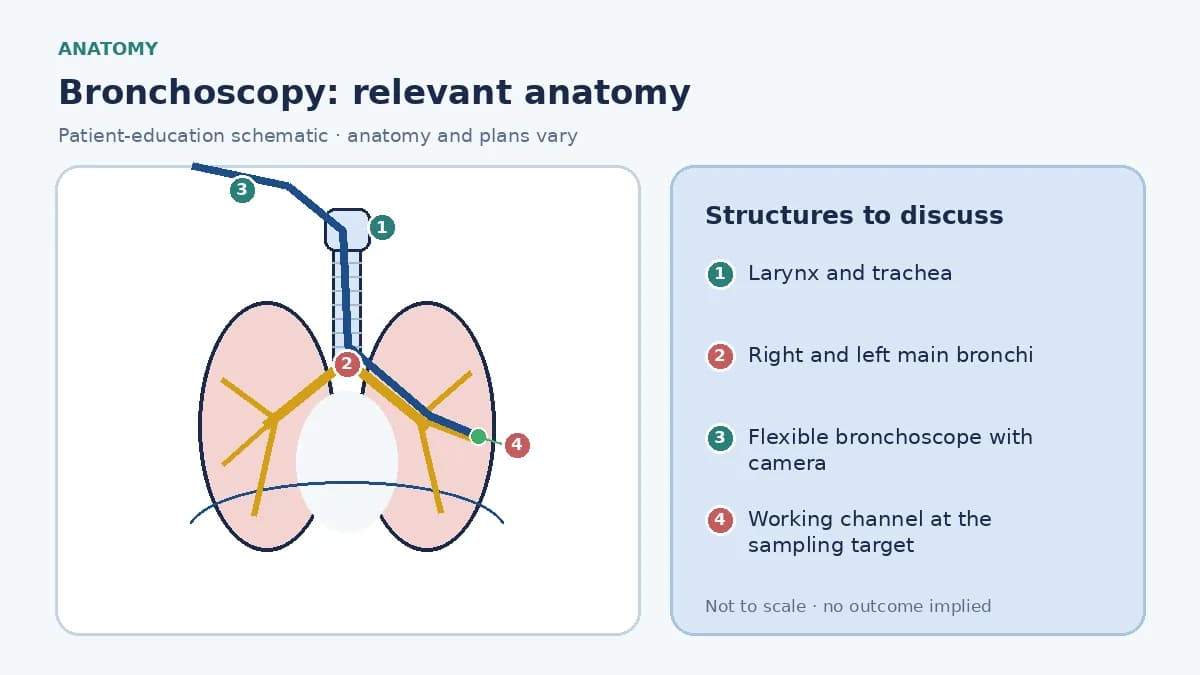
The trachea divides into right and left main bronchi, then progressively smaller airways. CT shows their shape from outside, but bronchoscopy gives a live view of the lining and lets the pulmonologist collect material from a precise segment. Saline introduced and suctioned back as bronchoalveolar lavage can identify infection, inflammation or malignant cells; forceps, brushings or needles collect tissue. A flexible scope reaches segmental bronchi, while a rigid scope creates a larger airway corridor for bleeding control and therapeutic tools.
This sheet covers standard flexible bronchoscopy and its common diagnostic sampling. EBUS, rigid bronchoscopy, transbronchial lung biopsy, endobronchial biopsy, TBNA, tumour debulking and foreign-body removal have separate active CMS slugs. The stored range is one procedure, not all possible samples, molecular studies or later treatment.
This guide compares quotations; it cannot diagnose, choose a procedure or decide timing. A respiratory specialist must connect symptoms, imaging, physiology and laboratory findings and explain uncertainty.
What Is Bronchoscopy?
Bronchoscopy is a minimally invasive airway procedure in which a thin flexible scope with a light, camera and working channel passes through the nose or mouth, larynx and trachea into the bronchi. It can inspect the airway, wash cells and microbes from a lung segment, brush or biopsy a lesion and, in therapeutic cases, remove secretions or treat an obstruction.
When Might Bronchoscopy Be Considered?
Bronchoscopy may be considered for persistent or unexplained cough, coughing blood, an abnormal chest X-ray or CT, a lung nodule or mass near an airway, unexplained collapse of a lung segment, recurrent or unusual infection, suspected airway narrowing or foreign body, and for obtaining lavage, cytology or biopsy when the result would change treatment.
How the operation is performed, recovery and variations →
Bronchoscopy cost in India
$400–$1,200 is the stored India planning range for bronchoscopy, per procedure, and $2,000–$6,000 the stored self-pay comparison. Neither is a guaranteed package; changed technique, extra pathology, ICU support or a longer stay alters the amount.
A usable estimate names the clinician, campus, approach, flexible bronchoscope and agreed sampling, sedation or anaesthesia, oxygen, ward nights, specimen studies and follow-up, with professional, facility, device, imaging and laboratory lines separated.
Budget separately for flights, visa, insurance, transfers, companion, lodging, meals, home oxygen or equipment and local follow-up unless included.
Planning Range ≠ Final Hospital Quotation. Current imaging, respiratory reserve, oxygen needs and assessment by a named pulmonologist or interventional pulmonologist come before technique, risks and a final offer are meaningful.
Planning range or quotation?
The $400–$1,200 figure is an indicative planning range. A final hospital quotation is itemised, issued after a consultant reviews your records, and still subject to what is found clinically.
Get a Personalized Cost Estimate
What is usually included in a Bronchoscopy package?
No two hospitals draw the line in the same place, so read an estimate for what it excludes as carefully as for what it covers. The pattern below is what listed campuses typically bundle into a surgical estimate for this procedure. Anything not written into your estimate should be assumed to be extra until the hospital confirms otherwise.
Usually included
Usually included
Named respiratory consultation
Records and imaging review by the operating pulmonologist when explicitly listed.
Usually included
Pre-procedure assessment
Stated blood tests, ECG, oxygen assessment, urine tests and anaesthesia review; unlisted work-up is extra.
Usually included
Procedure suite and sedation
Bronchoscopy or procedure-room time, standard monitoring, sedation or anaesthesia and recovery care within scope.
Usually included
Quoted hospital stay
The stated day-care or ward category, routine oxygen, nursing and medicines for the listed nights.
Usually included
Standard specimen processing
Histopathology, cytology or microbiology only when itemized; molecular panels and special stains may be separate.
Usually included
Flexible bronchoscope and agreed sampling
The stated scope, local anaesthetic, standard lavage, brushing or forceps consumables and initial specimen handling when itemized.
May be charged separately
May be separate
Changed procedural scope
A diagnostic scope becoming therapeutic, rigid-bronchoscopy conversion or an additional biopsy or drainage procedure.
May be separate
Complications and escalation
Unplanned ICU, ventilation, transfusion, chest drain, re-intervention, readmission or extra nights unless covered.
May be separate
Premium devices and consumables
Airway stents, valves, cryoprobes, catheters and single-use scopes beyond the written specification.
May be separate
Advanced diagnostics
PET-CT, molecular or biomarker testing, special microbiology, expert pathology review and repeat imaging unless listed.
May be separate
Travel and ongoing care
Flights, visa, insurance, lodging, companion, home oxygen, rehabilitation and treatment after return.
May be separate
EBUS, rigid intervention and advanced tissue studies
Ultrasound-guided nodal sampling, rigid bronchoscopy, stents, tumour ablation, molecular panels and repeat biopsy are separate unless written.
Catalog inclusions listed for this pathway: pulmonology consultation and records review; named consultant on camera before travel; scope, anaesthesia and overnight stay as quoted; histology, drain or icu step-down as indicated; discharge summary to your home physician.
What can increase the cost?
These are the drivers that actually move a bill for this operation, in rough order of how often they do it. Most of them are clinical decisions rather than commercial ones, which is why an honest estimate is written after a records review rather than before it.
- Diagnostic versus therapeutic purpose
- Inspection and lavage use fewer tools than mucus-plug clearance, bleeding control or treatment of an obstruction and may have different anaesthesia and admission needs.
- Sampling plan
- BAL, brushings, forceps biopsies and needle samples each add consumables and separate cytology, microbiology or histopathology lines.
- Flexible versus rigid backup
- A flexible day-care scope differs from a theatre procedure with rigid-bronchoscopy and anaesthesia backup for obstruction or significant bleeding.
- Respiratory reserve
- Severe COPD, low oxygen, pulmonary hypertension or recent respiratory failure can require arterial blood gas testing, anaesthesia, high-dependency monitoring or ICU.
- Infection precautions and microbiology
- Suspected tuberculosis or unusual infection may need isolation, special cultures, PCR or fungal studies and longer laboratory turnaround.
- Pathology and molecular testing
- Routine cytology or histology is different from immunohistochemistry and lung-cancer biomarker panels; tissue adequacy may require another procedure.
- Imaging and physiological testing
- Chest CT or HRCT, PET-CT, spirometry, DLCO, arterial blood gas and echocardiography add lines only when clinically relevant.
- Respiratory reserve and anaesthesia
- Low oxygen, severe airflow limitation, pulmonary hypertension and comorbidity change sedation, monitoring and ICU probability.
- Hospital category and room
- Campus tier, room class, bronchoscopy-suite resources and city shift facility and nursing charges.
- Pathology and follow-up
- Tissue adequacy, microbiology, molecular testing, repeat procedures and review after results alter the complete diagnostic cost.
Bronchoscopy: approaches and where they differ
The approach follows the clinical question, imaging target, airway or pleural anatomy, respiratory reserve and available equipment. Each option has different consumables, monitoring and follow-up, so the quotation must name it.
Swipe to compare surgical approaches →
| Approach | Relative complexity | GAF planning range | Notes |
|---|---|---|---|
| Flexible diagnostic bronchoscopy | Individual respiratory assessment determines suitability | No separate GAF sheetRelative complexity only | A slim scope under local anaesthetic and moderate sedation inspects segmental airways and permits washings, brushings and selected biopsies. It is usually day care. |
| Bronchoalveolar lavage (BAL) | Individual respiratory assessment determines suitability | No separate GAF sheetRelative complexity only | Sterile saline is instilled into a chosen lung segment and recovered for bacterial, fungal, tuberculosis, cytology or inflammatory studies. Laboratory panels drive cost. |
| Endobronchial brushing or forceps biopsy | Individual respiratory assessment determines suitability | No separate GAF sheetRelative complexity only | Visible mucosal or tumour tissue is sampled through the working channel. Bleeding risk and histopathology are greater than with inspection alone. |
| Therapeutic flexible bronchoscopy | Individual respiratory assessment determines suitability | No separate GAF sheetRelative complexity only | Secretions or mucus plugs are suctioned and selected minor obstructions treated. Major bleeding, central obstruction, stenting or foreign bodies usually need rigid bronchoscopy. |
Planning ranges appear only where GAF Healthcare already publishes a cost sheet for that operation. Other rows describe relative clinical complexity and should not be read as prices.
Diagnostic pulmonology: the subspecialty behind Bronchoscopy
Diagnostic pulmonology connects respiratory symptoms and chest imaging to physiological tests, airway inspection and tissue or microbiology sampling. The question being answered determines whether a wash, brushing, forceps biopsy, needle aspiration or parenchymal biopsy is appropriate.
Inspection, lavage and biopsy answer different questions
Inspection describes the airway surface: inflammation, secretions, narrowing, bleeding or a visible lesion. Bronchoalveolar lavage samples cells and microbes from smaller airways and alveoli beyond the camera's view. Brushings scrape cells from a surface, while forceps remove a small piece of visible tissue. The CT target and suspected diagnosis determine which are useful; collecting every sample routinely adds risk and cost without necessarily improving the answer.
Laboratory handling must be decided before the scope. Tuberculosis and fungal cultures need sterile microbiology containers, cytology needs cell-preserving fluid and a tumour biopsy needs formalin with enough viable tissue for immunohistochemistry and molecular testing. Ask the team to state the specimen plan and what happens if the sample is inadequate.
When EBUS or rigid bronchoscopy is a different procedure
Standard flexible bronchoscopy sees the inside of the airway but cannot see lymph nodes beyond its wall. EBUS adds an ultrasound probe and needle to sample mediastinal or hilar nodes for lung-cancer staging and other diagnoses; it therefore uses different equipment, cytology support and a separate cost sheet. A peripheral lung nodule may require navigation, radial ultrasound, transbronchial biopsy or a CT-guided route instead.
Rigid bronchoscopy uses a metal tube under general anaesthesia to secure a large airway and accommodate stents, balloons, suction and tumour-debulking tools. It is chosen for major central obstruction, large foreign bodies or bleeding control—not as a more expensive version of routine inspection.
Risks and side effects of Bronchoscopy
Risks include cough, throat irritation, transient low oxygen, wheeze or bronchospasm, nausea or reaction to sedatives, fever after lavage, bleeding after biopsy, infection and an inadequate or non-diagnostic sample. Pneumothorax is uncommon after airway inspection or lavage but becomes a relevant risk when a transbronchial lung biopsy is added; severe bleeding, respiratory deterioration or need for intubation is uncommon but requires immediate support.
Ask before travel who pays for unplanned ventilation, ICU, chest drainage, transfusion, repeat biopsy, readmission or a second procedure.
Bronchoscopy cost: India vs other medical tourism destinations
India and US values use stored GAF planning ranges; other countries require direct quotations. Compare the same intent, technique, devices, sedation, pathology, ward category and complication terms for bronchoscopy.
Swipe to compare destinations →
| Country | Approximate cost | Relative cost position | Important cost considerations |
|---|---|---|---|
| India | $400–$1,200 | Baseline | GAF catalog planning range. The stored figure covers the named procedure only as written. Diagnostic versus therapeutic scope, anaesthesia, devices, pathology and ICU assumptions must be itemized. |
| Turkey | Confirmation requiredIndicative planning estimate* | Higher than India | Direct quotation required. Compare scope type, biopsy or intervention, anaesthesia, pathology, molecular testing and complication terms rather than a headline package. |
| Thailand | Confirmation requiredIndicative planning estimate* | Higher than India | Direct quotation required. International coordination does not establish tissue adequacy, pathology turnaround, oxygen needs or continuity after return. |
| United Arab Emirates | Confirmation requiredIndicative planning estimate* | Higher than India | Direct quotation required. Pulmonologist, facility, anaesthesia, device, imaging, pathology and follow-up charges may be separate. |
| Singapore | Confirmation requiredIndicative planning estimate* | Higher than India | Private self-pay varies. Request an estimate tied to the imaging target, technique, device, tissue studies and expected admission. |
| Germany | Confirmation requiredIndicative planning estimate* | Higher than India | Private billing varies. Professional billing, eligibility, device scope and postoperative respiratory follow-up require provider confirmation. |
| United Kingdom | Confirmation requiredIndicative planning estimate* | Higher than India | Private self-pay varies. Overseas patients should verify acceptance, urgent respiratory access, pathology delivery and home handover. |
| United States | $2,000–$6,000 | ≈5× India | Stored self-pay reference. Pulmonologist, anaesthesia, facility, pathology and device charges may be separate; $2,000–$6,000 is a comparison range, not a quotation. |
International comparisons are indicative. Currency, changed findings, an added device or biopsy, pathology scope and respiratory monitoring alter the final amount.
Why do international patients consider India for bronchoscopy?
Some patients consider India for bronchoscopy because tertiary respiratory teams, interventional bronchoscopy, pleural services, pathology and respiratory critical care can be coordinated with a national planning range. Price alone is not a clinical reason to travel.
Evaluate clinician, licensure, campus, equipment, anaesthesia, ICU backup, pathology quality, urgent access and home handover. No provider is ranked and no outcome is promised; unstable breathing or suitable local care can make travel inappropriate.
Hospitals and respiratory centres for Bronchoscopy in India
Cards follow exact live relationships for Bronchoscopy. A general Pulmonology or accreditation label does not establish current acceptance, equipment or outcomes.
Indraprastha Apollo Hospital
 JCI Accredited
 NABH Accredited
- Radiation Oncology
- Surgical Oncology
- Medical Oncology
- Hematology
11 listed doctors for this pathway
Languages listed: English, Hindi
Apollo Hospital, Jubilee Hills, Hyderabad
- JCI Accredited
- NABH Accredited
- Radiation Oncology
- Surgical Oncology
- Medical Oncology
- Hematology
5 listed doctors for this pathway
Languages listed: English, Telugu, Hindi
Apollo Hospitals, Bannerghatta Road
- JCI Accredited
- NABH Accredited
- Radiation Oncology
- Surgical Oncology
- Medical Oncology
- Hematology
4 listed doctors for this pathway
Languages listed: English, Kannada, Hindi
Apollo Hospitals, Navi Mumbai
- JCI Accredited
- NABH Accredited
- Radiation Oncology
- Surgical Oncology
- Medical Oncology
- Hematology
4 listed doctors for this pathway
Languages listed: English, Hindi, Marathi
Artemis Hospital
- JCI Accredited
- NABH Accredited
- DHADHA
- Radiation Oncology
- Surgical Oncology
- Medical Oncology
- Hematology
3 listed doctors for this pathway
Languages listed: English, Hindi
BLK-Max Super Speciality Hospital
- JCI Accredited
- NABH Accredited
 NABL Accredited
- Radiation Oncology
- Surgical Oncology
- Medical Oncology
- Hematology
5 listed doctors for this pathway
Languages listed: English, Hindi
Fortis Memorial Research Institute
- JCI Accredited
- NABH Accredited
- NABL Accredited
- Radiation Oncology
- Surgical Oncology
- Medical Oncology
- Hematology
5 listed doctors for this pathway
Languages listed: English, Hindi
Fortis Hospital, Noida
- JCI Accredited
- NABH Accredited
- NABL Accredited
- Radiation Oncology
- Surgical Oncology
- Medical Oncology
- Hematology
3 listed doctors for this pathway
Languages listed: English, Hindi
Bronchoscopy hospitals in India · Talk to a treatment coordinator
Bronchoscopy specialists in India
Profiles appear only when Bronchoscopy is an exact current CMS relationship. Verify respiratory subspecialty, availability and campus; placement is not a ranking or outcome claim.

Dr. Ajay Kumar
Pulmonology
25+ years Experience
Bronchoscopy · EBUS (Endobronchial Ultrasound) · Medical Thoracoscopy
English, Hindi
Dr. Battu Chaithanya
Pulmonology
15+ years Experience
Lung Transplantation · Bronchoscopy · EBUS (Endobronchial Ultrasound)
English, Telugu, Hindi
Dr. Arjun Ramaswamy
Pulmonology
10+ years Experience
Bronchoscopy · EBUS (Endobronchial Ultrasound) · Medical Thoracoscopy
English, Hindi, Marathi
Dr. Aishwarya Rajkumar
Pulmonology
15+ years Experience
Bronchoscopy · Airway Stenting · Interstitial Lung Disease
English, Tamil, Hindi
Dr. Anand Jaiswal
Pulmonology
44+ years Experience
Bronchoscopy · EBUS (Endobronchial Ultrasound) · Medical Thoracoscopy
English, Hindi
Dr. Belgundi Preeti Vidyasagar
Pulmonology
13+ years Experience
EBUS (Endobronchial Ultrasound) · Medical Pleuroscopy · Transbronchial Lung Biopsy
English, Telugu, Hindi
Dr. Manjunath B G
Pulmonology
20+ years Experience
Bronchoscopy · EBUS (Endobronchial Ultrasound) · TBNA (Transbronchial Needle Aspiration)
English, Kannada, Hindi
Bronchoscopy doctors in India (109 listed) · Get a personalized cost estimate
Bronchoscopy cost by city in India
Delhi NCR, Mumbai, Bengaluru, Chennai and Hyderabad use $400–$1,200 because no verified city tariff is stored. City overlays add campus geography, transfers, climate, oxygen logistics and follow-up without inventing prices. Cards require an exact current Bronchoscopy CMS relationship.
Swipe to compare Indian cities →
Delhi NCR
$400–$1,200
India planning band — not a city quote
Typical stay Outpatient or 1 night
No verified Delhi NCR-only tariff for bronchoscopy is stored. Use $400–$1,200 as the national planning range until a named provider issues an itemized estimate; it is not a city price.
14 hospitals · 58 doctors
Mumbai
$400–$1,200
India planning band — not a city quote
Typical stay Outpatient or 1 night
No verified Mumbai-only tariff for bronchoscopy is stored. Use $400–$1,200 as the national planning range until a named provider issues an itemized estimate; it is not a city price.
5 hospitals · 12 doctors
Bengaluru
$400–$1,200
India planning band — not a city quote
Typical stay Outpatient or 1 night
No verified Bengaluru-only tariff for bronchoscopy is stored. Use $400–$1,200 as the national planning range until a named provider issues an itemized estimate; it is not a city price.
3 hospitals · 7 doctors
Chennai
$400–$1,200
India planning band — not a city quote
Typical stay Outpatient or 1 night
No verified Chennai-only tariff for bronchoscopy is stored. Use $400–$1,200 as the national planning range until a named provider issues an itemized estimate; it is not a city price.
3 hospitals · 9 doctors
Hyderabad
$400–$1,200
India planning band — not a city quote
Typical stay Outpatient or 1 night
No verified Hyderabad-only tariff for bronchoscopy is stored. Use $400–$1,200 as the national planning range until a named provider issues an itemized estimate; it is not a city price.
5 hospitals · 23 doctors
Costs vary considerably by hospital, specialist, clinical complexity, insurance, room or day-care category, and what is included in the package.
Choosing a city for bronchoscopy
What should international patients budget beyond the pulmonology procedure?
International planning starts with records and a named respiratory question. A remote opinion is provisional until examination, image review and anaesthesia assessment confirm the plan.
- Send records
- Provide chest ct or hrct report and complete image files showing the airway or lung target and recent imaging files.
- Remote review
- A named pulmonologist or interventional pulmonologist reviews whether bronchoscopy answers the clinical question.
- Define scope
- Name diagnostic or therapeutic intent, technique, samples, devices and likely stay.
- Itemize quotation
- Clinician, suite, anaesthesia, consumables, pathology, ward and exclusions.
- Plan travel
- Flexible flights, accessible lodging, companion and oxygen or equipment logistics.
- Arrive and reassess
- Examination, oxygen assessment, imaging and pre-anaesthetic review.
- Confirm consent
- Purpose, alternatives, risks, possible escalation and sample limitations.
- Complete procedure
- The consented bronchoscopy with respiratory monitoring.
- Early recovery
- Airway, oxygen level, bleeding, pain and sedation recovery.
- Review results
- Imaging, cytology, histopathology or microbiology and any next step.
- Clear travel
- Written travel fitness, medicines, oxygen and urgent-contact plan.
- Handover home
- Procedure note, images, pathology and follow-up schedule for the home team.
- Treatment episode$400–$1,200
- Pre-operative testsOften inside the estimate — confirm
- Hospital stayOutpatient or 1 night typically bundled
- Additional procedures or extended careQuoted separately if advised
- Accommodation for companionVaries by city and length of stay
- Local transportationAirport and daily hospital transfers
- FlightsDepends on origin
- Medical visaFee set by the issuing consulate
Planning estimate — not a hospital quotation.
Get a Personalized Treatment Estimate
What does medical travel for bronchoscopy in India involve?
The sequence below is how a records-first pathway normally runs. The order matters: everything before arrival exists so that you are not making decisions in an unfamiliar hospital corridor with a suitcase beside you.
Define the question
Symptoms, diagnosis, imaging target and prior treatment.
Collect records
CT or HRCT, physiology, pathology and admission history.
Identify specialist
Named pulmonologist or interventional pulmonologist and exact campus.
Assess reserve
Oxygen, lung function, comorbidity and anaesthesia fitness.
Choose technique
Diagnostic or therapeutic method for the findings.
Compare quotes
Same scope, devices, samples, nights and follow-up.
Plan travel
Flexible travel, accessible lodging, companion and oxygen.
Confirm consent
Purpose, alternatives, risks and possible escalation.
Complete care
Procedure and monitored recovery.
Process samples
Cytology, histopathology, microbiology or molecular tests.
Attend review
Results, oxygen or device plan and next treatment.
Handover home
Procedure record and respiratory follow-up schedule.
Documents to prepare
- Chest CT or HRCT report and complete image files showing the airway or lung target
- Previous bronchoscopy, lavage, cytology, histopathology and microbiology reports
- Current oxygen requirement, baseline saturation and recent respiratory admission records
- Anticoagulant or antiplatelet prescriptions and relevant allergies
- Recent pulmonology consultation and medication list
- Chest X-ray, CT chest or HRCT reports and image files where available
- Pulmonary function tests including spirometry and DLCO where performed
- Oxygen prescription, CPAP/BiPAP settings and recent admission summaries where relevant
Clinical detail
How the procedure is performed
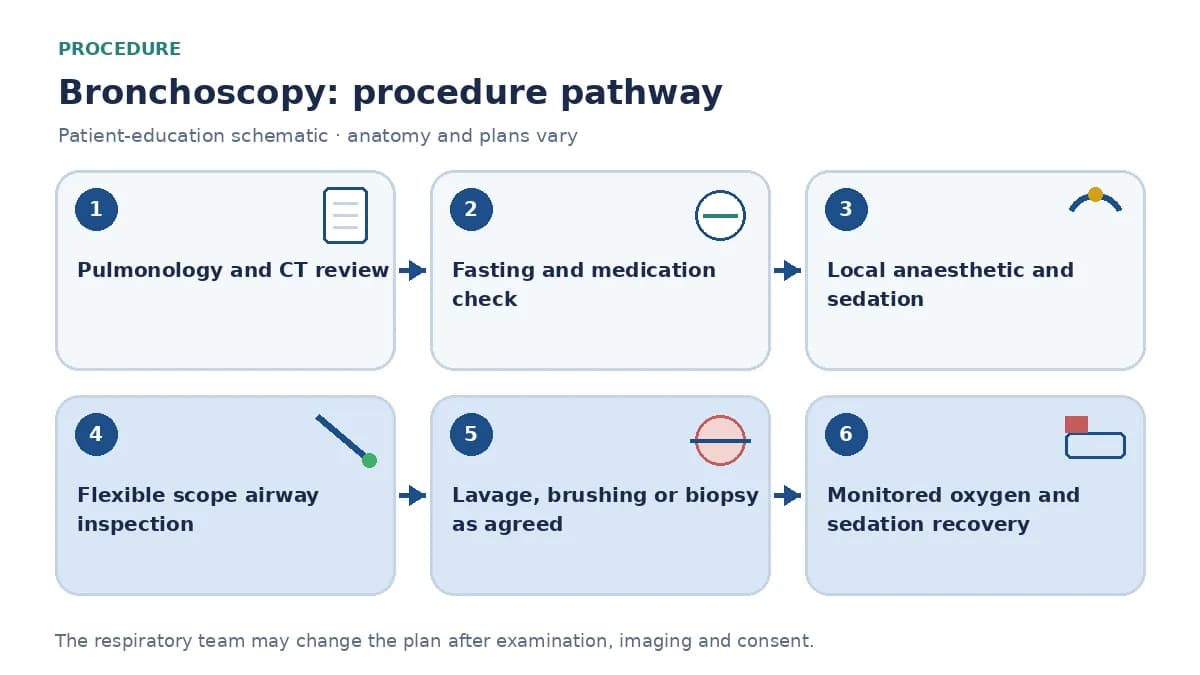
After fasting and consent, monitoring is applied and the nose and throat are numbed with local anaesthetic. With conscious sedation or, in selected cases, general anaesthesia, the flexible bronchoscope passes through the vocal cords into the trachea. The pulmonologist maps both bronchial trees, photographs abnormalities and performs only the agreed sampling: suction, saline lavage, brushing, forceps biopsy or a needle technique. Oxygen is given and saturation, heart rhythm and blood pressure are watched throughout.
Recovery staff monitor breathing, oxygen level, pulse, blood pressure, alertness and any bleeding until sedation and throat numbness recede. Food and drink wait until swallowing is safe. A chest X-ray is not routine after inspection or lavage but is obtained if a peripheral biopsy was performed or chest pain, breathlessness or low oxygen raises concern for pneumothorax.
Main variations
- Flexible diagnostic bronchoscopy
- A slim scope under local anaesthetic and moderate sedation inspects segmental airways and permits washings, brushings and selected biopsies.
- Bronchoalveolar lavage (BAL)
- Sterile saline is instilled into a chosen lung segment and recovered for bacterial, fungal, tuberculosis, cytology or inflammatory studies.
- Endobronchial brushing or forceps biopsy
- Visible mucosal or tumour tissue is sampled through the working channel.
- Therapeutic flexible bronchoscopy
- Secretions or mucus plugs are suctioned and selected minor obstructions treated.
Preparation
Assessment typically includes the actual CT chest or HRCT images, not only the report, oxygen saturation and respiratory examination, blood count and clotting tests when biopsy is planned, medication and anticoagulant review, pulmonary function or arterial blood gas in people with limited reserve, urine or sputum microbiology where relevant and an anaesthesia review if deep sedation is anticipated.
Clinicians direct fasting, inhalers, anticoagulants, diabetes medicines, antibiotics and oxygen. Active infection or unstable breathing may postpone an elective procedure.
Hospital stay and recovery
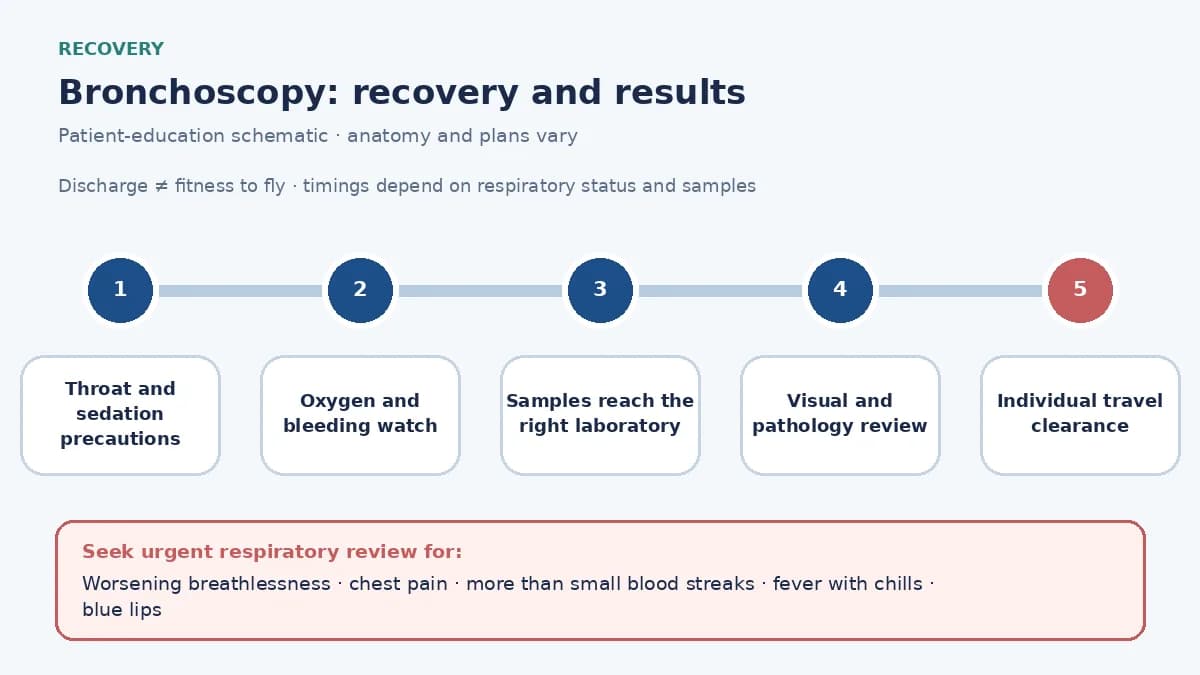
Most uncomplicated flexible bronchoscopies are day-care procedures or require one night; the stored Outpatient or 1 night reflects that. Frailty, low oxygen, substantial bleeding, pneumothorax or a therapeutic intervention can require admission. A numb or sore throat, hoarse voice, cough, sleepiness and small blood streaks after biopsy can occur for a day or two. A responsible adult should accompany the patient after sedation, and driving, alcohol and important decisions are avoided for the period instructed by the anaesthesia team. Flying is discussed after breathing and oxygen return to baseline and any biopsy-related pneumothorax has been excluded.
Follow the oxygen, activity and equipment plan. Seek urgent respiratory help for worsening breathlessness, chest pain, coughing more than small streaks of blood, fever with chills, confusion or blue lips.
How to compare Bronchoscopy quotes from Indian hospitals
Print these and work through them on the video call. A house that answers without hedging is telling you something useful about how it will behave when something goes wrong.
- Who is the named pulmonologist or interventional pulmonologist, and at which campus?
- What clinical question will bronchoscopy answer or treat?
- Is the scope diagnostic, therapeutic or both?
- Which approach is planned, and what might change it?
- Are pulmonologist, anaesthesia and procedure-suite fees included?
- Which imaging and respiratory tests are needed before the procedure?
- Which scopes, needles, probes, stents, valves, drains or catheters are assumed?
- Which cytology, histopathology and microbiology studies are included?
- Is molecular or biomarker testing included when tissue is obtained?
- How many day-care or ward nights are quoted?
- Are oxygen, non-invasive ventilation and ICU escalation covered?
- What is charged if another procedure or repeat sample is needed?
- How are pneumothorax, bleeding, ventilation and readmission billed?
- When will results be ready, and is the results consultation included?
- Which symptoms require urgent review and where?
- When may I work, exercise and fly?
- Who coordinates respiratory follow-up after I return home?
- Is this inspection only, lavage, brushing, forceps biopsy or a combination?
- Is moderate sedation or general anaesthesia planned?
- Which microbiology, cytology, histopathology and molecular studies are included?
- Is rigid-bronchoscopy or ICU backup available if bleeding or obstruction is encountered?
Frequently asked questions
How much does Bronchoscopy cost in India?
Bronchoscopy is typically planned at $400–$1,200 per procedure. This national range is not a quotation; technique, sedation, devices, pathology, ward nights and written terms determine the amount.
What is Bronchoscopy?
Bronchoscopy is a minimally invasive airway procedure in which a thin flexible scope with a light, camera and working channel passes through the nose or mouth, larynx and trachea into the bronchi. It can inspect the airway, wash cells and microbes from a lung segment, brush or biopsy a lesion and, in therapeutic cases, remove secretions or treat an obstruction.
When is bronchoscopy considered?
Bronchoscopy may be considered for persistent or unexplained cough, coughing blood, an abnormal chest X-ray or CT, a lung nodule or mass near an airway, unexplained collapse of a lung segment, recurrent or unusual infection, suspected airway narrowing or foreign body, and for obtaining lavage, cytology or biopsy when the result would change treatment.
What does the bronchoscopy planning range usually include?
It commonly includes the named respiratory specialist, procedure suite, routine monitoring, sedation or anaesthesia, standard consumables and quoted stay. Imaging, advanced devices, pathology panels and treatment after results may be separate.
What assessment is needed before bronchoscopy?
Assessment typically includes the actual CT chest or HRCT images, not only the report, oxygen saturation and respiratory examination, blood count and clotting tests when biopsy is planned, medication and anticoagulant review, pulmonary function or arterial blood gas in people with limited reserve, urine or sputum microbiology where relevant and an anaesthesia review if deep sedation is anticipated.
How long does bronchoscopy take?
Commonly about 20–60 minutes for the scope, plus preparation and monitored sedation recovery. Preparation and monitored recovery add time, and pathology or microbiology can extend the overall diagnostic journey.
Is hospitalization needed after bronchoscopy?
Most uncomplicated flexible bronchoscopies are day-care procedures or require one night; the stored Outpatient or 1 night reflects that. Frailty, low oxygen, substantial bleeding, pneumothorax or a therapeutic intervention can require admission. Discharge follows respiratory and clinical criteria, not a package calendar.
What are the important risks of bronchoscopy?
Risks include cough, throat irritation, transient low oxygen, wheeze or bronchospasm, nausea or reaction to sedatives, fever after lavage, bleeding after biopsy, infection and an inadequate or non-diagnostic sample. Pneumothorax is uncommon after airway inspection or lavage but becomes a relevant risk when a transbronchial lung biopsy is added; severe bleeding, respiratory deterioration or need for intubation is uncommon but requires immediate support.
When can an international patient fly after bronchoscopy?
There is no universal flight day. Flying is discussed after breathing and oxygen return to baseline and any biopsy-related pneumothorax has been excluded. The treating team must document travel fitness.
Is bronchoscopy painful?
Local anaesthetic numbs the nose and throat, and sedation reduces awareness and discomfort. Coughing or pressure can still occur. General anaesthesia is reserved for selected interventions, children or patients who cannot tolerate moderate sedation.
How long do bronchoscopy results take?
The visual findings are discussed the same day. Cytology or routine histopathology often takes several working days; cultures for tuberculosis or fungi and molecular biomarker testing can take longer. The result-review plan should be confirmed before travel.
Can bronchoscopy diagnose lung cancer?
It can diagnose cancers visible in or reachable from an airway, provided enough representative tissue is obtained. Peripheral nodules or lymph nodes may need transbronchial biopsy, EBUS or a CT-guided route, and a non-diagnostic sample does not exclude cancer.
Dr. Shabnam Choudhary, BDS, is a dental professional who graduated from Al-Ameen Medical College, Bijapur, Karnataka. She contributes to the curation and development of medically informative healthcare content, helping ensure that information is structured clearly and presented in a patient-friendly manner.
Content Curator
Dr. Shabnam Choudhary
BDS
Al-Ameen Medical College, Bijapur, Karnataka
Rajiv Gandhi University of Health Sciences (RGUHS), Bengaluru
Dr. Saffiyyah Chaudhary, BDS, is a dental professional who graduated from Al-Ameen Medical College, Bijapur, Karnataka. She provides medical review of healthcare content to help ensure that clinical information is accurate, understandable, and appropriately presented for patients and their families.
Medically Reviewed By
Dr. Saffiyyah Chaudhary
BDS
Al-Ameen Medical College, Bijapur, Karnataka
Rajiv Gandhi University of Health Sciences (RGUHS), Bengaluru
Related treatment costs
EBUS (Endobronchial Ultrasound) cost in India
$800–$2,500 · stay Outpatient or 1 night
Rigid Bronchoscopy cost in India
$1,200–$3,500 · stay 1–3 nights
Endobronchial Biopsy cost in India
$500–$1,500 · stay Outpatient or 1 night
Cost note
Cost ranges on this page are for preliminary planning and comparison only. The final treatment cost depends on the patient's diagnosis, treatment plan, hospital, doctor, procedure complexity and other clinical factors. A personalized quotation should be obtained before making treatment or travel decisions.
This page is general information about treatment costs and pathways. It is not a diagnosis, a treatment recommendation or a substitute for an individualised medical opinion. Decisions about whether this procedure is appropriate for you belong to a qualified doctor who has reviewed your records.
Last updated 13 September 2026. Cost data is maintained separately from this article and refreshed as listed campuses revise their planning ranges.
Bronchoscopy cost sheet · All treatment costs in India · Pulmonology costs