
Last updated: 12 September 2026 · Content curated by Dr. Shabnam Choudhary · Medically reviewed by Dr. Saffiyyah Chaudhary
Quick Answer
Spinal Decompression in India is typically planned at $4,000–$9,000. The stored international-patient stay is 2–5 nights, but preoperative optimization, number of levels, implant or graft work, ward course and discharge readiness can make an individual pathway shorter or longer.
The surgeon removes bone or ligament only as needed to free the named neural structure. The exact window should be written before travel. Commonly discussed pathways include Laminotomy or flavectomy, Foraminotomy, Combined decompression that becomes fusion. A qualified spine team chooses among them; this page does not recommend an operation.
- India cost range
- $4,000–$9,000
- Typical starting point
- $4,000
- Typical hospital stay
- 2–5 nights
- Procedure time
- often 1–3 hours depending on the named window and levels
- Recovery
- Walking practice and sitting advice follow the levels treated. A generic “decompression package” does not set those rules.
Major cost factors: which structure is decompressed, number of levels, conversion to a named product, prior surgery. International patients should also budget for accommodation, airport transfers, a medical visa, medicines and follow-up.
Often quoted separately: additional mri, ct or infection work-up; extra levels or a change from decompression to fusion; extended ward, icu or complication care; later physiotherapy, braces and medicines; travel and companion living costs.
Why request a cost through GAF rather than a hospital?
Writing to one campus gets you that campus’s package. A GAF request is reviewed against your records and returned as suitable doctor and hospital options with an indicative, itemised estimate. There is no obligation to book.
- Doctor review first. The number follows a reading of your imaging, test results and clinical records, not a brochure range.
- Hospital options. You can compare listed campuses before you travel, instead of starting over with each international desk.
- International-patient coordination. Visa letters, records routing and companion logistics sit with the same request.
Spinal decompression is the family of operations that free compressed neural elements — canal, recess or foramen — when the named product is not already a laminectomy, discectomy or fusion. It may be considered for stenosis or root compression that matches examination after non-operative care, when the team has not yet committed to a more specific named sheet.
MRI or CT that names the compressed structure is required. A request that only says “decompression” is not enough to quote honestly. Complete MRI or CT files and the neurological examination matter more than a procedure name written on a travel inquiry.
Ask whether any implant is contemplated. A decompression-only letter should not hide a cage. Walking is usually encouraged; restrictions follow the levels and whether fusion was added.
The catalog stores $4,000–$9,000 for India, $28,000–$60,000 for typical US self-pay and 2–5 nights for planning. Those tokens keep the article synchronized with the cost registry. They are not quotations, outcome forecasts or evidence that a particular centre can accept the case.
What Is Spinal Decompression?
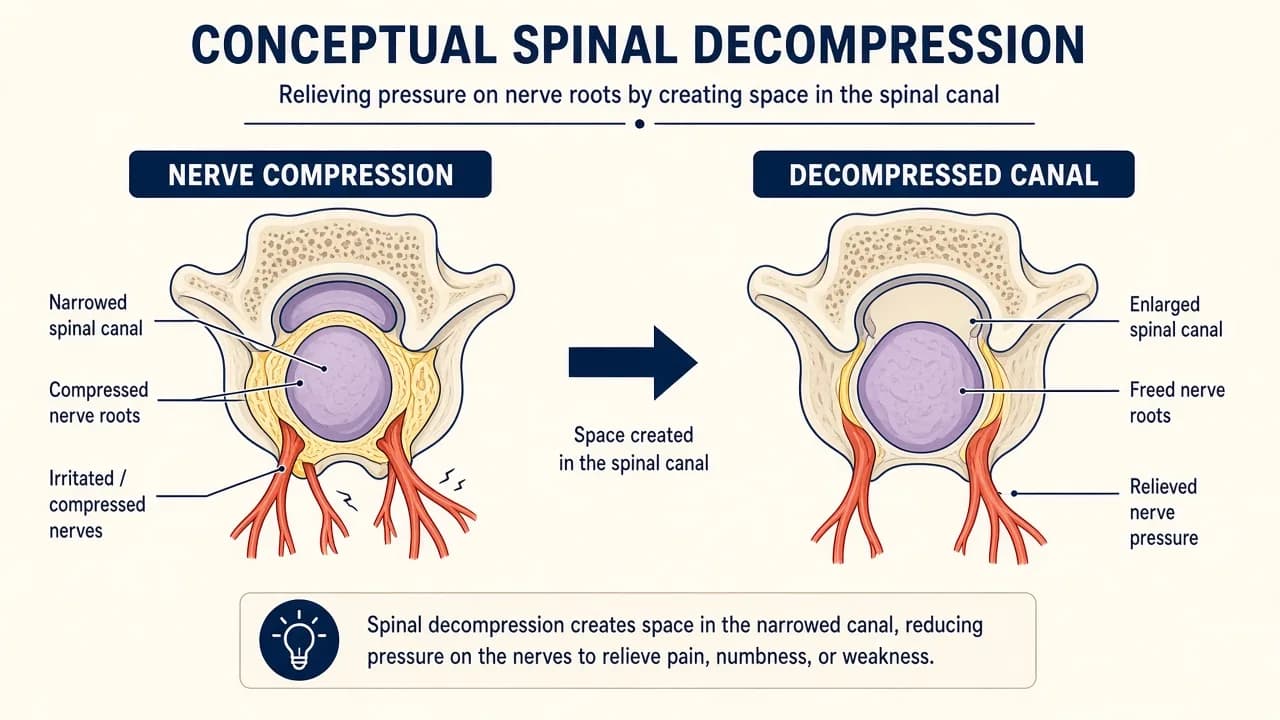
Spinal decompression is the family of operations that free compressed neural elements — canal, recess or foramen — when the named product is not already a laminectomy, discectomy or fusion.
The surgeon removes bone or ligament only as needed to free the named neural structure. The exact window should be written before travel.
Ask whether any implant is contemplated. A decompression-only letter should not hide a cage.
When Is Spinal Decompression Recommended?
It may be considered for stenosis or root compression that matches examination after non-operative care, when the team has not yet committed to a more specific named sheet.
A quote that is actually a fusion, ACDF or tumour resection should use those sheets. This page is not a synonym for every spine operation.
How the operation is performed, recovery and variations →
Spinal Decompression cost in India
The $4,000–$9,000 range is a national planning band for spinal decompression as quoted. It may include the scheduled procedure, professional fees, operating room, anaesthesia and a defined ward allowance. It does not establish what one hospital will charge.
Clinically important cost drivers include which structure is decompressed, number of levels, conversion to a named product, prior surgery, physiotherapy after discharge. A change in levels, implant, graft or staging is not a cosmetic package upgrade; it may represent a materially different episode of care.
Do not infer separate Delhi NCR, Mumbai, Bengaluru, Chennai or Hyderabad prices from the national range. Until a verified city figure exists, compare named teams and written inclusions while keeping travel, lodging and outpatient physiotherapy costs separate.
Stay follows the window and any CSF leak. The stored stay is 2–5 nights. Walking practice and sitting advice follow the levels treated. A generic “decompression package” does not set those rules. Return flights and sitting times should remain flexible until the patient is examined after treatment.
Spinal Decompression cost breakdown in India
Component prices are rarely published as a public tariff. The lines below describe what typically sits inside a surgical estimate, not a dollar amount for each row.
- Spine specialist review
- Neurosurgical or orthopaedic spine review of MRI or CT, examination, previous operations and the indication for spinal decompression.
- Preoperative investigations
- The baseline work-up follows the case: MRI or CT that names the compressed structure is required. A request that only says “decompression” is not enough to quote honestly. Confirm which tests are included and which are conditional.
- Operating room, implants, cages and consumables
- The estimate should state the planned approach, number of levels, screws, rods, cages, artificial discs or cement, bone-graft assumptions, and what happens if the plan changes intraoperatively.
- Anaesthesia, neuromonitoring and medical optimization
- Ask whether anaesthesia, neuromonitoring, blood products and medical clearance for comorbidity are included.
- Ward stay, ICU if required and inpatient physiotherapy
- Stay follows the window and any CSF leak. The stored stay is 2–5 nights. The quote should specify included ward or high-dependency nights and inpatient physiotherapy rather than relying only on 2–5 nights.
- Medicines, VTE prevention and postoperative imaging
- Confirm routine versus high-cost medicines, clot-prevention protocol, postoperative radiographs or CT and discharge prescriptions.
Planning range or quotation?
The $4,000–$9,000 figure is an indicative planning range. A final hospital quotation is itemised, issued after a consultant reviews your records, and still subject to what is found clinically.
Get a Personalized Cost Estimate
What is usually included in a Spinal Decompression package?
No two hospitals draw the line in the same place, so read an estimate for what it excludes as carefully as for what it covers. The pattern below is what listed campuses typically bundle into a surgical estimate for this procedure. Anything not written into your estimate should be assumed to be extra until the hospital confirms otherwise.
Usually included
Usually included
Named specialist assessment
A consultation tied to the clinician expected to perform or lead the proposed intervention, where bundled.
Usually included
The written procedure and planned levels
The estimate should use the exact name Spinal Decompression and identify levels and associated work rather than say only “spine surgery.”
Usually included
Theatre, anaesthesia and quoted neuromonitoring
Professional and facility fees for the scheduled episode, with invasive monitoring stated where relevant.
Usually included
Quoted implants, cages, discs or cement
Ask whether any implant is contemplated. A decompression-only letter should not hide a cage. Only items named in the letter are included.
Usually included
Quoted ward allowance and inpatient physiotherapy
Room category and included ward or high-dependency days; 2–5 nights is a trip-planning token, not an inclusion promise.
May be charged separately
May be separate
Additional MRI, CT or infection work-up
Repeat imaging, culture, bone-scan or specialist medical consultations may be additional when indicated.
May be separate
Extra levels or a change from decompression to fusion
Work beyond the documented operative plan, including an unplanned fusion or an extra instrumented level, is not automatically bundled.
May be separate
Extended ward, ICU or complication care
Extra nights, CSF-leak care, infection treatment, transfusion, medical events or return to theatre generally alter the bill.
May be separate
Later physiotherapy, braces and medicines
The discharge note should state what was actually decompressed. Rehabilitation follows that finding. Confirm what occurs after the first postoperative visit and what can be transferred home.
May be separate
Travel and companion living costs
Flights, visas, accessible lodging, meals, local transport and schedule changes are normally outside the hospital estimate.
Catalog inclusions listed for this pathway: spine consultation and records review; named surgeon on camera before travel; theatre, implants and overnight stay as quoted; neuromonitoring and post-op imaging as indicated; discharge summary to your home physician.
What can increase the cost?
These are the drivers that actually move a bill for this operation, in rough order of how often they do it. Most of them are clinical decisions rather than commercial ones, which is why an honest estimate is written after a records review rather than before it.
- Which structure is decompressed
- Canal, recess and foramen are different windows.
- Number of levels
- Should be explicit.
- Conversion to a named product
- Laminectomy, discectomy or fusion belong on those sheets.
- Prior surgery
- Scar changes time and leak risk.
- Physiotherapy after discharge
- Often extra.
Approaches related to Spinal Decompression
The surgeon removes bone or ligament only as needed to free the named neural structure. The exact window should be written before travel. These are clinical pathways, not consumer upgrades.
The receiving team should explain why its proposed route fits the current anatomy and neurology, and what finding could change that route after arrival.
Swipe to compare surgical approaches →
| Approach | Relative complexity | GAF planning range | Notes |
|---|---|---|---|
| Laminotomy or flavectomy | Selected by anatomy, levels and prior surgery | No separate GAF sheetRelative complexity only | A limited window when a full laminectomy is not required. |
| Foraminotomy | Selected by anatomy, levels and prior surgery | No separate GAF sheetRelative complexity only | Frees a specific root in the foramen. |
| Combined decompression that becomes fusion | Selected by anatomy, levels and prior surgery | No separate GAF sheetRelative complexity only | If instability appears, the honest product changes. |
Planning ranges appear only where GAF Healthcare already publishes a cost sheet for that operation. Other rows describe relative clinical complexity and should not be read as prices.
Risks and considerations after Spinal Decompression
Dural tear, residual compression, instability, infection and the need for a more extensive later operation should be discussed.
This is not an exhaustive consent list and does not assign likelihood. The treating spine specialist should discuss the risks that apply to the planned levels, approach and medical background.
No page can promise that symptoms will resolve, that fusion will unite, or that a second operation will never be needed.
Spinal Decompression cost: India vs other medical tourism destinations
India and United States values come from the stored GAF registry. Other rows are explicitly modelled from relative private-care levels and are not official tariffs or evidence of availability.
International comparisons are easily distorted when levels, implant or graft assumptions, ward stay and follow-up physiotherapy differ. Obtain like-for-like written estimates after record review.
Swipe to compare destinations →
| Country | Approximate cost | Relative cost position | Important cost considerations |
|---|---|---|---|
| India | $4,000–$9,000 | Baseline | GAF catalog planning range. The stored India range is a comparison band. A named spine team must review MRI, examination and the planned levels before issuing a case-specific quotation. |
| Turkey | $7,200–$11,500Indicative planning estimate* | ≈1.4× India | Private international-care market. Confirm the exact procedure, number of levels, implant or cage assumptions, neuromonitoring and whether revision or staged tumour care is included. |
| Thailand | $8,500–$14,500Indicative planning estimate* | ≈1.8× India | Private international hospitals. International desks may exist, but implant brand, bone-graft source, navigation and outpatient physiotherapy still need a written letter. |
| United Arab Emirates | $14,500–$23,500Indicative planning estimate* | ≈2.9× India | Regional premium private care. Travel may be shorter for Gulf patients; specialist, facility, implant and rehabilitation charges may remain separate. |
| Singapore | $18,000–$31,000Indicative planning estimate* | ≈3.8× India | High-cost specialist private care. Ask for an international self-pay estimate tied to the exact spine plan rather than a general “spine package.” |
| Germany | $16,500–$29,500Indicative planning estimate* | ≈3.5× India | European elective spine care. International access, professional billing and post-discharge physiotherapy arrangements vary by centre and should be established before travel. |
| United Kingdom | $14,500–$26,000Indicative planning estimate* | ≈3.1× India | Private self-pay for many visitors. Overseas patients should verify eligibility, the treating unit and whether imaging, implants and follow-up physiotherapy are separately charged. |
| United States | $28,000–$60,000 | ≈6.8× India | Stored self-pay reference. Facility, surgeon, anesthesia, implant, imaging and rehabilitation may be billed by different entities; $28,000–$60,000 is a comparison range, not one bundled quote. |
*Figures other than India and the United States are modelled planning estimates scaled from the India catalog band, not hospital quotations. All figures are planning information. Currency, diagnosis, spinal level, approach, implant choice, clinical course, hospital terms and length of stay can change the final amount; no row predicts outcomes.
Why do international patients consider India for spinal decompression?
Some international patients evaluate India for access to a named spine team and a self-pay planning band below typical United States figures. Cost alone is not a reason to travel.
The key questions are clinical acceptance, the proposed team's relevance to the levels and approach, implant transparency, physiotherapy continuity after return, and fitness to fly. These require direct written confirmation.
No hospital or clinician is described as best. Progressive neurological deficit, an unstable fracture, active infection or a patient who cannot complete the rehabilitation plan may be unsafe to fly, and established funded care near home may be more appropriate.
Hospitals for spinal decompression in India
Hospital cards should follow live entity relationships, not names embedded in editorial copy. Accreditation or a general spine label does not prove current case acceptance, implant inventory, navigation systems, volumes or outcomes.
Campuses for this pathway are being confirmed. Ask the desk which houses currently quote it.
Spine surgeons to consider for spinal decompression in India
Profiles should be pulled dynamically only when Spinal Decompression appears in the clinician's current procedure relationships. Some Spine Surgery procedures have no tagged doctors in some or all cities; the renderer must leave those sections empty. Verify role, case relevance, availability and campus. Placement is not a ranking, and this article adds no experience, volume, robotic-capability or outcome claim.
Named consultants for this pathway are being matched. Request a dossier and we will advise which campuses can quote it.
Spinal Decompression cost by city in India
Delhi NCR, Mumbai, Bengaluru, Chennai and Hyderabad retain $4,000–$9,000 until verified city-level data is stored. Their overlays focus on genuinely different airport, geography, lodging and rehabilitation logistics.
Clinician and hospital cards must resolve dynamically from current data. This module names no provider, makes no robotic-capability, volume or outcome claim and offers no ranking. Several Spine Surgery procedures currently have no tagged doctors in some or all cities — including PLIF, TLIF, ALIF and Spinal Decompression nationally, ACDF, disc replacement and revision lists in Bengaluru, and scoliosis correction outside Delhi NCR. An empty card area is a catalog gap, not a hidden roster.
Swipe to compare Indian cities →
Delhi NCR
$4,000–$9,000
India planning band — not a city quote
Typical stay 2–5 nights
No verified Delhi NCR-only tariff is stored. Use $4,000–$9,000 as the national planning band until a named hospital supplies an itemized case estimate.
0 hospitals · consultant match on request
Mumbai
$4,000–$9,000
India planning band — not a city quote
Typical stay 2–5 nights
No verified Mumbai-only tariff is stored. Use $4,000–$9,000 as the national planning band until a named hospital supplies an itemized case estimate.
0 hospitals · consultant match on request
Bengaluru
$4,000–$9,000
India planning band — not a city quote
Typical stay 2–5 nights
No verified Bengaluru-only tariff is stored. Use $4,000–$9,000 as the national planning band until a named hospital supplies an itemized case estimate.
0 hospitals · consultant match on request
Chennai
$4,000–$9,000
India planning band — not a city quote
Typical stay 2–5 nights
No verified Chennai-only tariff is stored. Use $4,000–$9,000 as the national planning band until a named hospital supplies an itemized case estimate.
0 hospitals · consultant match on request
Hyderabad
$4,000–$9,000
India planning band — not a city quote
Typical stay 2–5 nights
No verified Hyderabad-only tariff is stored. Use $4,000–$9,000 as the national planning band until a named hospital supplies an itemized case estimate.
0 hospitals · consultant match on request
Costs vary considerably by hospital, specialist, clinical complexity, insurance, room or day-care category, and what is included in the package.
Choosing a city for spinal decompression
What should international patients budget beyond the surgery?
A complete spinal decompression budget includes much more than the $4,000–$9,000 hospital planning band. Add remote MRI review, tests not bundled, companion travel, accessible lodging, local transport, medicines, outpatient physiotherapy and contingency for extra nights.
Travel should follow a written clinical acceptance and itemized estimate. A visa letter or directory card is not medical clearance.
- Records and neurology review
- Share MRI or CT files, current pain and walking status, medicines, prior operations, implant stickers if relevant and the referring clinician's question.
- Specialist planning
- Spine, anaesthetic and physiotherapy teams clarify indication, levels, timing, approach and whether commercial travel is appropriate.
- Itemized estimate and logistics
- Match the exact procedure to included tests, implants or grafts, ward days, neuromonitoring, physiotherapy, exclusions, escalation rates and companion accommodation.
- Arrival and reassessment
- Allow time for examination, repeat imaging, blood tests and anaesthesia review; consent should include alternatives and case-specific uncertainty.
- Procedure and monitored recovery
- The surgeon removes bone or ligament only as needed to free the named neural structure. The exact window should be written before travel. Stay follows the window and any CSF leak. The stored stay is 2–5 nights.
- Discharge, nearby review and handover
- Walking practice and sitting advice follow the levels treated. A generic “decompression package” does not set those rules. Travel only after review and carry the operative note, implant details, medicine plan and physiotherapy schedule.
- Treatment episode$4,000–$9,000
- Pre-operative testsOften inside the estimate — confirm
- Hospital stay2–5 nights typically bundled
- Additional procedures or extended careQuoted separately if advised
- Accommodation for companionVaries by city and length of stay
- Local transportationAirport and daily hospital transfers
- FlightsDepends on origin
- Medical visaFee set by the issuing consulate
Planning estimate — not a hospital quotation.
Get a Personalized Treatment Estimate
What does medical travel for spinal decompression in India involve?
The sequence below is how a records-first pathway normally runs. The order matters: everything before arrival exists so that you are not making decisions in an unfamiliar hospital corridor with a suitcase beside you.
Send complete imaging
Provide actual MRI or CT files, reports, current neurological status, medicines and all prior operative notes or implant stickers.
Confirm clinical acceptance
A named spine team reviews diagnosis, urgency, levels, implant or graft needs, travel safety and the likely intervention.
Hold a remote discussion
Ask why treatment is indicated now, what alternatives exist, what remains uncertain and who will lead care.
Compare itemized quotations
Use the same operative scope, levels and implant assumptions; do not compare a partial estimate with a comprehensive episode.
Plan flexible travel
Obtain required documents, refundable flights and accessible lodging near the exact campus, with contingency for a longer stay.
Repeat assessment after arrival
The patient is examined and undergoes indicated imaging, laboratory and anaesthesia review before final consent.
Treatment and ward recovery
Care follows the agreed approach, with escalation according to the clinical course rather than package limits.
Start physiotherapy and prepare discharge
Patients learn wound, medicine, brace or sitting instructions and receive written records.
Complete local review
Remain nearby until the team reviews recovery and explicitly discusses fitness for travel.
Continue care at home
Transfer records to the patient's local clinician. The discharge note should state what was actually decompressed. Rehabilitation follows that finding.

Documents to prepare
- MRI naming the compressed structure
- A clinic note stating the mechanical or claudication symptom
- Recent MRI and any CT already obtained, preferably as complete files rather than phone photographs
- Current medication list, allergies and recent laboratory results
- All prior spine operative notes, discharge summaries and implant or cage details
- Passport and companion documentation required for travel and consent
Clinical detail
How the operation is performed
The surgeon removes bone or ligament only as needed to free the named neural structure. The exact window should be written before travel.
The listed procedural forms are Laminotomy or flavectomy, Foraminotomy, Combined decompression that becomes fusion. Incision, implants, grafts and associated decompression depend on the patient's anatomy.
Stay follows the window and any CSF leak. The stored stay is 2–5 nights. Walking is usually encouraged; restrictions follow the levels and whether fusion was added.

Main variations
- Laminotomy or flavectomy
- A limited window when a full laminectomy is not required.
- Foraminotomy
- Frees a specific root in the foramen.
- Combined decompression that becomes fusion
- If instability appears, the honest product changes.
Preparation
MRI or CT that names the compressed structure is required. A request that only says “decompression” is not enough to quote honestly. Send complete imaging files rather than screenshots or a one-line report.
The receiving team sets fasting, medicine and skin-preparation instructions. Report fever, new weakness, saddle numbness, urinary retention, calf pain or a sudden increase in pain promptly; these may alter timing.
Hospital stay and recovery
Stay follows the window and any CSF leak. The stored stay is 2–5 nights. Walking practice and sitting advice follow the levels treated. A generic “decompression package” does not set those rules.
The catalog's 2–5 nights is for broad planning, not a discharge promise. Pain control, wound healing, neurology, sitting tolerance and physiotherapy progress can affect the actual stay.
Dural tear, residual compression, instability, infection and the need for a more extensive later operation should be discussed.
The discharge note should state what was actually decompressed. Rehabilitation follows that finding. Patients need a written handover, emergency contacts and a local spine or physiotherapy plan.
Seek urgent clinical help for new weakness, saddle numbness, urinary retention, chest pain, shortness of breath, calf swelling, fever, wound leakage or any warning sign specified at discharge.
How to compare Spinal Decompression quotes from Indian hospitals
Print these and work through them on the video call. A house that answers without hedging is telling you something useful about how it will behave when something goes wrong.
- Why is spinal decompression recommended now, and what alternatives were considered?
- Which imaging or neurological finding drives the plan?
- Who will perform the procedure, and at which exact campus?
- Does the quotation use the exact treatment name and list the spinal levels?
- Which investigations must be repeated after arrival, and are they included?
- Which implant, cage, disc, cement or bone-graft assumptions are written?
- Is neuromonitoring included, and who interprets it?
- How many ward or high-dependency nights and inpatient physiotherapy sessions are included?
- What finding could change the approach or add a fusion or extra level?
- How are extra nights, CSF-leak care, infection treatment or return to theatre billed?
- What room category is quoted, and can a companion remain nearby?
- What is the written sitting, brace and venous-thromboembolism plan?
- Which discharge medicines, first follow-up and physiotherapy block are included?
- When will the team assess fitness to fly, and what follow-up is needed at home?
- Which exact window and levels are priced?
- What is billed if fusion or a full laminectomy is required?
Frequently asked questions
How much does spinal decompression cost in India?
Spinal Decompression is typically planned at $4,000–$9,000. This stored range is not a quote; levels, implant or graft plan, ward course and hospital terms determine the final amount.
What is spinal decompression?
Spinal decompression is the family of operations that free compressed neural elements — canal, recess or foramen — when the named product is not already a laminectomy, discectomy or fusion.
When is spinal decompression considered?
It may be considered for stenosis or root compression that matches examination after non-operative care, when the team has not yet committed to a more specific named sheet.
Does every patient with this diagnosis need the same procedure?
A quote that is actually a fusion, ACDF or tumour resection should use those sheets. This page is not a synonym for every spine operation. Timing and approach require individualized spine review.
What tests are needed before treatment, and does MRI matter?
MRI or CT that names the compressed structure is required. A request that only says “decompression” is not enough to quote honestly.
What approaches may be discussed?
The surgeon removes bone or ligament only as needed to free the named neural structure. The exact window should be written before travel. Relevant forms include Laminotomy or flavectomy, Foraminotomy, Combined decompression that becomes fusion; they are selected clinically, not by package price.
How long does spinal decompression take?
often 1–3 hours depending on the named window and levels This is an orientation only; extra levels and the patient's condition can extend the episode.
How long is recovery, and what does the stored stay mean?
Walking practice and sitting advice follow the levels treated. A generic “decompression package” does not set those rules. The stored stay is 2–5 nights, but discharge and travel dates remain individualized. Stay follows the window and any CSF leak. The stored stay is 2–5 nights.
How much do spinal implants affect the final cost?
Ask whether any implant is contemplated. A decompression-only letter should not hide a cage. Walking is usually encouraged; restrictions follow the levels and whether fusion was added.
What can make the quotation change?
Important drivers include which structure is decompressed, number of levels, conversion to a named product, prior surgery, physiotherapy after discharge. Ask for each change in writing.
Are complications and extra nights included?
Only if the itemized estimate says so. Ask how infection care, CSF-leak management, transfusion, medical events, return to theatre and days beyond the allowance are billed.
How should an international patient choose a spine surgeon?
Verify the proposed clinician's role, relevance to the levels, exact campus, implant plan, physiotherapy support, communication and handover. Directory placement is not a ranking, and this page names no provider.
When can the patient fly home?
Fitness to fly follows neurology, wound and walking, not the word decompression.
What follow-up and rehabilitation are required?
The discharge note should state what was actually decompressed. Rehabilitation follows that finding.
Dr. Shabnam Choudhary, BDS, is a dental professional who graduated from Al-Ameen Medical College, Bijapur, Karnataka. She contributes to the curation and development of medically informative healthcare content, helping ensure that information is structured clearly and presented in a patient-friendly manner.
Content Curator
Dr. Shabnam Choudhary
BDS
Al-Ameen Medical College, Bijapur, Karnataka
Rajiv Gandhi University of Health Sciences (RGUHS), Bengaluru

Dr. Saffiyyah Chaudhary, BDS, is a dental professional who graduated from Al-Ameen Medical College, Bijapur, Karnataka. She provides medical review of healthcare content to help ensure that clinical information is accurate, understandable, and appropriately presented for patients and their families.
Medically Reviewed By
Dr. Saffiyyah Chaudhary
BDS
Al-Ameen Medical College, Bijapur, Karnataka
Rajiv Gandhi University of Health Sciences (RGUHS), Bengaluru

Related treatment costs
Laminectomy cost in India
$4,000–$9,500 · stay 2–5 nights
Discectomy cost in India
$3,500–$8,000 · stay 1–3 nights
Microdiscectomy cost in India
$3,000–$7,500 · stay 1–3 nights
Spinal Fusion cost in India
$8,000–$18,000 · stay 4–8 nights
Cost note
Cost ranges on this page are for preliminary planning and comparison only. The final treatment cost depends on the patient's diagnosis, treatment plan, hospital, doctor, procedure complexity and other clinical factors. A personalized quotation should be obtained before making treatment or travel decisions.
This page is general information about treatment costs and pathways. It is not a diagnosis, a treatment recommendation or a substitute for an individualised medical opinion. Decisions about whether this procedure is appropriate for you belong to a qualified doctor who has reviewed your records.
Last updated 12 September 2026. Cost data is maintained separately from this article and refreshed as listed campuses revise their planning ranges.
Spinal Decompression cost sheet · All treatment costs in India · Spine Surgery costs