
Last updated: 13 September 2026 · Content curated by Dr. Shabnam Choudhary · Medically reviewed by Dr. Saffiyyah Chaudhary
Quick Answer
Cataract Surgery in Hyderabad is planned against $800–$2,500 per eye per eye, with Outpatient or 1 night used only for broad trip planning. Neither is a local tariff, treatment recommendation or acceptance promise.
Confirm whether one or two eyes are proposed, separate operating dates, exact IOL, technique, day-care scope, included checks and where urgent review occurs.
- India cost range
- $800–$2,500 per eye
- Typical starting point
- $800
- Typical hospital stay
- Outpatient or 1 night
- Procedure time
- commonly a short day-care operation, with theatre and recovery time varying by eye, technique and complexity
- Recovery
- Vision and comfort change at different rates. Drops, protection and examination findings guide work, driving and flying.
Major cost factors: one eye or two-eye plan, cataract density and pupil, cornea and ocular surface, retina, macula and optic nerve. International patients should also budget for accommodation, airport transfers, a medical visa, medicines and follow-up.
Often quoted separately: second eye; additional diagnostics; complex or combined surgery; complications and later treatment; travel and living.
Why request a cost through GAF rather than a hospital?
Writing to one campus gets you that campus’s package. A GAF request is reviewed against your records and returned as suitable doctor and hospital options with an indicative, itemised estimate. There is no obligation to book.
- Doctor review first. The number follows a reading of your imaging, test results and clinical records, not a brochure range.
- Hospital options. You can compare listed campuses before you travel, instead of starting over with each international desk.
- International-patient coordination. Visa letters, records routing and companion logistics sit with the same request.
Cataract Surgery in Hyderabad
It may be considered when lens clouding meaningfully affects daily tasks or prevents necessary examination or treatment inside the eye, after symptoms, alternatives, ocular health and general fitness are reviewed. A procedure-specific work-up includes refraction, slit-lamp examination, pupil dilation, intraocular-pressure measurement and retina and optic-nerve checks, followed by optical biometry and keratometry for IOL planning.
The airport is south of major hospital districts. Jubilee Hills, Hi-Tech City and Secunderabad produce different transfer plans, so confirm every clinical location first. Dilation can blur vision, so arrange a companion and do not plan to drive unless the clinical team says it is safe.
Keep flexible lodging and a companion within the response radius advised by the eye team, rather than assuming an airport-area stay is suitable. Summer heat and a long airport transfer can add fatigue while drops are frequent. Plan indoor recovery and the first review before departure.
Doctor and hospital cards in Hyderabad resolve only from exact live CMS relationships for Cataract Surgery. If that exact relationship is absent, cards must remain empty; a generic Ophthalmology, eye-care or hospital label cannot verify current case acceptance. This is a catalog gap, not an availability or quality claim.
Send records before non-refundable travel. Remote review can change after slit-lamp examination, refraction, dilation, pressure measurement, retina assessment and repeat biometry.
What cataract surgery typically costs in Hyderabad
Cataract density, pupil size, cornea, axial length, astigmatism, ocular comorbidity, posterior-capsule support, technique and lens model can alter resources.
Ask for named surgeon, named eye, IOL model, tests, anaesthesia, theatre, routine drops, scheduled reviews, exclusions and complication terms in writing.
Budget separately for travel through Rajiv Gandhi International Airport, nearby lodging, companion support, local transport, take-home medicines and extra nights if the second eye or a review is delayed.
What moves the quote in Hyderabad
- One eye or two-eye plan
- Each eye needs separate assessment, calculation, date and quotation.
- Cataract density and pupil
- Density or a small pupil can change instruments and time.
- Cornea and ocular surface
- Astigmatism, corneal weakness or dry eye can alter testing and planning.
- Retina, macula and optic nerve
- Retinal or glaucoma findings can add imaging and specialist review.
Medical travel through Hyderabad
Send eye notes, biometry, keratometry, retina imaging and relevant medical records before travel to Hyderabad.
Obtain written acceptance from a named ophthalmologist and verify the exact campus, IOL availability, day-care facility and urgent ophthalmic contact.
Vision and comfort change at different rates. Drops, protection and examination findings guide work, driving and flying. Summer heat and a long airport transfer can add fatigue while drops are frequent. Plan indoor recovery and the first review before departure. Carry the procedure note and IOL sticker for local follow-up.
Hospitals and units listed in Hyderabad
Doctor and hospital cards in Hyderabad resolve only from exact live CMS relationships for Cataract Surgery. If that exact relationship is absent, cards must remain empty; a generic Ophthalmology, eye-care or hospital label cannot verify current case acceptance. This is a catalog gap, not an availability or quality claim.
General accreditation does not establish current lens stock, surgeon acceptance or case-specific support. Verify all three for the named eye and date.
Cataract Surgery doctors in Hyderabad · Cataract Surgery hospitals in Hyderabad · Cataract Surgery cost in India
What Is Cataract Surgery?
Cataract surgery removes the eye's cloudy natural lens and usually replaces it with a calculated intraocular lens, or IOL.
The natural lens sits behind the iris and focuses light. Surgery removes its cloudy material and usually places an IOL in the retained capsular bag.
IOL power is calculated from measurements, but healing, corneal shape, prior surgery and retinal or optic-nerve function still affect the result.

When Might Cataract Surgery Be Considered?
It may be considered when lens clouding meaningfully affects daily tasks or prevents necessary examination or treatment inside the eye, after symptoms, alternatives, ocular health and general fitness are reviewed.
Severity is not appearance alone. The ophthalmologist relates glare, reading, work, mobility and driving difficulty to findings and excludes other causes. Urgent eye disease needs another pathway.
How the operation is performed, recovery and variations →
Cataract Surgery cost in India
$800–$2,500 per eye is the stored India planning range per eye. It is not a two-eye total or a guaranteed package. $3,500–$8,000 per eye is likewise a per-eye reference. Currency movement, a changed lens, additional imaging, complex surgery or extra review can alter the final amount.
An estimate should name eye, surgeon, campus, technique, IOL manufacturer, model, power and category. Separate professional, diagnostic, facility, lens, pharmacy and follow-up lines, including a changed-placement plan.
For both eyes, request separate estimates and dates. The fellow eye can have different astigmatism, cataract, power, comorbidity or support; first-eye findings inform but do not determine its plan.
Budget separately for flights, visa, insurance, transfers, companion, lodging, meals, protection, drops, extra nights and local follow-up unless expressly included.
Planning Range ≠ Final Hospital Quotation. A slit-lamp and dilated assessment, pressure check, measurements and surgeon review are required before candidacy, lens choice, risks and a final offer are meaningful.
Planning range or quotation?
The $800–$2,500 per eye figure is an indicative planning range. A final hospital quotation is itemised, issued after a consultant reviews your records, and still subject to what is found clinically.
Get a Personalized Cost Estimate
What is usually included in a Cataract Surgery package?
No two hospitals draw the line in the same place, so read an estimate for what it excludes as carefully as for what it covers. The pattern below is what listed campuses typically bundle into a surgical estimate for this procedure. Anything not written into your estimate should be assumed to be extra until the hospital confirms otherwise.
Usually included
Usually included
Named-eye clinical assessment
The quotation should identify right eye, left eye or both and include the stated surgeon consultation and day-care assessment.
Usually included
Routine measurements
List optical biometry, keratometry and any stated refraction, slit-lamp, dilation, IOP or retina checks rather than assuming every test.
Usually included
Consented cataract procedure
Name phacoemulsification, manual small-incision surgery or femtosecond-assisted steps and the operating ophthalmologist.
Usually included
Exact intraocular lens
Manufacturer, model, power, optical category and toric axis where relevant should match the lens calculation and consent.
Usually included
Day-care episode
State theatre, local anaesthesia or sedation assumptions, medicines, consumables, recovery observation and discharge review.
Usually included
Early follow-up
Name included reviews, pressure or wound checks, routine drops and the emergency contact period.
May be charged separately
May be separate
Second eye
A per-eye quotation does not include the other eye unless both eyes and separate dates are explicitly listed.
May be separate
Additional diagnostics
Corneal topography or tomography, macular or optic-nerve OCT, ultrasound and specialist retina review may be separate.
May be separate
Complex or combined surgery
Poor posterior-capsule or zonular support, vitrectomy, glaucoma work, corneal treatment or another procedure requires separate scope.
May be separate
Complications and later treatment
Extra visits, injections, pressure treatment, retinal care, IOL repositioning or exchange and later laser capsulotomy are not presumed included.
May be separate
Travel and living
Flights, visa, insurance, transfers, companion, lodging, meals, extra nights and care after returning home are separate.
Catalog inclusions listed for this pathway: ophthalmology consultation and records review; named consultant on camera before travel; biometry, tomography or oct as indicated; lens, graft, laser or implant as quoted; discharge summary to your home physician.
What can increase the cost?
These are the drivers that actually move a bill for this operation, in rough order of how often they do it. Most of them are clinical decisions rather than commercial ones, which is why an honest estimate is written after a records review rather than before it.
- One eye or two-eye plan
- Each eye needs separate assessment, calculation, date and quotation.
- Cataract density and pupil
- Density or a small pupil can change instruments and time.
- Cornea and ocular surface
- Astigmatism, corneal weakness or dry eye can alter testing and planning.
- Retina, macula and optic nerve
- Retinal or glaucoma findings can add imaging and specialist review.
- Biometry and prior surgery
- Unusual eye length or prior refractive surgery can change calculations.
- IOL design and model
- Lens designs require different devices and counselling.
- Technique and equipment
- Surgical methods use different equipment and consumables.
- Capsular and zonular support
- Weak support may require devices, another IOL position or staged care.
- Combined surgery
- Combined eye procedures require added consent and resources.
- Reviews and complication terms
- Included reviews, medicines and later treatment differ.
Cataract surgery methods and where they differ
The approach is selected for the examined eye; it is not a quality ladder. Surgeon judgment, cataract density, corneal health, pupil, zonules, posterior capsule, available equipment and patient needs all matter.
Femtosecond assistance performs selected steps but does not remove the need for a surgeon, phaco or another lens-removal method, IOL insertion and careful postoperative review.
Swipe to compare surgical approaches →
| Approach | Relative complexity | GAF planning range | Notes |
|---|---|---|---|
| Phacoemulsification | Individual eye assessment determines suitability | No separate GAF sheetRelative complexity only | Ultrasound removes lens material through a small incision, adjusted for cataract and corneal characteristics. |
| Manual small-incision cataract surgery | Individual eye assessment determines suitability | No separate GAF sheetRelative complexity only | The lens is removed through a self-sealing tunnel without phaco ultrasound, including for selected dense cataracts. |
| Femtosecond-assisted cataract surgery | Individual eye assessment determines suitability | No separate GAF sheetRelative complexity only | A laser assists selected steps before surgeon-controlled lens removal and IOL placement, without promising a better result. |
Planning ranges appear only where GAF Healthcare already publishes a cost sheet for that operation. Other rows describe relative clinical complexity and should not be read as prices.
The preoperative eye assessment
Slit-lamp examination confirms the cataract and reviews cornea, iris, pupil and support. Refraction records correction; dilation permits retinal assessment. IOP, optic nerve and macula matter because cataract is not the only cause of reduced vision.
A blocked retinal view may prompt ultrasound. OCT, corneal topography or tomography and dry-eye treatment follow specific findings or lens goals.
Monofocal, toric, multifocal, trifocal and EDOF lenses
A monofocal IOL targets one main focal zone; glasses may remain useful. A toric IOL addresses selected regular corneal astigmatism and requires reliable measurements and alignment.
Multifocal and trifocal designs distribute light across focal zones but can introduce halos, glare or contrast tradeoffs. EDOF lenses extend a focus range with near-vision and optical tradeoffs. Corneal, macular and optic-nerve health affect suitability.
No category promises spectacle independence or a specific result. Discuss night driving, near work, screens, occupation, ocular disease, cost and alternatives.
Cataract severity, support and combined surgery
A dense cataract, small pupil, shallow chamber, weak corneal endothelium, trauma, pseudoexfoliation, unstable zonules or unusual eye length can change instruments, time and risk. Posterior-capsule and zonular support govern IOL placement.
Combined vitrectomy, glaucoma surgery, corneal treatment or pupil devices make a different episode requiring specific consent, coordination, consumables, follow-up and quotation.
Procedure-specific risks and later changes
Risks include infection, inflammation, bleeding, pressure or corneal problems, wound leak, retinal detachment, macular swelling, residual refractive error, dysphotopsia, posterior-capsule rupture, vitreous loss, IOL displacement, further treatment and loss of vision.
The capsule behind the IOL can cloud later. A separate YAG laser capsulotomy may be appropriate; it is not recurrent cataract or presumed part of the surgical quote.
Planning one eye and the fellow eye
The more symptomatic or appropriate eye may be treated first. Eyes are commonly scheduled on separate dates for first-eye review, although practice varies. Ask what interval and findings could alter the fellow-eye plan.
Keep the first-eye operative note, IOL label, biometry and follow-up. They inform later care without implying identical healing.
Cataract Surgery cost: India vs other medical tourism destinations
India and United States values use stored GAF per-eye ranges. The other countries require direct quotations because lens, diagnostics, professional billing and review scope are not reliably comparable as a single package.
Compare the same eye, cataract complexity, surgeon role, technique, exact IOL, tests, day-care setting, medicines, visits and complication terms. A lower headline with a different lens or follow-up is not like-for-like.
Swipe to compare destinations →
| Country | Approximate cost | Relative cost position | Important cost considerations |
|---|---|---|---|
| India | $800–$2,500 per eye | Baseline | GAF catalog planning range. The stored figure is a national per-eye planning range. It does not specify lens model, technique, investigations, candidacy or a final quotation. |
| Turkey | Confirmation requiredIndicative planning estimate* | Higher than India | Quotation required. Compare laterality, measurements, exact IOL, surgeon and facility scope, drops, reviews and complication terms rather than a headline package. |
| Thailand | Confirmation requiredIndicative planning estimate* | Higher than India | Quotation required. International coordination does not establish retinal suitability, lens availability, postoperative pressure review or continuity after return. |
| United Arab Emirates | Confirmation requiredIndicative planning estimate* | Higher than India | Quotation required. Professional, day-care, diagnostic, IOL, pharmacy and follow-up charges may be billed separately and require written confirmation. |
| Singapore | Confirmation requiredIndicative planning estimate* | Higher than India | Private self-pay varies. Request an estimate tied to the examined eye, optical biometry, selected lens and any retinal, corneal or glaucoma work. |
| Germany | Confirmation requiredIndicative planning estimate* | Higher than India | Private billing varies. Eligibility, professional billing, IOL scope and postoperative ophthalmology follow-up require direct provider confirmation. |
| United Kingdom | Confirmation requiredIndicative planning estimate* | Higher than India | Private self-pay varies. Overseas patients should verify acceptance, quote boundaries, early review, urgent access and handover to a local ophthalmologist. |
| United States | $3,500–$8,000 per eye | ≈3.5× India | Stored self-pay reference. Facility, surgeon, diagnostic, IOL and follow-up charges may be separate; $3,500–$8,000 per eye is a per-eye comparison range, not a bundled quotation. |
International comparisons are indicative. Currency, measurements, lens availability, changed findings, additional treatment and length of stay can change the final amount.
Why do international patients consider India for cataract surgery?
Some patients consider India for named ophthalmologists, eye diagnostics, day-care infrastructure and a national self-pay range. Price alone is not a clinical reason to travel, and listing does not establish acceptance.
Evaluate surgeon, licensure, campus, IOL traceability, measurements, day-care processes, relevant specialist support, urgent access and home handover.
No provider is ranked and no visual outcome is promised. Unstable eye or medical disease, insufficient records or suitable local care can make travel inappropriate.
Cataract Surgery hospitals and eye units in Hyderabad
Cards follow exact live CMS relationships for Cataract Surgery. A general Ophthalmology, accreditation or eye-care label does not establish current surgeon acceptance, IOL availability, case-specific support or results.
Apollo Hospital, Jubilee Hills, Hyderabad
 JCI Accredited
 NABH Accredited
- Radiation Oncology
- Surgical Oncology
- Medical Oncology
- Hematology
5 listed doctors for this pathway
Languages listed: English, Telugu, Hindi
Yashoda Hospitals, Hi-Tech City
- JCI Accredited
- NABH Accredited
 NABL Accredited
- Radiation Oncology
- Surgical Oncology
- Medical Oncology
- Hematology
3 listed doctors for this pathway
Languages listed: English, Telugu, Hindi
Yashoda Hospitals, Secunderabad
- JCI Accredited
- NABH Accredited
- NABL Accredited
- Radiation Oncology
- Surgical Oncology
- Medical Oncology
- Hematology
2 listed doctors for this pathway
Languages listed: English, Telugu, Hindi
Yashoda Hospitals, Somajiguda
- JCI Accredited
- NABH Accredited
- NABL Accredited
- Radiation Oncology
- Surgical Oncology
- Medical Oncology
- Hematology
1 listed doctor for this pathway
Languages listed: English, Telugu, Hindi
KIMS Hospitals, Secunderabad
- JCI Accredited
- NABH Accredited
- NABL Accredited
- Radiation Oncology
- Surgical Oncology
- Medical Oncology
- Hematology
1 listed doctor for this pathway
Languages listed: English, Telugu, Hindi
Cataract Surgery hospitals in Hyderabad · Talk to a treatment coordinator
Cataract surgeons and ophthalmologists in Hyderabad
Profiles require an exact CMS Cataract Surgery relationship. Verify the ophthalmologist, assessment, technique and campus; placement is not a recommendation.

Dr. Ajit Babu Majji
Ophthalmology
37+ years Experience
Cataract Surgery · LASIK Eye Surgery · Glaucoma Surgery
English, Telugu, Hindi
Dr. Annam Sridhar
Ophthalmology
28+ years Experience
Cataract Surgery · LASIK Eye Surgery · Glaucoma Surgery
English, Telugu, Hindi
Dr. B. Pranathi
Ophthalmology
20+ years Experience
Age-related Macular Degeneration (AMD) · Cataract Surgery · Corneal Transplant
English, Telugu, Hindi
Dr. Bhanu Prakash M
Ophthalmology
17+ years Experience
Phacoemulsification Cataract Surgery · Cataract Surgery · ICL (Implantable Collamer Lens)
English, Telugu, Hindi
Dr. Indumathy T Ramachandran
Ophthalmology
26+ years Experience
Corneal Transplant · Cataract Surgery · Complex Cataract Surgery
English, Telugu, Hindi
Dr. K Sreekumar Reddy
Ophthalmology
26+ years Experience
Phacoemulsification Cataract Surgery · Cataract Surgery
English, Telugu, Hindi
Cataract Surgery doctors in Hyderabad (12 listed) · Get a personalized cost estimate
Cataract Surgery cost by city in India
Delhi NCR, Mumbai, Bengaluru, Chennai and Hyderabad use $800–$2,500 per eye because no verified city tariff is stored. Their overlays add campus geography, airport transfer, lodging, climate and early-review logistics without inventing local prices or capabilities.
Doctor and hospital cards resolve only from CMS entities carrying an exact current Cataract Surgery relationship. Missing mappings leave cards empty rather than borrowing generic Ophthalmology or hospital entities.
Swipe to compare Indian cities →
Delhi NCR
$800–$2,500 per eye
India planning band — not a city quote
Typical stay Outpatient or 1 night
No verified Delhi NCR-only cataract tariff is stored. Use $800–$2,500 per eye as the national per-eye planning range until a named provider issues an itemized estimate; it is not a city price.
13 hospitals · 70 doctors
Mumbai
$800–$2,500 per eye
India planning band — not a city quote
Typical stay Outpatient or 1 night
No verified Mumbai-only cataract tariff is stored. Use $800–$2,500 per eye as the national per-eye planning range until a named provider issues an itemized estimate; it is not a city price.
5 hospitals · 7 doctors
Bengaluru
$800–$2,500 per eye
India planning band — not a city quote
Typical stay Outpatient or 1 night
No verified Bengaluru-only cataract tariff is stored. Use $800–$2,500 per eye as the national per-eye planning range until a named provider issues an itemized estimate; it is not a city price.
3 hospitals · 3 doctors
Chennai
$800–$2,500 per eye
India planning band — not a city quote
Typical stay Outpatient or 1 night
No verified Chennai-only cataract tariff is stored. Use $800–$2,500 per eye as the national per-eye planning range until a named provider issues an itemized estimate; it is not a city price.
2 hospitals · 2 doctors
Hyderabad
$800–$2,500 per eye
India planning band — not a city quote
Typical stay Outpatient or 1 night
No verified Hyderabad-only cataract tariff is stored. Use $800–$2,500 per eye as the national per-eye planning range until a named provider issues an itemized estimate; it is not a city price.
5 hospitals · 12 doctors
Costs vary considerably by hospital, specialist, clinical complexity, insurance, room or day-care category, and what is included in the package.
Choosing a city for cataract surgery
What should international patients budget beyond the ophthalmology procedure?
International planning starts with records and a named-eye clinical question, not a package reservation.
An appointment or remote opinion is provisional until in-person examination and measurements confirm the plan.
- Send records
- Provide eye notes, imaging, prior surgery and medical history.
- Remote triage
- A named team considers in-person assessment.
- Eye examination
- Complete refraction, slit-lamp, dilation, IOP and retina checks.
- Measurements
- Perform biometry, keratometry and indicated imaging.
- Discuss choices
- Compare observation, technique, target and suitable lenses.
- Itemize quotation
- Name eye, surgeon, IOL, day care, reviews and exclusions.
- Confirm on arrival
- Validate examination and measurements before consent.
- Complete procedure
- Perform consented lens removal and IOL placement.
- Review early
- Check wound, inflammation, pressure, IOL and vision.
- Plan fellow eye
- Reassess need, timing and lens separately.
- Clear travel
- Review findings, drops and urgent-care access.
- Handover home
- Carry operative note, IOL label and follow-up plan.
- Treatment episode$800–$2,500 per eye
- Pre-operative testsOften inside the estimate — confirm
- Hospital stayOutpatient or 1 night typically bundled
- Additional procedures or extended careQuoted separately if advised
- Accommodation for companionVaries by city and length of stay
- Local transportationAirport and daily hospital transfers
- FlightsDepends on origin
- Medical visaFee set by the issuing consulate
Planning estimate — not a hospital quotation.
Get a Personalized Treatment Estimate
What does medical travel for cataract surgery in India involve?
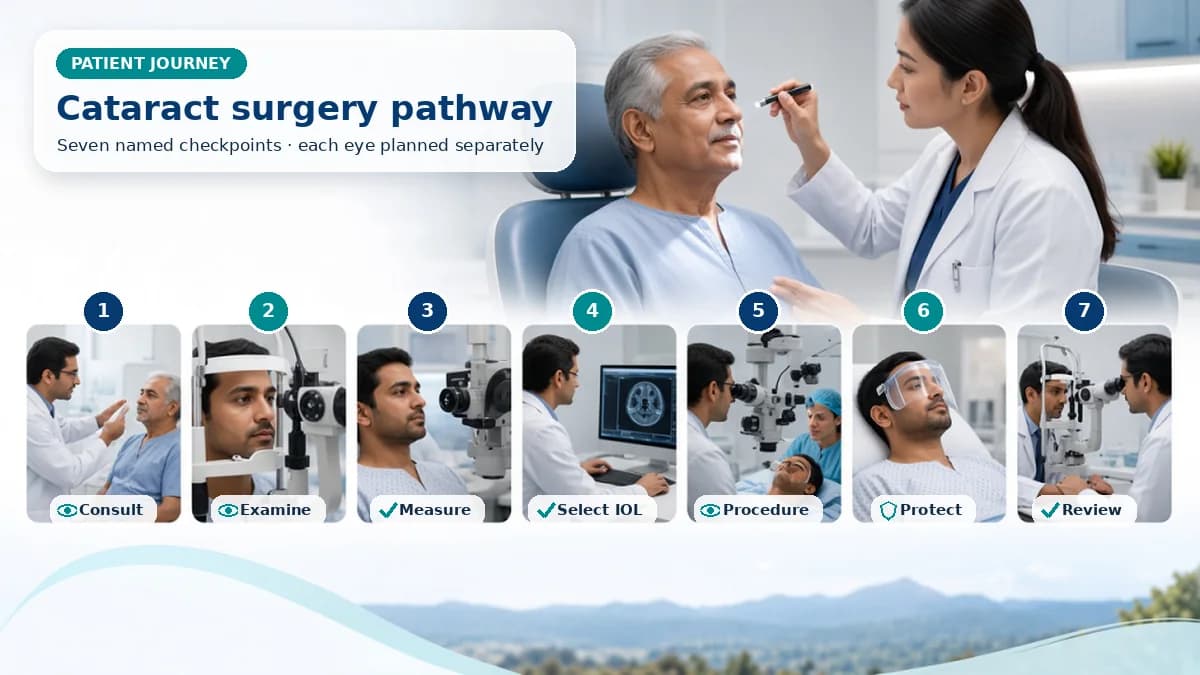
The sequence below is how a records-first pathway normally runs. The order matters: everything before arrival exists so that you are not making decisions in an unfamiliar hospital corridor with a suitcase beside you.
Define the eye
Document symptoms and laterality.
Collect records
Gather examination, imaging and prior procedure details.
Identify clinician
Confirm ophthalmologist and campus.
Assess each eye
Review cataract, cornea, pressure, support and retina.
Measure
Complete biometry and keratometry.
Discuss choices
Review alternatives, technique, target and lens.
Compare quotes
Hold eye, lens, tests and follow-up constant.
Plan travel
Arrange flexible travel, lodging and companion.
Confirm consent
Recheck eye, risks and possible changes.
Complete day care
Undergo treatment and monitored recovery.
Protect and review
Use drops and shield; attend examination.
Handover home
Share operative record, IOL label and schedule.
Documents to prepare
- Ophthalmology consultation notes and cataract diagnosis for each eye
- Current and previous spectacle or contact-lens prescription
- Slit-lamp, dilated retina and intraocular-pressure findings
- Optical biometry and keratometry printouts when already available
- Corneal topography or tomography and macular or optic-nerve OCT when performed
- Prior eye operation, laser, injection and implant records
- Diabetes, hypertension and other relevant medical records
- Current medicines, eye drops, allergies and anticoagulant information
Clinical detail
How the procedure is performed
The surgeon opens the front capsule, removes cloudy lens material by phacoemulsification or another selected method, preserves the capsular bag when safe and inserts the planned IOL if support is adequate.
After eye marking, dilation and anaesthesia, a small incision provides access. The surgeon opens the capsule, removes lens material, inserts the IOL when support permits, checks the wound and applies protection.
A posterior-capsule tear or weak zonules may require vitreous management, another IOL position, sutures or staged surgery; consent should address this.
Main variations
- Phacoemulsification
- Ultrasound removes lens material through a small incision, adjusted for cataract and corneal characteristics.
- Manual small-incision cataract surgery
- The lens is removed through a self-sealing tunnel without phaco ultrasound, including for selected dense cataracts.
- Femtosecond-assisted cataract surgery
- A laser assists selected steps before surgeon-controlled lens removal and IOL placement, without promising a better result.
Preparation
A procedure-specific work-up includes refraction, slit-lamp examination, pupil dilation, intraocular-pressure measurement and retina and optic-nerve checks, followed by optical biometry and keratometry for IOL planning.
Optical biometry estimates eye length and IOL power; keratometry measures corneal curvature. Contact lenses, ocular-surface instability or previous refractive surgery may require repeat measurements.
Reconcile medicines and allergies. Clinicians direct anticoagulants, diabetes medicines, glaucoma drops, fasting, hygiene and infection precautions.
Hospital stay and recovery
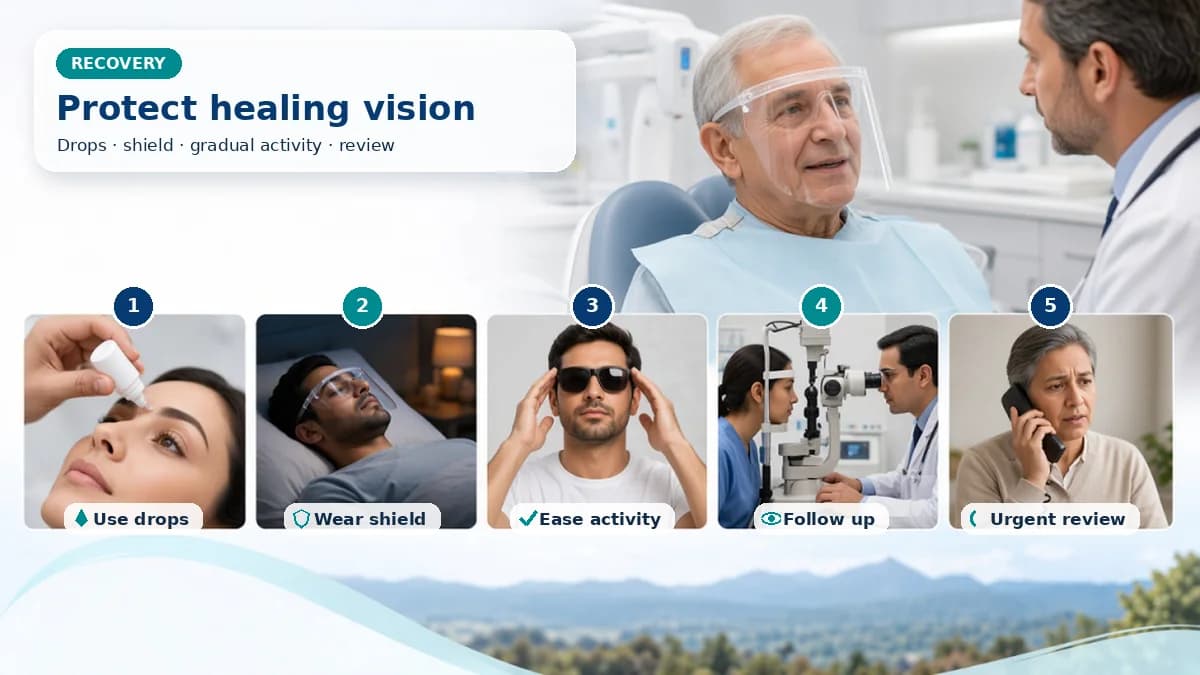
Most planned adult cataract pathways use day care; medical needs, combined surgery or a complication can require longer observation or admission. Vision and comfort change at different rates. Drops, protection and examination findings guide work, driving and flying.
Use prescribed drops cleanly. Wear the shield, avoid rubbing and protect the eye from dirty water, dust and impact.
Driving, lifting, exercise, swimming, work hazards and flying need individualized instructions. Reviews check healing, IOL, pressure and vision.
Seek urgent ophthalmic help for marked or worsening pain, sudden vision reduction, increasing redness, discharge, new flashes or many floaters, a curtain or shadow, injury, severe nausea or a clinician-specified pressure warning; sudden symptoms require examination, not only remote messaging.
How to compare Cataract Surgery quotes from Indian hospitals
Print these and work through them on the video call. A house that answers without hedging is telling you something useful about how it will behave when something goes wrong.
- Which eye is being quoted, and is every amount explicitly per eye?
- Does the fellow eye need treatment or observation?
- Who is the operating ophthalmologist, and at which exact campus?
- Could another corneal, retinal, optic-nerve or glaucoma condition limit benefit?
- Are refraction, slit-lamp, dilation, IOP and retina checks complete?
- Are optical biometry and keratometry included?
- Is corneal imaging or macular OCT indicated?
- Is phaco, manual small-incision or femtosecond assistance planned?
- Why does that technique fit this cataract and eye?
- What refractive target and uncertainty are discussed?
- Which exact IOL manufacturer, model, power and category are quoted?
- What lens-design tradeoffs apply to this eye?
- Could glasses still be needed?
- How is toric eligibility and alignment checked?
- Do cataract density, pupil, zonules or capsule add complexity?
- What if support is inadequate for the intended lens?
- Could vitrectomy, pupil, glaucoma or retinal work be needed?
- Which professional, facility and day-care lines are included?
- Which drops, shield and reviews are included?
- How are changed scope and complications billed?
- Which symptoms require urgent review, and where?
- When is the first postoperative examination?
- What guides timing of a second eye?
- When may I work, exercise, drive and fly?
- Which operative and IOL records will I receive?
- Who coordinates follow-up after I return home?
Frequently asked questions
How much does Cataract Surgery cost in Hyderabad?
$800–$2,500 per eye is the stored national per-eye planning range. No verified Hyderabad-only tariff is stored; request an itemized quotation.
Which Hyderabad clinician should assess cataract?
A named ophthalmologist or cataract surgeon should assess each eye. Dynamic cards require an exact CMS relationship and are not recommendations.
Where should a patient stay in Hyderabad?
Keep flexible lodging and a companion within the response radius advised by the eye team, rather than assuming an airport-area stay is suitable. The airport is south of major hospital districts. Jubilee Hills, Hi-Tech City and Secunderabad produce different transfer plans, so confirm every clinical location first.
Can both eyes be treated during one trip?
Possibly, but they are usually planned as separate eyes and often separate sittings. Timing follows the surgeon's assessment and first-eye review.
What should the local estimate name?
It should name eye, surgeon, campus, technique, exact IOL, investigations, day-care scope, drops, reviews, exclusions and complication terms.
How much does Cataract Surgery cost in India?
$800–$2,500 per eye is a per-eye planning range, not a two-eye total. Tests, technique, IOL and follow-up define the quotation.
Is cataract pricing per eye?
$800–$2,500 per eye and $3,500–$8,000 per eye are per eye. A two-eye plan should itemize each eye and date.
Can both eyes be operated on the same day?
Practice varies, but eyes are commonly scheduled separately. The surgeon should explain timing and how first-eye findings affect the fellow eye.
Which tests are needed before surgery?
Assessment includes refraction, slit-lamp, dilation, IOP and retina checks, biometry and keratometry; other imaging follows findings.
What is phacoemulsification?
Phaco uses ultrasound through a small incision to fragment and remove lens material before suitable IOL placement.
How is manual small-incision surgery different?
It removes the lens through a self-sealing tunnel without phaco ultrasound and may suit selected dense cataracts.
Does femtosecond laser replace the surgeon?
No. It assists selected steps; a surgeon still removes lens material, places the IOL and manages care.
How is an IOL selected?
No lens suits every eye. Designs differ in optical aims, eligibility, tradeoffs and cost.
Will glasses be unnecessary afterward?
That cannot be promised. Target, healing, residual prescription and ocular health can leave a need for glasses.
What are the important risks?
Risks include infection, inflammation, bleeding, pressure or corneal problems, wound leak, retinal detachment, macular swelling, residual refractive error, dysphotopsia, posterior-capsule rupture, vitreous loss, IOL displacement, further treatment and loss of vision.
What care is needed after surgery?
Use drops and shield, avoid rubbing and contamination, follow activity limits, attend reviews and act on warnings.
When can an international patient fly home?
There is no universal date. The ophthalmologist should confirm stable findings, drops, follow-up and urgent-care access.
Dr. Shabnam Choudhary, BDS, is a dental professional who graduated from Al-Ameen Medical College, Bijapur, Karnataka. She contributes to the curation and development of medically informative healthcare content, helping ensure that information is structured clearly and presented in a patient-friendly manner.
Content Curator
Dr. Shabnam Choudhary
BDS
Al-Ameen Medical College, Bijapur, Karnataka
Rajiv Gandhi University of Health Sciences (RGUHS), Bengaluru

Dr. Saffiyyah Chaudhary, BDS, is a dental professional who graduated from Al-Ameen Medical College, Bijapur, Karnataka. She provides medical review of healthcare content to help ensure that clinical information is accurate, understandable, and appropriately presented for patients and their families.
Medically Reviewed By
Dr. Saffiyyah Chaudhary
BDS
Al-Ameen Medical College, Bijapur, Karnataka
Rajiv Gandhi University of Health Sciences (RGUHS), Bengaluru

Related treatment costs
Phacoemulsification Cataract Surgery cost in India
$900–$2,800 per eye · stay Outpatient
Femto Laser Cataract Surgery cost in India
$1,600–$3,800 per eye · stay Outpatient
Pediatric Cataract Surgery cost in India
$1,200–$3,800 per eye · stay 1–2 nights
Vitrectomy cost in India
$2,000–$5,500 · stay 1–2 nights
Cost note
Cost ranges on this page are for preliminary planning and comparison only. The final treatment cost depends on the patient's diagnosis, treatment plan, hospital, doctor, procedure complexity and other clinical factors. A personalized quotation should be obtained before making treatment or travel decisions.
This page is general information about treatment costs and pathways. It is not a diagnosis, a treatment recommendation or a substitute for an individualised medical opinion. Decisions about whether this procedure is appropriate for you belong to a qualified doctor who has reviewed your records.
Last updated 13 September 2026. Cost data is maintained separately from this article and refreshed as listed campuses revise their planning ranges.
Cataract Surgery cost sheet · All treatment costs in India · Ophthalmology costs